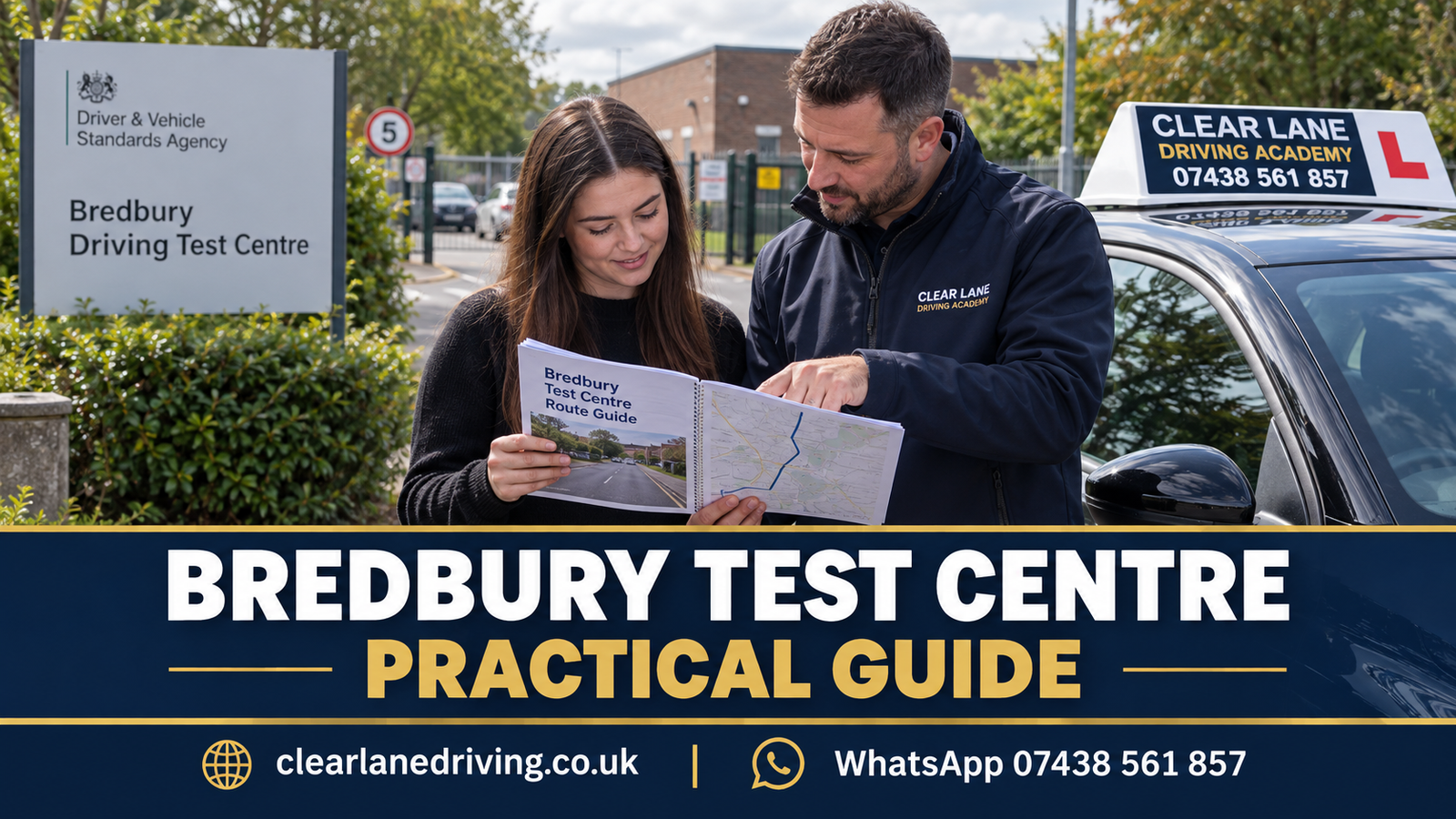
Bredbury can feel very different depending on the time of day. A quiet residential road may lead quickly to a busy junction, while traffic around Stockport and the surrounding local routes can build without much warning. This guide to Bredbury test centre will help you prepare for the things that genuinely matter: safe observation, good planning, controlled decisions and a calm approach when conditions change.
Your practical test is not about driving a perfect, memorised route. It is about showing that you can drive independently and safely, including when you meet everyday pressure such as parked cars, roundabouts, changing speed limits or a vehicle waiting to turn.
What to Expect at Bredbury Test Centre
Before test day, check your practical test confirmation for the current arrival instructions, address and time. Test centre arrangements can change, so it is always best to rely on the details supplied with your booking rather than an old route video or advice from a friend.
Aim to arrive with enough time to settle, but not so early that you spend half an hour getting more nervous in the car park. Around 10 to 15 minutes beforehand is usually sensible. Make sure you have your provisional driving licence, and that the vehicle you are using is roadworthy, insured for the test and suitable for the examiner to use safely.
The examiner will ask you to read a number plate from a distance. They will then explain how the test will run and ask a vehicle safety question, commonly called a ‘tell me’ question. During the drive, you may be asked one ‘show me’ question, such as operating a control when it is safe to do so.
The practical test normally lasts about 40 minutes. It includes a period of independent driving, usually following a sat nav or traffic signs, and may include one manoeuvre. One in three tests also includes an emergency stop. None of this is designed to catch you out. The examiner is assessing how safely you observe, respond and remain in control.
Local Driving Challenges Around Bredbury
A good Bredbury test-centre preparation plan should include more than repeating a handful of possible routes. Local roads can present a mixture of residential streets, busier through roads, roundabouts, parked vehicles and junctions where visibility is not always perfect.
Meeting Traffic and Parked Cars
Narrower roads with parked cars require judgement. You need to recognise early when there is not enough room for two vehicles to pass, then decide whether to give way or continue. The key is not being overly hesitant, but being prepared to pause when the situation calls for it.
Look well ahead for gaps, oncoming traffic and places where a vehicle could emerge. If you choose to wait, position the car sensibly and keep checking your mirrors. If you decide to proceed, do so at a speed that allows you to stop if the situation changes. Trying to squeeze through simply because you have started moving is rarely a good decision.
Junctions, Roundabouts and Lane Discipline
Learners often focus on turning the steering wheel correctly at a junction, but the stronger skill is planning the approach. Reduce speed early, select the right gear where needed, and use effective observation before committing. At a limited-view junction, a careful creep forward may be necessary, but only after you have stopped and assessed what you can see.
On larger roads and roundabouts, lane discipline becomes more important. Read road markings early, check mirrors before changing position and avoid last-minute decisions. If you take the wrong lane or miss a turn during independent driving, stay calm and continue safely. Going the wrong way is not automatically a fault. Creating a risk by swerving, stopping unexpectedly or cutting across another lane can be.
Changing Speeds and Road Conditions
Speed limits can change quickly between built-up areas and wider roads. Regular sign checks are essential, especially after turning into a new road. Driving at the limit is not always the right speed either. Rain, poor visibility, parked cars, pedestrians and tight bends may all mean a lower speed is safer.
Bredbury-area preparation should also include reading developing hazards. Watch for people stepping out between vehicles, cyclists moving around road defects, buses pulling away and cars waiting to turn. Early observation gives you time to respond smoothly rather than braking late.
How to Prepare Properly for Your Test
The most useful final lessons are focused, not frantic. By the last stage of training, you should know the areas that still need attention and practise them repeatedly in realistic conditions. That might be right turns at busy junctions, clutch control on an incline, roundabout approach lanes or maintaining concentration on an unfamiliar road.
A mock driving test can be particularly helpful if nerves are likely to affect your usual driving. Treat it as a proper test: drive without coaching, follow directions independently and discuss the result afterwards. The aim is not to get a perfect score. It is to identify patterns before test day, when there is still time to improve them.
It also helps to practise the safety questions until your answers are clear and natural. You do not need to deliver them like a script. You do need to understand the controls and be able to explain how you would check an item safely.
In the week before the test, avoid trying to relearn everything at once. Keep driving regularly if possible, prioritise sleep and arrive with a realistic plan. If you are taking an intensive course, build in time for consolidation rather than treating every lesson as a new challenge.
Test-Day Habits That Build Confidence
Nerves are normal, including for learners who drive well in lessons. The goal is not to eliminate nerves completely. It is to stop them rushing your decisions.
Before moving off, take a moment to set your seat, mirrors and steering position correctly. Breathe, listen carefully to the examiner’s instructions and ask them to repeat an instruction if you genuinely did not hear it. Guessing is unnecessary and can make a simple situation harder.
During the drive, keep your attention on the next safe action rather than replaying something that has already happened. A stall, an imperfect gear change or a wrong turn does not necessarily mean the test is over. Recover calmly, observe properly and continue. Examiners assess the drive as a whole, not whether every moment felt flawless to you.
Use your mirrors with purpose. Check them before changing speed, direction or road position, but do not turn mirror checks into obvious head movements that distract you from the road ahead. Good driving looks calm because it is based on routine observation and forward planning.
Common Mistakes to Avoid
Many test faults come from decisions made too late. Approaching a junction too quickly, checking mirrors after braking rather than before, or realising the correct lane only at the roundabout can all put pressure on you. The answer is usually to look further ahead and give yourself more time.
Another common issue is over-caution. Waiting when it is clearly safe to go can hold up traffic and suggest uncertainty. Safe driving is not about taking every gap, but it is about recognising a reasonable opportunity and moving with appropriate control.
Finally, do not let sat-nav instructions override road signs, markings or safety. The road environment always comes first. If directions appear confusing, follow the safe legal route available and keep driving responsibly.
Getting the Right Final Support
If Bredbury is your test centre, your lessons should include local-style situations alongside the wider skills needed for any practical test. Route familiarity can settle nerves, but true readiness comes from being able to assess roads you have not seen before.
Clear Lane Driving Academy can support learners with structured test preparation, mock tests, intensive driving courses and test-day car hire where appropriate. The right choice depends on your experience, confidence and how close you are to test standard. Honest feedback is more useful than being rushed towards a date before you are ready.
On test day, give yourself permission to drive the way you have been trained: look ahead, leave space, make measured decisions and deal with one situation at a time. That calm, safe approach will serve you well far beyond the car park at Bredbury test centre.