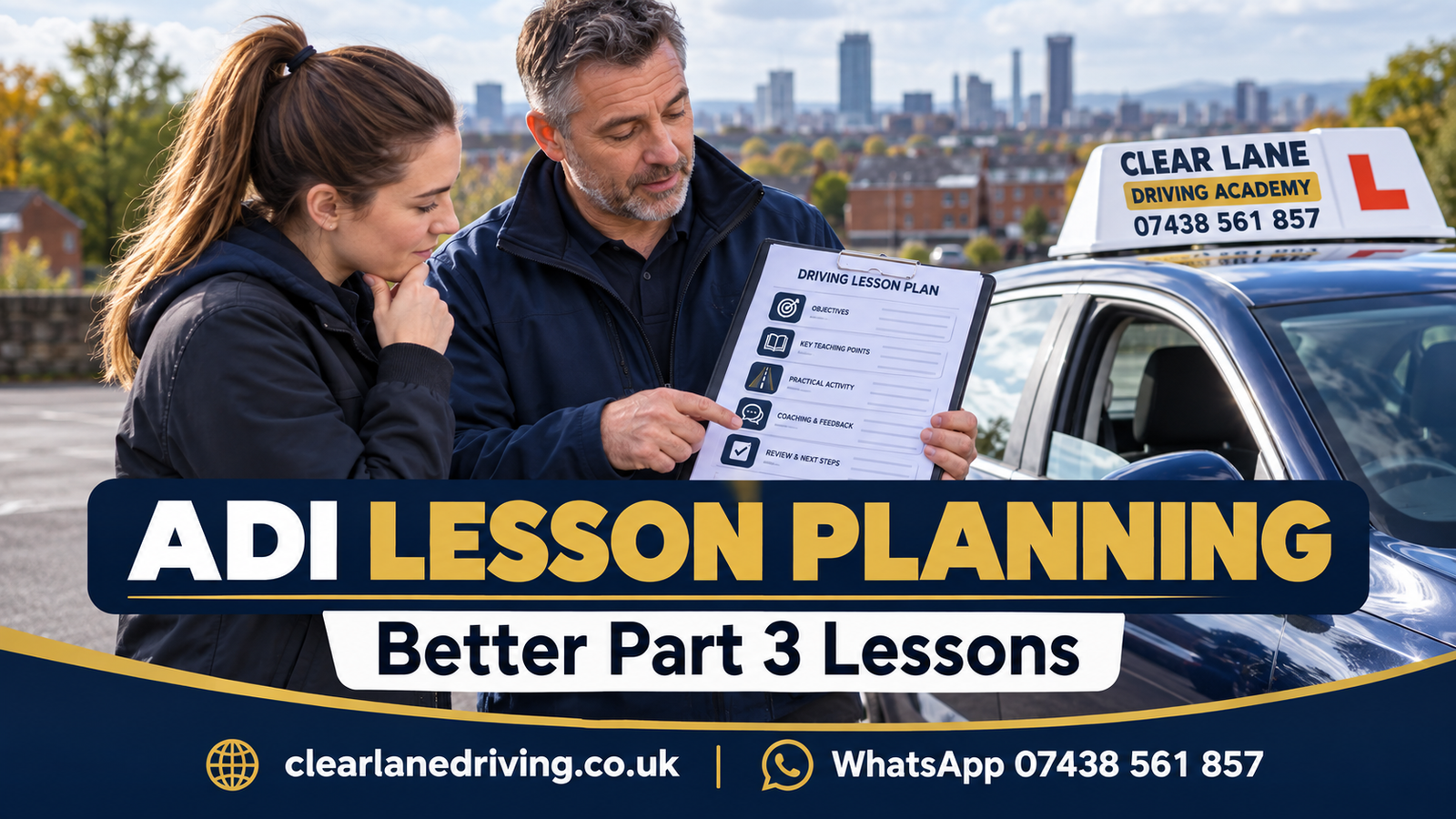
A well-planned lesson can be the difference between a learner repeating a manoeuvre without understanding it and making a safe, independent decision when the road changes. For PDIs, effective ADI lesson planning is not about memorising a script or trying to impress an examiner with complicated language. It is about having a clear purpose, adapting to the pupil in front of you, and keeping safety central from the first briefing to the final review.
For the ADI Part 3 test, and later in everyday instruction, planning gives your coaching structure. It helps you choose the right subject, judge the pupil’s starting point, manage risk and make the best use of lesson time. The plan matters, but your ability to change it appropriately matters just as much.
What good ADI lesson planning looks like
A useful lesson plan starts with a realistic outcome. Rather than writing, “Practise roundabouts”, be more specific: “Help the pupil identify a safe approach speed, choose an appropriate lane and respond safely to developing traffic at a familiar multi-lane roundabout.”
That outcome gives the lesson direction. It also makes it easier to review progress at the end. The pupil should understand what they are working on, why it matters, and what success looks like for their current level of experience.
Good planning should account for three things at once: the pupil’s ability, the environment and the level of risk. A new learner may need a quiet route and more direct instruction while they build the basic routine. A test-ready learner who hesitates at busy junctions may need carefully selected, more demanding routes and questions that develop independent thinking. The subject can be similar, but the coaching approach should not be identical.
This is why a plan should be a working guide, not a fixed timetable. If the pupil arrives tired, anxious or struggling with a skill that was secure last week, pressing ahead simply because it was written down is rarely good instruction.
Start with the pupil, not the subject
Before deciding how to teach a lesson, establish what the pupil already knows. A short conversation and a suitable recap drive can reveal far more than assumptions based on their previous lesson notes.
Ask clear, open questions. For example: “What do you find most difficult about emerging at busy junctions?” or “Talk me through what you are looking for as we approach this roundabout.” Their answer may show whether the issue is observation, planning, speed, positioning, confidence or knowledge of the rules.
The agreed goal should come from that discussion. This is a key part of learner-centred teaching. It does not mean allowing the pupil to choose an unsuitable task or drive beyond their ability. It means involving them in decisions, explaining professional judgement and agreeing a sensible way forward.
For example, a pupil may say they want to tackle a difficult dual carriageway roundabout straight away. If their approach observations are inconsistent on quieter roads, an instructor may explain that the lesson will first strengthen the foundations before increasing the challenge. That is honest guidance, not a lack of flexibility.
Build a plan around a single learning need
Trying to cover every weakness in one session can leave a pupil overwhelmed and unclear about what actually improved. A focused lesson has a better chance of producing lasting progress.
If the main fault is rushing towards a junction, keep the lesson centred on approach planning. You may still correct steering or gear selection where necessary, but do not turn the drive into a running list of faults. Help the pupil recognise the pattern: early observations, a controlled approach, an appropriate speed and a decision based on what they can see.
A simple structure is often enough: establish the starting point, agree the goal, practise with the right level of support, review what happened, then set a clear next step. This can work for a complete beginner, a nervous driver and a learner preparing for a practical test.
Plan risk management before the car moves
Safety cannot be added as an afterthought. During ADI Part 3 training, PDIs need to show that they can identify where a lesson may become risky and decide how they will manage it.
Consider the route, weather, traffic conditions, road layout and the pupil’s present ability. A learner who is practising bay parking may be ready to attempt it in a quiet car park but not beside fast-moving traffic with limited space. A pupil practising meeting traffic may cope on a residential street but need more support on a narrow road with poor visibility.
Think in advance about your intervention strategy. When might a verbal prompt be enough? When could a timely question help the pupil act independently? At what point would you need to use an instructor control or stop the vehicle? There is no benefit in allowing a situation to develop too far just to see whether the pupil recovers. Early, proportionate action protects everyone and preserves the pupil’s confidence.
The best interventions are usually calm and clear. Afterwards, discuss what was happening, what clues were available and how the pupil could spot the risk sooner next time. The aim is not simply to prevent an error. It is to help the pupil learn from it safely.
Use questions with a purpose
Questions are valuable when they encourage the pupil to assess, plan and reflect. They are less helpful when they become a constant commentary or feel like a test of memory.
Before a junction, you might ask, “What are you expecting could happen here?” After a difficult approach, “What made that feel rushed?” These questions encourage the learner to connect their decisions with the result. They also give you evidence of whether they understand the problem.
It depends on the pupil, however. A beginner handling the controls for the first time may need concise instructions and time to process them. A more experienced pupil may benefit from greater responsibility, including deciding the route, identifying hazards and reviewing their own drive. ADI lesson planning should include this balance between instruction, coaching and practice.
Avoid asking a question at the exact moment the pupil needs full concentration to deal with a developing hazard. Timing is part of effective communication. If the road requires their attention, let them drive first and discuss the detail when it is safe.
Adapt the lesson without losing its aim
Examiners are not looking for a perfect lesson where nothing goes wrong. Real learners make mistakes, traffic changes and confidence can rise or fall during a drive. What matters is how you respond.
Imagine the lesson goal is safe progress at roundabouts, but the pupil repeatedly stalls when moving away. Continuing to work exclusively on roundabouts may be unproductive if their moving-off routine has broken down. You may need to reduce the demand, rebuild that routine and decide whether to return to the original subject later in the lesson.
Equally, a pupil may progress faster than expected. Instead of repeating an easy route, increase the challenge in a controlled way. Use unfamiliar junctions, busier traffic or greater independence, provided they have the skills to manage it safely. Adaptation should be purposeful, not random.
For trainee instructors in Manchester, local road knowledge can support planning when it is used thoughtfully. A route near a test centre may offer useful features such as complex junctions, changing speed limits or busy pedestrian areas. But route familiarity should never replace an assessment of the pupil’s needs. A challenging road is only useful if it is the right challenge at the right time.
Finish with a review that leads somewhere
The final few minutes are part of the lesson, not an optional extra. Ask the pupil to assess their own performance before giving your view. They may recognise an improvement that you can reinforce, or identify a difficulty that needs further work.
Keep the review specific. “Your driving was better” is encouraging but vague. “You began checking the junction much earlier, which gave you time to reduce speed and choose a safe gap” tells the pupil exactly what to repeat.
Agree what happens next. That could be further practice on the same subject, a related skill, or a short piece of private study such as revisiting the Highway Code. For learners taking intensive courses, this clear continuity is especially valuable because lessons are closer together and progress needs to be monitored carefully.
Strong planning does not make lessons rigid. It gives you the confidence to stay calm when the lesson changes, explain your decisions and keep the pupil moving forward safely. For an ADI, that is the standard worth building: clear goals, thoughtful coaching and a learner who leaves each drive better prepared to make safe decisions independently.
Learn smart. Drive safe. Pass with Clear Lane.