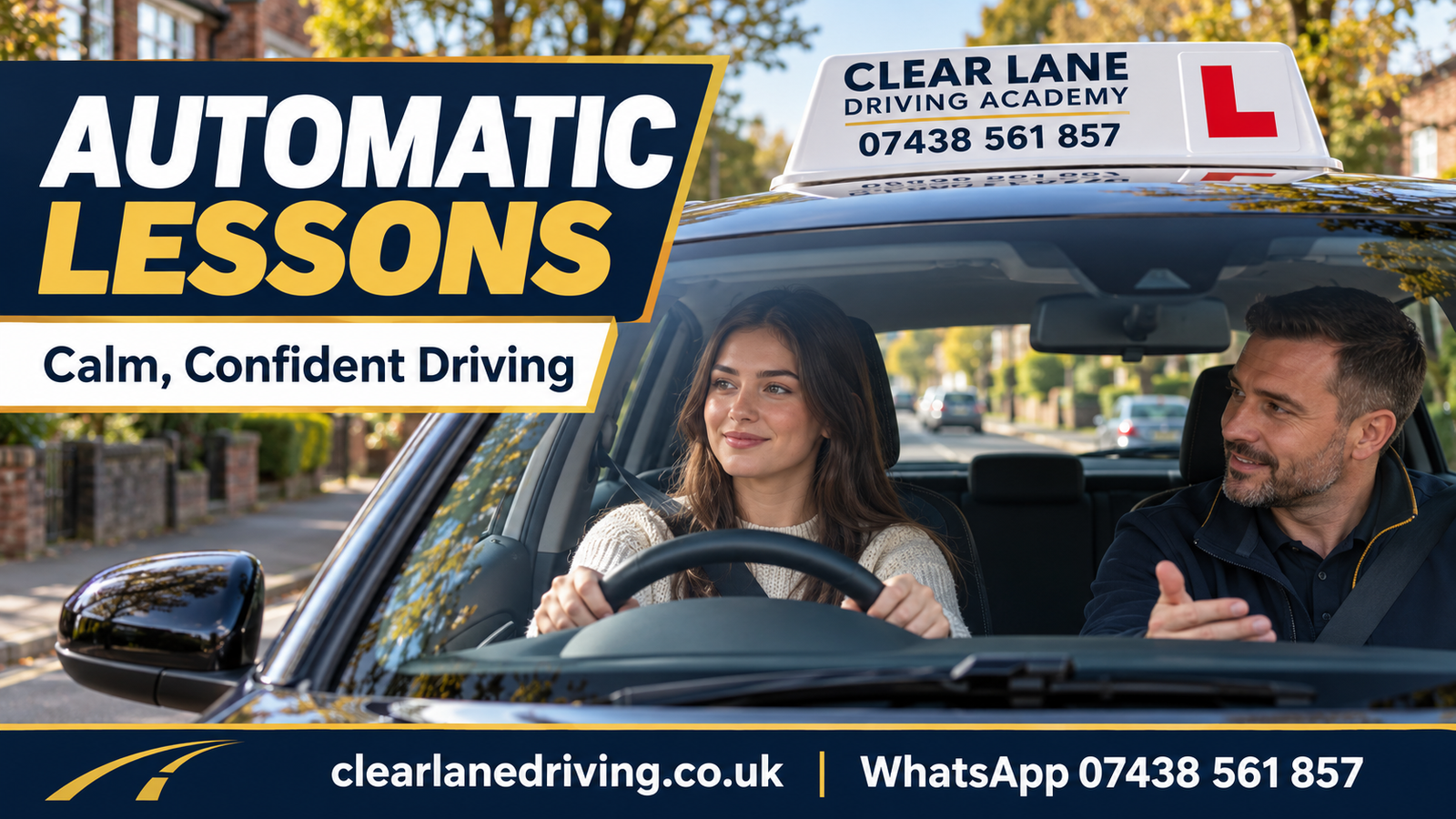
For many learners, the hardest part of driving is not reading the road or learning manoeuvres. It is trying to manage the clutch, gears and traffic at the same time. Automatic lessons remove that extra pressure, giving you more mental space to focus on steering, observation, road position and safe decisions.
That does not mean learning in an automatic is effortless. You still need to develop judgement, control and good habits. What changes is the order of learning: instead of battling with gear changes from the start, you can concentrate on becoming a calm, aware and capable driver.
What happens in automatic lessons?
An automatic car changes gear for you. There is no clutch pedal, and you will usually use your right foot for both the accelerator and brake. Before moving off, you select the correct driving mode, release the parking brake when safe, carry out your observations and apply gentle acceleration.
The early lessons still cover the same foundations as any other learner journey. You will learn cockpit drills, moving off and stopping safely, steering control, effective mirror checks, approaching junctions and reading road signs. The difference is that you are not also timing clutch release and gear changes.
This can make the first few drives feel less overwhelming, especially on busier Greater Manchester roads where there is often plenty to process. Your instructor should introduce new skills in manageable stages, explain the reason behind each action and give you time to practise without rushing.
Who are automatic driving lessons best for?
Automatic driving lessons can suit a wide range of learners. They are often a good option for nervous beginners, people learning later in life, those returning to driving after a long break and learners who have found manual lessons frustrating.
They can also work well for people with a clear timescale, such as a new job, university placement or family responsibility that makes driving more useful. With fewer vehicle controls to manage, some learners make quicker progress through the early stages. However, faster progress is never automatic. It still depends on regular practice, lesson frequency, confidence, prior experience and how quickly you can apply feedback.
An automatic may be particularly helpful if you have struggled to move off smoothly in a manual car. Stalling at a roundabout or on a hill can knock confidence, even though it is a normal part of learning. In an automatic, you can put more attention into gaps, mirrors, positioning and planning your next move.
The main trade-off is your licence. If you pass your practical test in an automatic, you can drive automatic vehicles but not manual cars. For some people this matters a great deal, particularly if they expect to share a manual family car or need flexibility for work. For others, an automatic licence is the practical choice because it gets them learning confidently in the type of car they intend to drive.
Why confidence often grows sooner
Confidence should not mean feeling fearless or assuming every situation will be easy. Real driving confidence comes from knowing what to do, spotting hazards early and having enough practice to stay composed when plans change.
Automatic tuition can support that process because your attention is less divided. At a complex junction, for example, you can focus on checking mirrors, choosing the correct lane, judging the traffic and responding safely to pedestrians. You are not worrying about selecting the wrong gear at the same time.
That extra thinking space is valuable, but it needs to be used well. A good instructor will not simply tell you where to turn. They will help you build a routine: look well ahead, assess what is developing, prepare early and act smoothly. This is how lessons become more than test practice. They become preparation for independent driving.
A structured route from first lesson to test day
There is no fixed number of hours that suits every learner. Honest advice matters more than a rushed estimate. Some people need time to settle behind the wheel, while others have previous road awareness from cycling, motorcycling or supervised practice.
A structured course normally begins with vehicle controls and quiet roads, then progresses to meeting traffic, junctions, roundabouts, dual carriageways where appropriate, manoeuvres and independent driving. Your instructor should revisit skills as routes become more demanding, rather than treating a topic as finished after one attempt.
As your test approaches, lessons should include realistic practice around the conditions you are likely to face. That might involve busy town-centre traffic, residential streets with parked cars, changing speed limits and roundabouts that require clear lane discipline. Learners preparing for Chadderton, Cheetham Hill or Rochdale, for instance, benefit from practising the kinds of decisions those local routes regularly demand, not just memorising individual roads.
Mock driving tests can be especially useful at this stage. They reveal whether you can make safe decisions without frequent prompts and whether nerves affect your observation, speed or planning. The value is not the score alone. It is having time afterwards to understand patterns and work on them properly.
How to get more from each lesson
The best progress usually comes from consistency. A long gap between lessons can mean spending valuable time rebuilding confidence and recalling routines. Where possible, choose a lesson pattern you can maintain and discuss your availability honestly from the beginning.
Arrive ready to learn, rather than expecting perfection. If something felt difficult last time, mention it. A calm instructor will adapt the lesson plan, give clear guidance and help you practise the skill again in a suitable setting. There is no benefit in pretending you understand when you do not.
Between lessons, keep the learning active. Think through the routines you have practised, review feedback and ask questions about any road situation that confused you. If you have access to private practice in a suitable automatic car with an eligible supervising driver, agree with your instructor what would be helpful to reinforce. Private practice works best when it supports the lesson plan rather than introducing conflicting advice.
It also helps to focus on one improvement at a time. Perhaps you need earlier mirror checks before changing direction, a steadier approach speed at junctions or better planning around parked vehicles. Small, specific goals are easier to practise and easier to measure than simply telling yourself to “drive better”.
Choosing the right instructor and course
The car matters, but the coaching matters more. Look for an instructor who explains clearly, stays patient under pressure and gives you honest feedback. You should understand what you are working on, why it matters and what needs to improve before moving on.
If you need to learn quickly, an intensive automatic course may be suitable, but only if you can commit the time and energy. Intensive learning can build momentum because skills are practised close together. It can also feel tiring, particularly for a nervous learner. A responsible instructor will help you choose a pace that is ambitious but realistic.
At Clear Lane Driving Academy, the focus is on structured progress, safe habits and calm preparation for the road ahead. Whether you are starting from scratch or rebuilding confidence after a previous test, the aim should be the same: to become a driver who can think clearly and act safely without relying on prompts.
Your first automatic lesson does not need to prove that you are naturally good at driving. It is simply the first opportunity to learn the right routines in a supportive environment. Give yourself permission to take it step by step. With steady practice and clear coaching, confidence has room to grow.