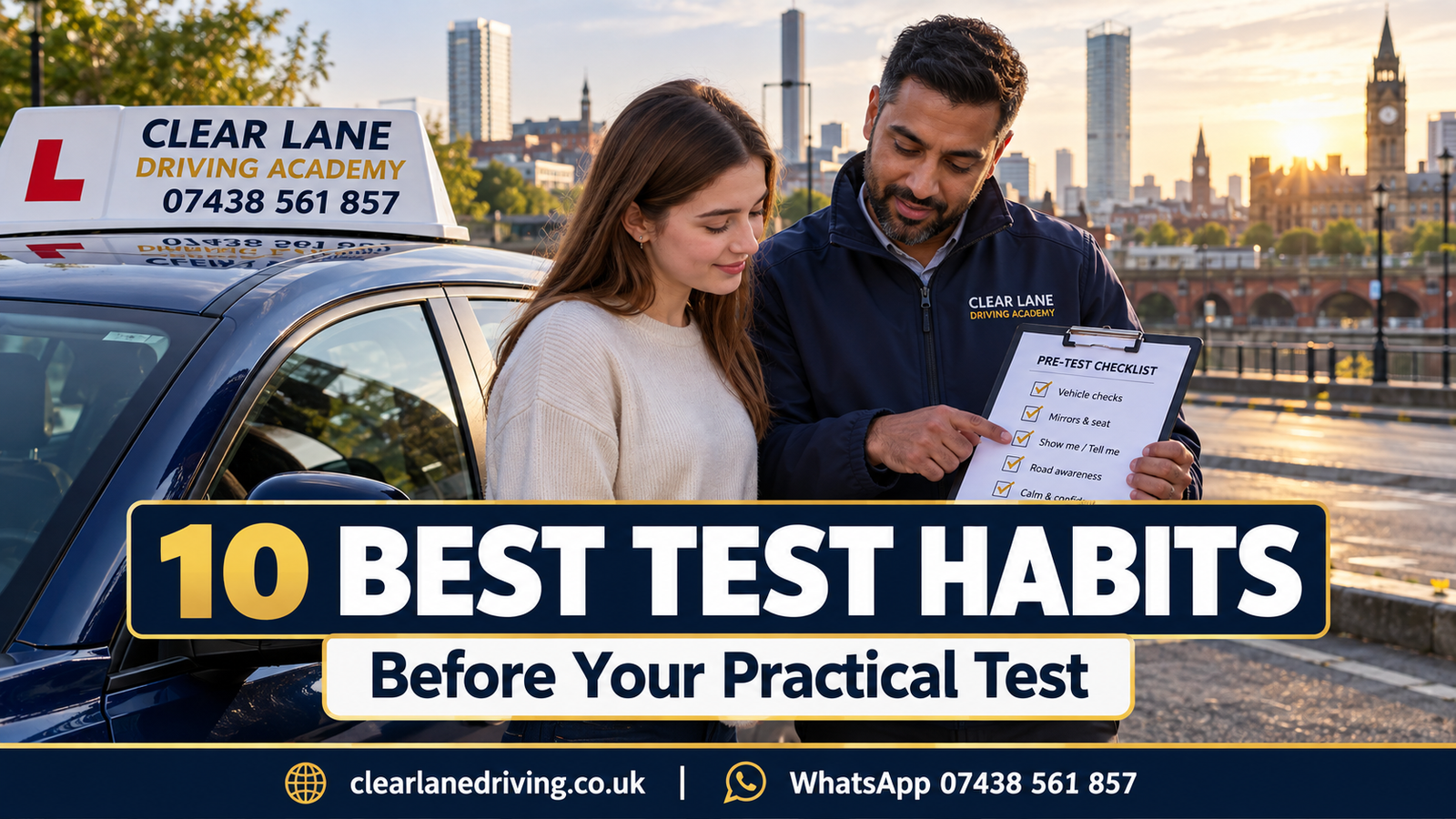
Your practical test is not usually decided by one difficult roundabout or an unfamiliar road. It is decided by the small routines you repeat without being reminded: checking properly, planning early, controlling the car smoothly and recovering calmly when something does not go perfectly. The best habits before practical test day are the ones that make safe driving feel normal rather than something you have to perform.
For many learners, the final few weeks can feel more pressured than the first few months. That is understandable, particularly if you are fitting lessons around work, college or family life. The answer is not to cram every possible situation into one lesson. It is to practise with purpose and give yourself reliable habits to fall back on.
1. Start every drive with a settled routine
Before moving away, take a few seconds to get yourself ready. Set the seat, mirrors and steering position properly, check your seatbelt, and make sure you know where the key controls are. This may sound basic, but rushing the start of a drive often creates avoidable distractions later.
Use the same calm sequence at the beginning of each lesson and private practice session. You are building a routine that helps you feel in control, whether you are starting from a quiet residential street or pulling away after stopping in busy traffic.
A good routine should be practical, not theatrical. The examiner is looking for effective preparation and safe control, not exaggerated movements or a memorised performance.
2. Make observations active, not automatic
Good observation is more than looking in the general direction of a mirror. It means checking at the right time and using what you see to make a safe decision. Before moving off, changing direction, slowing significantly, turning or manoeuvring, ask yourself what could be around you and where you need to look.
Develop the habit of checking mirrors early enough to act on the information. For example, if you are approaching a parked vehicle and may need to move out, check your mirrors before you reach it. This gives you time to judge following traffic and adjust your speed without last-minute braking.
Blind-spot checks matter when moving off and whenever your instructor has taught that one is needed. Make them purposeful. A quick, clear check is safer and more natural than turning your head at random because you think you ought to.
3. Read further ahead than the bonnet
Learners often focus on the vehicle directly in front, especially when nerves rise. Looking further ahead gives you more time to plan and usually makes your drive smoother. Notice pedestrian crossings, changing traffic lights, bus stops, road signs, lane markings and brake lights well before they become an immediate problem.
This habit is especially useful on busier routes around Manchester, where traffic flow can change quickly. If you identify a developing hazard early, you can ease off the accelerator, choose the correct lane and create space without feeling rushed.
Try saying your plan quietly in your head: “Lights ahead, traffic slowing, check mirrors, ease off.” You do not need to narrate the whole drive, but a simple internal prompt can help turn observation into action.
4. Practise independent decisions
Your instructor’s prompts are there to support learning, but test-ready driving means making safe decisions for yourself. During lessons, ask for sections where you take more responsibility for following signs, choosing a safe position and responding to traffic without constant coaching.
That does not mean guessing. If a direction is unclear, it is fine to ask for it to be repeated when appropriate. If you take a wrong turn during the independent driving part of the test, do not panic or attempt to correct it suddenly. Continue safely, and follow the next instruction. A wrong route is not automatically a fault. An unsafe reaction can be.
Best Habits Before Your Practical Test: Smooth Control
Smooth control is a sign that you are planning ahead. Aim to brake progressively, select gears in good time in a manual car, and use the accelerator with restraint. In an automatic, smoothness still matters: steady speed control and well-timed braking show that you are reading the road rather than reacting late.
Do not chase perfection at the expense of safety. A slightly untidy gear change is usually less significant than staring down at the gear lever or allowing it to distract you from the road. If the engine stalls, secure the car, take a breath, restart safely and move on when it is appropriate. How you recover matters.
5. Treat manoeuvres as everyday parking skills
Reversing exercises can feel like a separate part of learning, but they are really about control, observation and judgement. Practise them in different spaces and conditions rather than relying on one exact reference point or one familiar bay.
Focus on slow speed and continuous awareness. Look around properly for pedestrians, cyclists and other road users, especially in car parks and residential areas. If you lose your position, pause safely, reassess and correct it. Taking a shunt is often better than forcing a manoeuvre that is no longer developing safely.
Your instructor can help you understand the reference points that suit your vehicle, but the strongest habit is knowing why you are looking and what you are checking for.
6. Learn from faults without carrying them into the next mile
A common test-day trap is allowing one small mistake to take over your thinking. Perhaps you approached a junction too slowly, selected the wrong gear or felt you hesitated longer than you wanted to. Once you have dealt with it safely, bring your attention back to the road ahead.
After each lesson, discuss patterns rather than simply counting faults. Was a hesitation caused by weak observation, uncertainty over priority, or arriving at the junction too quickly to assess it properly? Knowing the cause gives you something useful to practise.
Keep a short record of two things after a lesson: what improved and what needs work next time. This creates structured progress and prevents the final weeks becoming a blur of worries.
7. Take a realistic mock test
A mock driving test is valuable because it shows how your habits hold up when you are not receiving ongoing guidance. It can reveal whether your independent driving, show-me-tell-me knowledge, manoeuvres and decision-making are consistent enough for test conditions.
Ask for honest feedback. A reassuring mock test is useful, but a realistic one is more useful. If an area needs further work, that is not bad news. It gives you a clear plan before the real test rather than an unpleasant surprise on the day.
If you are using test day car hire, make sure you are already comfortable with the vehicle. Know the main controls and practise the routines you will use. Test day is not the time to adapt to an unfamiliar clutch, biting point or dashboard layout.
8. Protect the day before the test
The day before is for preparation, not a frantic final revision session. If you have a lesson, keep it focused and confidence-building. Revisit any key routines your instructor recommends, then give yourself time to rest.
Prepare what you need in advance. Your practical test booking details and valid provisional licence should be easy to find. Confirm your lesson or car-hire arrangements, set more than one alarm if needed, and plan your journey so you arrive with time to settle.
Avoid asking ten different people for last-minute advice. Well-meaning friends can leave you second-guessing methods that have been working well with your instructor. Trust the structured coaching and practice that brought you to this point.
9. Give yourself a calm test-day start
Eat something light if that suits you, drink water and wear comfortable footwear that lets you feel the pedals properly. Arrive early enough that a short delay does not create panic, but not so early that you spend an hour building anxiety in the car park.
Before the test begins, take a few slow breaths and remind yourself of the real task: safe, legal and controlled driving. You do not have to impress anyone with speed. You do not need a fault-free drive. You need to show that you can deal with normal road situations responsibly.
During the drive, keep returning to your routine. Look ahead, check the relevant mirrors, choose a safe speed, position correctly and act on what you see. If the examiner gives an instruction that cannot be followed safely, deal with the immediate hazard first. Safe judgement always comes first.
10. Drive the road you are on
Test routes can include busy main roads, quieter estates, awkward junctions and roads you have not practised before. Route familiarity can help, but it should never replace sound driving habits. The road signs, markings and traffic conditions in front of you matter more than trying to remember what might come next.
Be patient at junctions. Keep a safe distance in queues. Give vulnerable road users the space and attention they need. If another driver behaves unpredictably, do not let their urgency become yours. Staying calm is not passive driving – it is good judgement.
A practical test is one drive on one day, but the habits you build beforehand are for every journey after it. Learn smart, drive safe and give yourself the time to make those habits dependable.