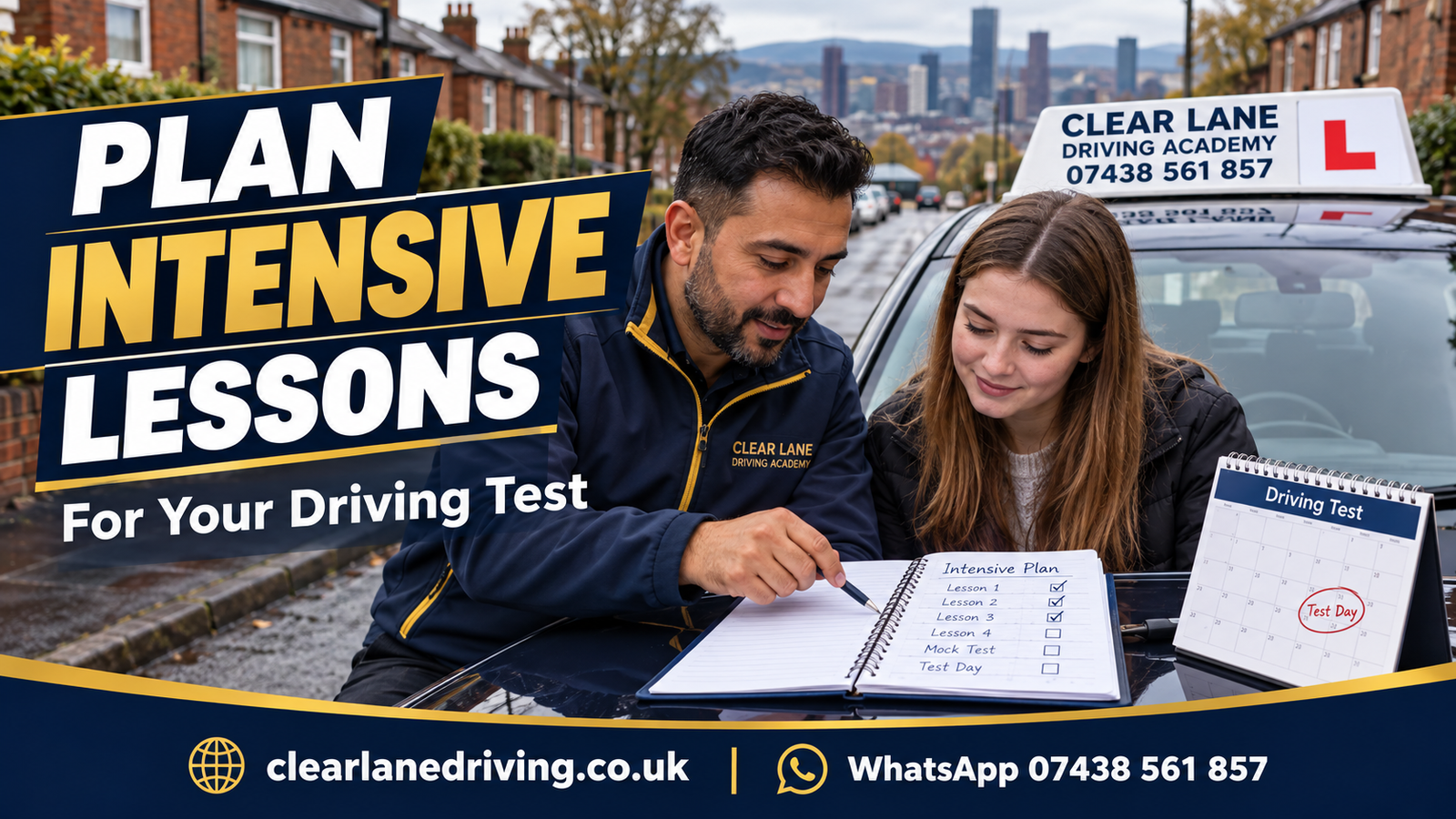
A good intensive course should never feel like being rushed through a checklist. The aim of how to plan intensive lessons is to create enough regular driving time for skills to settle, confidence to grow and safe decisions to become more natural before your practical test.
Intensive driving lessons can work very well for learners who need focused progress, have time away from work or study, or want to prepare efficiently for a test. They are not the right answer for every learner at every stage. The best plan depends on your current experience, availability, confidence and how close you are to test standard.
Start with an honest driving assessment
Before choosing lesson dates, establish your starting point. A complete beginner needs time to understand the controls, move off and stop safely, steer accurately, use mirrors well and deal with basic junctions. A learner who has already had regular lessons may instead need to strengthen independent driving, manoeuvres, roundabouts or test-route awareness.
An assessment drive gives you and your instructor a realistic picture. It should look beyond whether you can physically operate the car. Safe driving also means planning ahead, responding calmly to other road users, choosing a suitable speed and making sound decisions without prompts.
Be open about previous lessons, any failed tests and situations that make you nervous. If dual carriageways, busy roundabouts or parallel parking have caused problems before, they should be included in the plan early rather than left until the final day.
How to plan intensive lessons around your goal
The most useful intensive plan begins with a clear outcome. You may want to build a foundation from scratch, refresh rusty skills, prepare for a practical test, or gain confidence after a previous test attempt. Each goal needs a different pace.
For a beginner, the early sessions should build control and routines before the driving becomes more demanding. For someone nearing test standard, the focus may be on consistently meeting the required standard across a range of roads and conditions. Trying to copy a test route repeatedly is not enough if the underlying skills are not secure.
Work backwards from any test date, but leave room for honest adjustments. A test booking can provide useful focus, yet it should not force a learner to sit a test before they are ready. If a particular skill needs more time, it is better to address it properly than to hope it will disappear under pressure.
Set lesson objectives, not just lesson hours
Hours alone do not measure progress. Two learners can complete the same number of hours and need very different next steps. Give each lesson a clear purpose, such as approaching junctions safely, improving gear changes, dealing with meeting traffic or driving independently using sat nav directions.
At the end of each session, review what improved, what still needs attention and what the next lesson will cover. This keeps the course structured and avoids the feeling of simply driving around without a reason.
Choose a pace that helps you learn
Many intensive courses use longer lessons across consecutive days or several sessions each week. This can be effective because you spend less time re-learning what happened in the previous lesson. However, more hours in one day are not always better.
For most learners, two to four hours of focused driving in a day is plenty. Longer sessions can be valuable for test-ready learners who need sustained practice, but concentration drops when someone is tired, overwhelmed or anxious. A short break between blocks can make a real difference.
Consider your energy outside the car too. If you are combining lessons with night shifts, university deadlines or caring responsibilities, a tightly packed schedule may create unnecessary pressure. A slightly longer course with better concentration is often more productive than cramming every available hour into one week.
It also helps to plan lessons at varied times. Quiet roads are useful for introducing a new skill, while busier periods develop observation, patience and decision-making. For learners preparing at Chadderton or Cheetham Hill, practising on different types of Greater Manchester roads can build adaptability rather than dependence on one familiar route.
Build skills in a sensible order
Intensive learning works best when every new skill has a base underneath it. Your instructor may adapt the order to suit your needs, but the course should normally move from basic control towards more complex traffic situations and independent decision-making.
A learner needs to be comfortable moving off, stopping, changing gear in a manual car or managing an automatic car, steering, using mirrors and understanding road position. From there, lessons can develop junctions, crossroads, roundabouts, pedestrian crossings, country roads, dual carriageways and manoeuvres.
Do not treat manoeuvres as isolated exercises. Parallel parking, bay parking and pulling up on the right all rely on observation, control and planning. When they are taught as part of normal driving, they become less intimidating and more useful beyond the test.
Leave space for reflection and private practice
Intensive courses are not only about time behind the wheel. Learners make faster progress when they have time to process feedback between lessons. Write down one or two key reminders after each drive, rather than trying to remember every instruction at once.
If you have access to a suitable supervising driver and insured car, private practice can support professional lessons. Keep it purposeful. Rehearse familiar routines that your instructor has already explained, such as moving off safely, approaching junctions or parking in a quiet area. Avoid attempting difficult roads or new manoeuvres without guidance simply to get more hours in.
Watching driving videos or reading the Highway Code may also reinforce theory, but neither replaces practical coaching. The value comes from understanding why a decision is safe, then applying it calmly on the road.
Plan test preparation before the final few lessons
Test preparation should be built into the course, not saved for the last session. Once the core skills are developing well, include independent driving, sat nav practice, responding to directions and dealing with mistakes without losing concentration.
Mock driving tests are especially useful when they are handled constructively. They reveal how you cope with unfamiliar instructions, nerves and a period of quiet from the instructor. The result matters less than the debrief. Look for patterns, such as rushed approaches to roundabouts, missed mirror checks or hesitation that affects other road users.
Your final lessons should not be about adding lots of new information. They should reinforce reliable routines, address any remaining weaknesses and help you arrive at test day feeling prepared rather than overloaded. Make sure the practical details are also clear: your licence, test appointment, lesson time, and whether you need test day car hire.
Be prepared to adjust the course
A structured plan should be flexible enough to respond to real progress. Some learners improve quickly once they have regular practice. Others need more time to make a skill consistent, particularly after a long break from driving or a difficult previous experience.
Ask your instructor for direct feedback throughout. A calm, professional instructor should explain what is going well, what needs more work and whether the current pace still makes sense. Honest guidance is more useful than false reassurance.
If you feel overwhelmed, say so early. It may be possible to shorten a session, add a rest day, revisit a key topic or spread the remaining lessons more evenly. Needing an adjustment is not a setback. It is part of learning safely and building confidence that lasts after the test.
An intensive course is most effective when it gives you focused practice without taking away the time to think, recover and improve. Plan around your real starting point, listen to honest feedback and let safe, consistent driving set the pace.