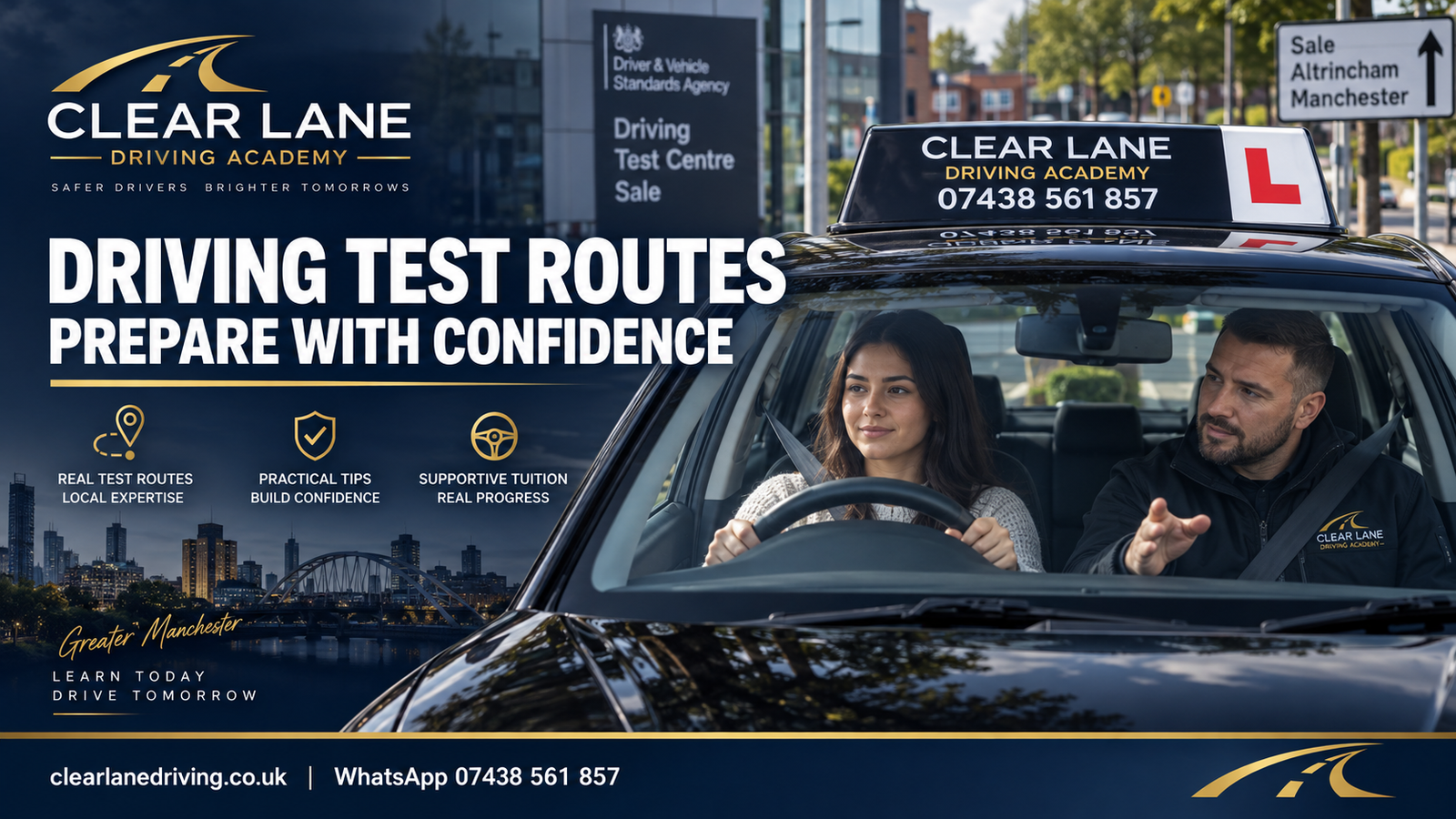
A practical test is not a memory test, and driving test routes Sale should not be treated as something to memorise turn by turn. The strongest preparation is knowing how to handle the types of roads, junctions and decisions you may meet around Sale with safe, independent judgement. That approach gives you confidence even when the examiner takes a road you have not driven before.
Sale is a busy part of Greater Manchester, with residential streets, larger through-roads, changing speed limits and plenty of opportunities to show calm observation. The aim is simple: drive safely, legally and with enough planning that your journey feels controlled rather than rushed.
What Driving Test Routes in Sale Usually Involve
DVSA examiners do not publish fixed practical test routes, and the route on your day can change for traffic, roadworks or other operational reasons. Anyone claiming to know the exact route cannot remove that uncertainty. What your preparation can do is make the local road environment feel familiar.
Around Sale, learners may encounter quieter residential roads alongside busier routes connecting local shopping areas, tram stops and main road networks. This can mean meeting parked vehicles, reading road markings early, choosing the correct lane and responding safely to pedestrians, cyclists and buses. There may also be roundabouts, traffic lights, crossroads and junctions where a clear approach and good observation matter more than speed.
A good instructor will help you practise the patterns behind these situations. Rather than saying, “turn left here because it is on the test route”, they should help you recognise the clues: signs, lane arrows, vehicle positioning, changing road width and the behaviour of other road users.
Residential roads and meeting traffic
Narrower streets are often where planning becomes visible. You may need to judge whether to give way to an oncoming vehicle, use a suitable gap between parked cars, or wait before committing. The key is not to force your way through or stop unnecessarily. Look well ahead, decide early and communicate your intention through sensible road position and speed.
Be especially aware of doors opening, children near parked vehicles and limited views at side roads. Keeping an appropriate speed gives you time to react without appearing hesitant. If a situation is unclear, patience is usually the safer choice.
Roundabouts, lanes and busy junctions
Sale-area driving can involve multi-lane approaches and roundabouts where traffic moves quickly. These are not designed to catch you out, but they do reward preparation. Check signs as early as you can, choose a lane in good time, and use your mirrors before changing position or signalling.
Many learners focus so hard on selecting a lane that they forget their final safety checks. A wrong turn is not automatically a problem on a driving test. Attempting a late lane change, cutting across a line or reacting sharply to a missed exit can be. If you are safely in the wrong lane, continue safely and allow the examiner to direct you.
Prepare for Road Types, Not a Secret Route
Route familiarisation has value when it is used properly. Practising near the test centre can reduce the pressure of unfamiliar road layouts and help you understand the local pace of traffic. It should never replace broader driving skills.
Your lessons should include a balanced mix of local roads and unfamiliar journeys. If you only practise the same few roads, you may feel confident until one diversion, different traffic condition or new instruction changes the plan. A test-ready driver can adapt.
It is worth asking your instructor to include the following situations during your final preparation:
- Busy and quiet junctions, including limited-view emerging
- Roundabouts with different lane choices and exit positions
- Dual carriageway or higher-speed road approaches where appropriate
- Hill starts, controlled stops and moving off safely near parked vehicles
- Independent driving using both sat nav-style directions and traffic signs
The purpose is not to collect every possible scenario. It is to build a reliable routine: mirrors, position, speed, gears where relevant, observation and decision-making.
Independent driving without panic
For part of the practical test, you will drive independently by following a sat nav or traffic signs. In a familiar area, it can be tempting to switch off and follow what you expect to happen next. Keep treating the instructions as guidance, while signs, road markings and safety remain your priority.
Listen to the instruction, then give yourself time to process it. You do not need to respond immediately if the next turning is not yet safe or clear. If you miss a direction, continue safely. The examiner will help you get back on course, and a small navigation error does not mean you have failed.
For manual drivers, independent driving can expose rushed gear choices when attention moves to the sat nav. Keep your observation routine steady, select the gear that suits your speed and avoid staring at the screen. Automatic drivers should apply the same planning, using the extra mental space to look further ahead rather than relaxing their concentration.
Use Mock Tests to Find the Real Gaps
A mock driving test is one of the most useful ways to prepare for driving test routes in Sale because it reveals what happens when you must make decisions without continuous coaching. A calm instructor can assess your driving in a test-like format, then explain the result honestly and constructively afterwards.
The value is not the score alone. It is understanding the pattern behind any fault. For example, repeated hesitation may come from not looking far enough ahead. Late braking may show that you are reading signs too late. Weak observations at a roundabout may be linked to trying to make a decision before your approach speed is under control.
Use the feedback to shape your final lessons. If manoeuvres are secure but busy junctions still make you anxious, spend more time on real traffic situations. If your driving is generally safe but you lose concentration after a small mistake, practise resetting quickly. One imperfect moment does not have to affect the rest of the drive.
Build a Test-Day Routine That Keeps You Calm
Test-day confidence is usually built before you arrive at the centre. Get enough rest, allow extra time for travel and wear comfortable footwear that gives you proper pedal control. If you are using test day car hire, make sure you have already driven the car enough to feel familiar with its controls, reference points and clutch bite if it is manual.
Before setting off, take a moment to settle in. Adjust the seat, mirrors and steering position properly. Know where the demisters, lights and windscreen wipers are. These small checks help you feel in control if the weather changes or you need a control during the drive.
During the test, focus on the next safe decision rather than trying to predict the outcome. Breathe at a red light. Use the pause to check your position, observe the developing traffic and prepare for moving off. If you make an error, do not assume the test is over. Continue with the same safe routines you have practised.
When More Local Practice Makes Sense
The right amount of Sale route preparation depends on your experience. A learner who has driven confidently across different parts of Greater Manchester may only need a focused session to become comfortable near the centre. Someone who has mainly driven in quieter areas, returned to learning after a break, or feels nervous around complex junctions may benefit from more structured local practice.
An intensive course can also work well when it includes time for consolidation, mock tests and honest assessment rather than simply packing in hours. Fast progress is possible when lessons follow a clear plan, but confidence needs repeated safe decisions in real traffic.
Clear Lane Driving Academy supports learners with calm, structured preparation for Sale and other Manchester test centres. The focus is always on the driving skills that travel with you beyond test day: forward planning, safe observation and the confidence to handle the road in front of you.
A route may change, the weather may turn, and traffic will never follow a script. When you can stay composed, read the road and make safe decisions independently, you are preparing for far more than one journey from the test centre.