If you’re about to start learning to drive, one of the first decisions you’ll face is whether to take automatic or manual driving lessons. It’s a question we hear all the time at Clear Lane Driving Academy — and the honest answer is that it depends on your goals, lifestyle, and how quickly you want to pass.
In this guide, we’ll break down the key differences between automatic and manual lessons, who each option suits best, and help you make the right choice before you book your first lesson.
The Main Difference: How the Car Works
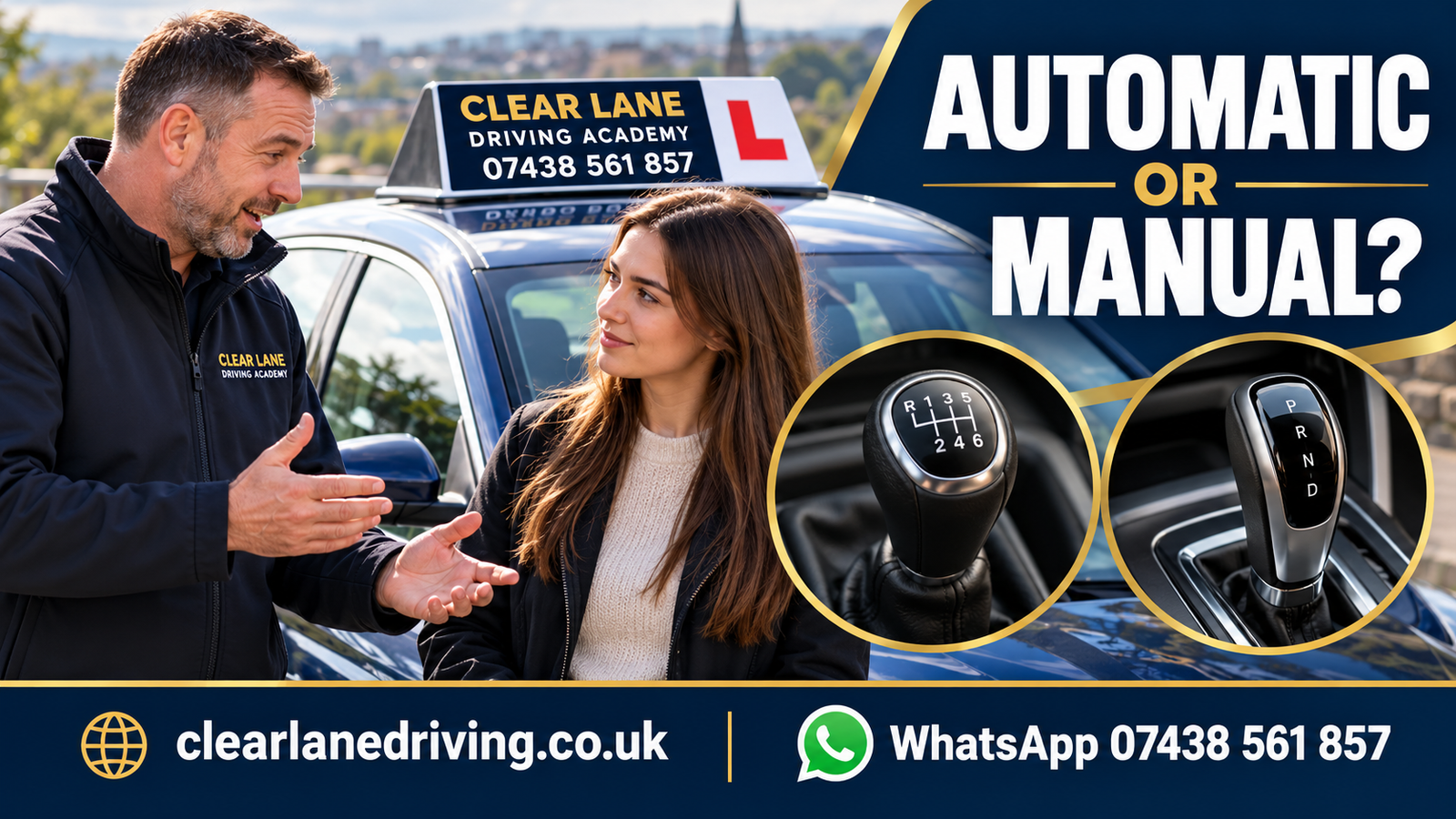
A manual car (also called stick shift) has a clutch pedal and gear stick. You have to change gears yourself as you accelerate and slow down. It takes more coordination, especially early on, but most learners pick it up within a few lessons.
An automatic car doesn’t have a clutch pedal and changes gears for you. You only have two pedals — brake and accelerator — and the car does the rest. This means you can focus entirely on steering, observation, and road positioning rather than managing the gearbox.
Automatic Driving Lessons: Pros and Cons
Pros of Automatic Lessons
- Easier to learn — no clutch control means fewer things to think about at once
- Less stressful — ideal for nervous learners or those with anxiety about driving
- Faster to pass — many automatic learners need fewer hours to reach test standard
- Great for city driving — stop-start traffic in Manchester and Oldham is much less tiring in an automatic
- Suitable for certain disabilities — if you have limited mobility in your left leg or foot, automatic is often the recommended route
Cons of Automatic Lessons
- Automatic-only licence — if you pass in an automatic, you can’t legally drive a manual car without taking another test
- More expensive cars — automatics generally cost more to buy and insure
- Fewer rental options — most hire cars in the UK are manual
Manual Driving Lessons: Pros and Cons
Pros of Manual Lessons
- Full licence — a manual pass means you can drive both manual and automatic cars
- More car choice — the majority of UK cars are still manual
- Better long-term control — many drivers feel more in tune with the road in a manual
- Cheaper vehicles — manual cars cost less to buy and run on average
Cons of Manual Lessons
- Steeper learning curve — clutch control, gear changes, and hill starts all need practice
- Can take longer to pass — the DVSA average for manual learners is around 45 hours of lessons
- More to think about — especially in busy areas like Oldham town centre or Cheetham Hill
Which Is Faster to Pass?
Automatic learners often reach test standard more quickly because there’s simply less to master. The DVSA reports that the average manual learner takes around 45 hours of lessons, while automatic learners can sometimes pass in 25–35 hours — though this varies hugely depending on the individual.
At Clear Lane Driving Academy, our students in Oldham, Chadderton, Rochdale, and surrounding areas often find that automatic lessons allow them to focus on what really matters in the test: observation, anticipation, and safe decision-making. The gearbox stops being a distraction.
Who Should Choose Automatic?
Automatic driving lessons are a great choice if:
- You’re a nervous or anxious learner
- You’ve previously struggled with clutch control in a manual
- You mainly plan to drive in city or urban areas
- You have a physical condition affecting your left leg or foot
- You want to pass as quickly as possible
- You already own or plan to buy an automatic car
Who Should Choose Manual?
Manual lessons make more sense if:
- You want the most flexibility — the ability to drive any car
- You plan to drive on motorways, rural roads, or long distances regularly
- You’re happy to take a little longer to learn in exchange for a full licence
- Most of the cars in your household are manual
What Does Clear Lane Driving Academy Offer?
We offer both automatic and manual driving lessons across Oldham, Chadderton, Rochdale, Failsworth, Middleton, Ashton-under-Lyne, and Cheetham Hill. Our instructors are fully DVSA-approved and experienced with both car types.
If you’re unsure which to choose, we offer a no-pressure first lesson where you can try the car and get a feel for things before committing to a full course. Many of our students who were undecided found that one session in an automatic made the decision obvious.
Find out more on our automatic driving lessons page, or get in touch to discuss which option suits you best.
Frequently Asked Questions
Can I switch from automatic to manual lessons part way through?
Yes, but it will set you back. If you’ve been learning in an automatic and switch to manual, you’ll need to start building clutch control from scratch. Most instructors recommend committing to one type from the beginning.
Is an automatic driving test easier than a manual?
The test itself is the same — the same manoeuvres, the same marking criteria. The difference is that in an automatic you have one less thing to worry about, which many candidates find helps them stay calm and focused.
How much do automatic driving lessons cost?
At Clear Lane, our lesson prices are competitive and transparent. Automatic lessons are typically the same price as manual. Check our driving lesson prices page for current rates.
If I pass in automatic, can I ever drive a manual?
Not legally, unless you pass a separate manual driving test. Your driving licence will show a restriction code indicating automatic-only. If you later want to upgrade to a full licence, you’d need to take a manual test from scratch.