You can drive well all week, then feel your hands go cold the moment test day arrives. That is normal. Some of the best tips for driving test day have very little to do with last-minute driving technique and much more to do with how you prepare your mind, your timing and your routine before the examiner even says hello.
A practical driving test is not designed to catch you out. It is there to check that you can drive safely, make sensible decisions and stay in control under normal road conditions. If you treat it that way, rather than as a performance, you give yourself a much better chance of showing what you can already do.
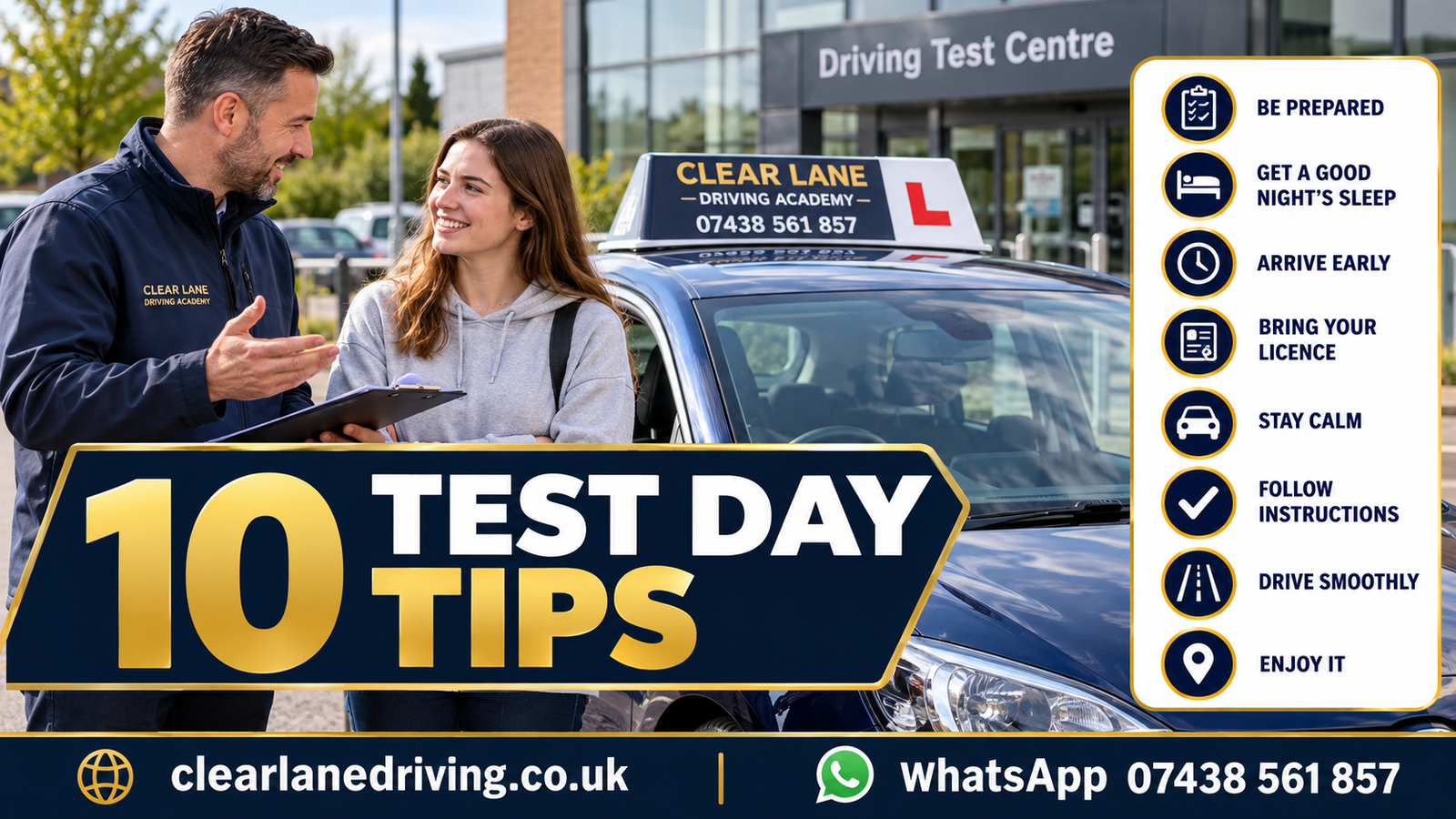
The best tips for driving test day start the night before
Good test-day preparation begins well before you get into the car. A late night, a rushed morning or forgetting key documents can make you feel unsettled before the test has even started. Calm preparation creates calm driving.
Try to keep the evening simple. Get your licence ready, check your test time and set out what you need. If you are using your instructor’s car or arranging test day car hire, confirm the plan in advance so there are no surprises in the morning. You do not need to revise every manoeuvre at midnight. In most cases, that only increases pressure.
Sleep matters, but do not panic if you do not get a perfect night. Many learners worry that poor sleep means a poor test. It can affect concentration a little, but one slightly restless night does not undo months of preparation. The aim is to be rested enough, not perfect.
Give yourself more time than you think you need
Rushing is one of the biggest causes of early nerves. If your whole morning feels tight, that tension usually follows you into the driver’s seat. Leave enough time to get ready, eat something light and travel without feeling pressed.
Arriving too early can sometimes increase overthinking, but arriving in a panic is worse. A sensible balance is best. Give yourself enough time to settle, use the toilet if needed and take a few slow breaths before the test begins.
If your test is at a busy centre or in a part of Manchester where traffic builds quickly, planning ahead matters even more. The goal is simple – remove avoidable stress before the test starts.
Eat lightly and keep your energy steady
Some learners skip food because they feel nervous. Others drink too much caffeine hoping it will help them feel alert. Both can backfire.
A light meal or snack is usually the better option. Something steady and familiar helps more than sugary food that gives you a quick lift and then a dip. Water is useful too, but there is no need to overdo it. You want to feel comfortable, focused and physically settled.
This is one of those areas where it depends on the person. If you normally drink tea or coffee, a normal amount is fine. If caffeine tends to make you shaky, test day is not the time to have extra.
Use your warm-up drive properly
If you have a lesson before the test, treat it as a chance to settle in, not a final attempt to cram everything. A short warm-up drive can help you find your rhythm, check your observations and remind yourself that you can drive calmly and safely.
This is not the time to chase perfection. If you make a mistake in the lesson before your test, do not let it become the story of the day. Correct it, reset and move on. Many learners drive better once the test actually starts because they become more focused.
A good instructor will usually keep that pre-test session steady and structured. The aim is confidence, not pressure.
Focus on safe driving, not on trying to impress
One of the most useful driving test tips is to stop thinking about what looks impressive. Examiners are not looking for flashy driving. They are looking for safe, legal, controlled decisions.
That means clear observations, good speed control, sensible positioning and responding properly to road signs, hazards and other road users. If you are unsure whether to be quicker or more cautious, safe and controlled is usually the better choice.
Many faults happen because learners try to force progress when the road is not ready for it. At roundabouts, junctions and busy meeting situations, patience is often a strength, as long as you are not hesitating without reason. There is a difference between waiting for a safe gap and freezing because you have lost confidence. Trust your training and keep reading the road.
Best tips for driving test day when nerves kick in
Nerves are not the problem by themselves. Most learners feel nervous. What matters is whether you let those nerves rush your decisions.
If you feel tense, bring your attention back to the next few seconds of driving. Check mirrors. Read the road ahead. Breathe out slowly at a red light. Keep your hands relaxed on the wheel. These small resets matter more than trying to “get rid” of nerves completely.
It also helps to avoid mentally scoring the test while you are still in it. Learners often make one small mistake, assume they have failed, then lose focus for the next ten minutes. A minor fault does not mean the test is over. Even a more serious moment does not change what you need to do next, which is continue driving as safely as possible.
Listen carefully to the examiner and ask if needed
You are allowed to ask the examiner to repeat an instruction if you did not hear it properly. That is far better than guessing. Misunderstood directions can lead to rushed lane changes or late turns, and those errors are often avoidable.
Examiners understand that people are nervous. They are not expecting robotic perfection. They want to see that you can respond safely. If you go the wrong way but do so safely, that is usually much less of an issue than making a sudden move to stay on route.
The same applies during the independent driving part of the test. If you miss a sign or take a different road but stay safe, keep calm and carry on. Road safety comes first, route accuracy second.
Do not let one manoeuvre define the whole test
Learners often place huge pressure on reversing manoeuvres, pulling up on the right or the emergency stop. In reality, these are just parts of the test. They matter, but they are not the whole picture.
If you are asked to complete a manoeuvre, slow everything down. Take time to observe properly and keep control of the car. It is fine to correct the car if needed, provided you stay safe and aware. Rushing a manoeuvre to get it over with is where many avoidable faults appear.
The same goes for parking at the end. Some people relax too early because they think the test is basically done. Stay switched on until the car is safely parked and the examiner tells you the test has finished.
Keep your driving simple and consistent
On test day, simple usually wins. Use the routines that have worked in your lessons. Check mirrors before changing speed or direction. Signal when needed. Keep a safe following distance. Make your observations obvious and genuine, not exaggerated.
Consistency is more valuable than occasional brilliance. A calm, steady drive with good awareness often creates a stronger result than a drive that starts confidently but becomes rushed under pressure.
If conditions change because of rain, traffic or roadworks, adapt without panicking. The examiner is not expecting identical conditions to your mock tests. They are looking at how you respond to what is in front of you.
After the test, keep perspective whatever happens
Passing feels brilliant, and it should. But if the result is not the one you wanted, it does not mean you are not capable of becoming a safe driver. Sometimes a fail reflects nerves, timing, or one poor decision in an otherwise solid drive. What matters next is understanding it clearly and preparing properly for the next step.
This is where honest feedback matters. A structured review with your instructor can help you separate a one-off error from a pattern that needs more work. For some learners, a few focused lessons and a mock test are enough. For others, especially if confidence has taken a knock, a calmer rebuild is the better option.
At Clear Lane Driving Academy, that steady approach is what helps many learners move from test anxiety to test readiness across Manchester test centres. Fast progress is useful, but only when it is built on safe habits and real confidence.
The best test-day mindset is not, “I must not make any mistakes.” It is, “I will deal with the road in front of me safely and calmly.” That thought gives you something practical to hold onto when the nerves show up, and it keeps your focus exactly where it should be – on driving well, one decision at a time.