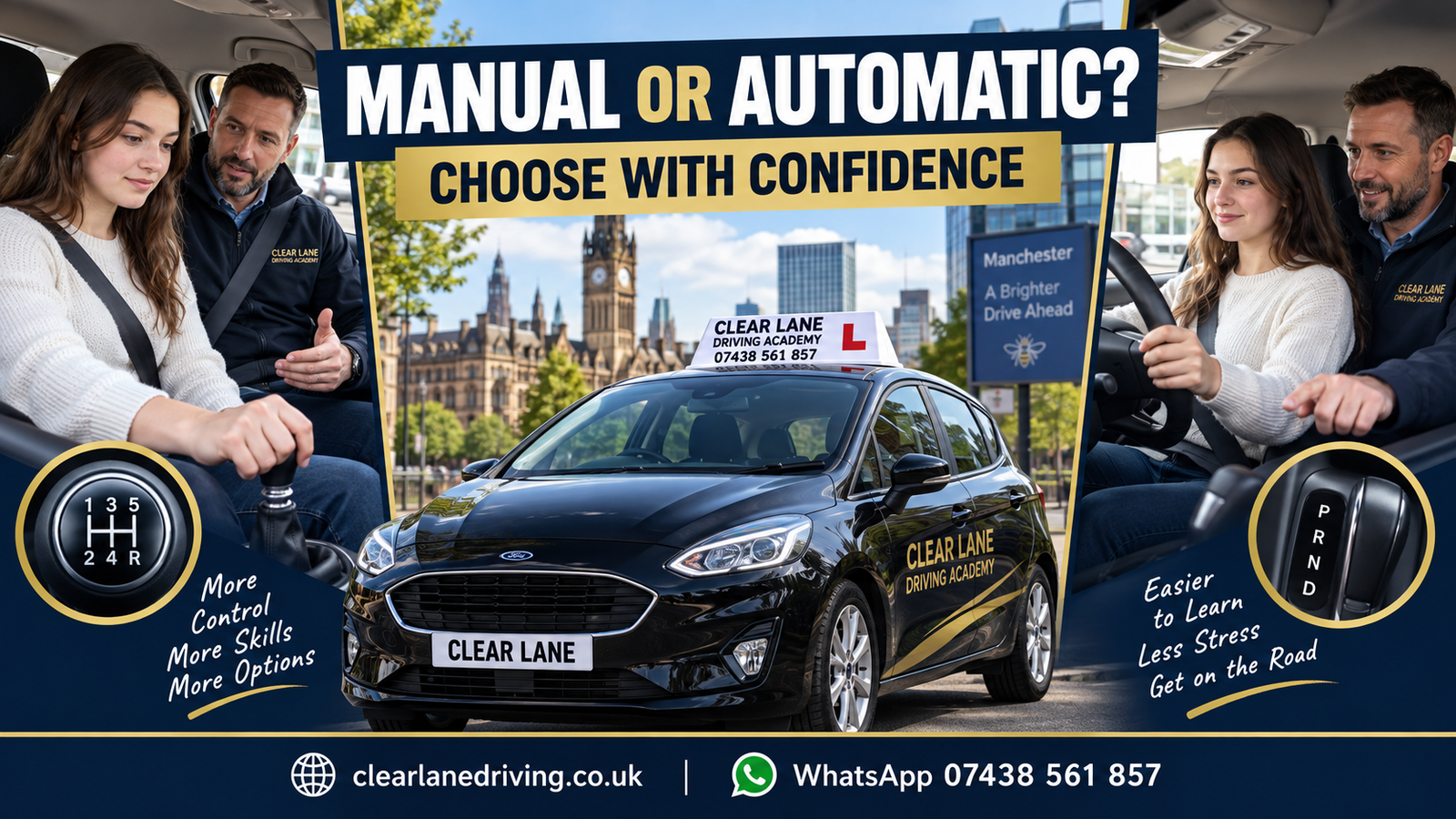
A manual vs automatic test decision is not just about which car feels easier on your first lesson. It affects the type of licence you receive, the skills you will practise, how you approach your driving test and, most importantly, how confident you feel when driving independently afterwards.
For some learners, manual gears become second nature with calm, structured practice. For others, choosing automatic removes a major source of pressure and lets them focus sooner on the road, planning and safe decision-making. Neither route is a shortcut around learning to drive safely. The right choice is the one that gives you the best chance to learn consistently and drive with confidence.
Manual vs automatic test: the key difference
The practical driving test follows the same DVSA standard whether you take it in a manual or automatic car. You will still need to drive safely and independently, follow sat-nav or traffic-sign directions, carry out a manoeuvre when asked and show good awareness of other road users.
The difference is in the licence. Pass in a manual car and you can drive both manual and automatic vehicles. Pass in an automatic car and your licence is restricted to automatic vehicles only. If you later want to drive a manual, you will need to pass another practical test in a manual car.
That restriction matters, but it should not automatically decide the issue. Automatic cars are increasingly common, particularly electric and hybrid vehicles. If you expect to drive an automatic car after passing, an automatic licence may suit your needs perfectly well.
What learning in a manual involves
A manual car gives you direct control over the clutch and gears. Early lessons normally focus on moving away safely, stopping smoothly, changing gear at the right time and dealing with junctions without stalling. Hill starts, busy roundabouts and stop-start traffic can take additional practice because your feet and hands are managing several actions at once.
Once these routines settle, many learners enjoy the sense of control a manual offers. You learn how the car responds to different speeds, gradients and road conditions, and gear selection can become a useful part of planning ahead.
Manual lessons can be a good fit if you would like the widest possible choice of cars after passing. They may also suit learners who are comfortable with co-ordination tasks and do not mind spending extra time on the mechanical side of driving. A manual licence can be useful where family cars, work vehicles or future vehicle choices are likely to include manual models.
The honest trade-off is that some learners need more time before they can give full attention to traffic, mirrors, positioning and anticipation. This is normal. Being able to change gear is only one part of safe driving, and it should never take attention away from what is happening around you.
What learning in an automatic involves
An automatic car has no clutch pedal and does not require you to select gears during normal driving. You use the accelerator and brake while the vehicle manages gear changes. That leaves more mental space for observation, speed control, lane discipline and reading developing hazards.
For a nervous beginner, this can feel significantly calmer. Pulling away at a busy Manchester junction or approaching a roundabout is still a skill to learn, but there is one less process to manage. Learners who have previously struggled with stalling or clutch control often find that automatic lessons allow their confidence to build more steadily.
Automatic does not mean effortless. You still need to judge gaps properly, use effective observation, understand road signs, manage speed and make safe decisions. The test examiner assesses the quality of your driving, not how many pedals you use.
An automatic route can be especially practical if you plan to drive an automatic vehicle, want to focus quickly on road awareness, or need a more straightforward route after a long break from driving. It can also suit an intensive course, provided you have enough time to practise between lessons and develop sound judgement rather than simply memorising routes.
Which option helps you pass more confidently?
There is no single answer because confidence comes from progress, not from forcing yourself into a car that does not suit you. A learner who feels settled in an automatic may progress quickly because their attention is available for the road. Another learner may feel equally comfortable in a manual and value the flexibility of an unrestricted licence.
The better question is: where is your effort going? If most of your lesson is spent worrying about stalling, finding the biting point or selecting the wrong gear, automatic may be worth considering. If those tasks are improving with practice and you want to drive either type of vehicle after passing, continuing in manual could make sense.
Do not choose automatic simply because someone says it is easier, and do not choose manual solely because others expect it. Your instructor should assess your current skills, goals, availability and confidence level, then give clear advice without pressure.
Think about the car you will drive after passing
Your plans after the test should play a central role in the decision. If you will use a parent’s manual car or expect to share a manual vehicle, learning manual avoids the need for another test later. If your household has an automatic, or you intend to buy or lease an automatic car, the restriction may have little practical effect.
It is also worth considering how soon you need to be driving. A learner preparing for a new job, university placement or family responsibilities may prioritise a route that lets them develop safe, independent driving with less unnecessary stress. Fast progress is valuable, but only where it is based on secure skills and regular practice.
For test-ready learners in Greater Manchester, car availability on the day can matter too. Your test car must be suitable, insured and familiar to you. Practising in the same type of vehicle you will use for your test helps reduce avoidable nerves.
Can you change from manual to automatic lessons?
Yes. Moving from manual to automatic is a common and sensible decision for some learners. The roadcraft you have already developed still counts: mirror checks, junction routines, steering, positioning, hazard awareness and the rules of the road all transfer. You may find that the first automatic lesson feels unfamiliar, but many learners settle quickly.
Changing the other way, from automatic to manual, usually requires more adjustment because you must add clutch and gear control while continuing to manage the road. It is possible, but it should be approached with patience and realistic expectations.
If you have already booked a practical test, check that the car and licence category match the test you intend to take. A manual test must be taken in a manual car, while an automatic test must be taken in an automatic vehicle.
How to make the right choice before booking
Start with an honest conversation about your goals. Consider the vehicle you are likely to use after passing, your previous driving experience, how you respond to busy roads and how much time you can commit to lessons. A calm assessment lesson can be particularly helpful if you are unsure or returning after a failed test.
It can help to try both types of car where possible. One or two well-structured lessons often reveal whether clutch control feels like a manageable skill to build or an obstacle that is holding back your wider progress. The aim is not to make a rushed decision. It is to choose the learning environment in which you can concentrate, practise well and become a safe driver.
Clear Lane Driving Academy supports manual and automatic learners with structured lessons, mock tests and test preparation based on the roads and challenges around Manchester test centres. The focus is always on honest guidance: choosing the route that fits your real driving plans, not the one that sounds best on paper.
Your licence type is a practical decision, but the bigger goal stays the same. Choose the car that helps you learn smart, drive safe and arrive at test day knowing you can handle the road with calm confidence.