The first time you move off smoothly in a manual car can feel like a major breakthrough. Until then, the pedals and gear lever may seem like too much to manage at once. A good guide to manual driving lessons should make that early stage feel manageable, not rushed. With calm instruction, clear routines and regular practice, manual driving becomes a practical skill built one decision at a time.
Manual lessons suit learners who want the flexibility to drive both manual and automatic vehicles after passing. They can also give you a stronger feel for how a car responds, especially when approaching junctions, managing hills and adjusting speed in busy Manchester traffic. The learning curve is real, but it is one that most learners can handle with structured support.
What Happens in Manual Driving Lessons?
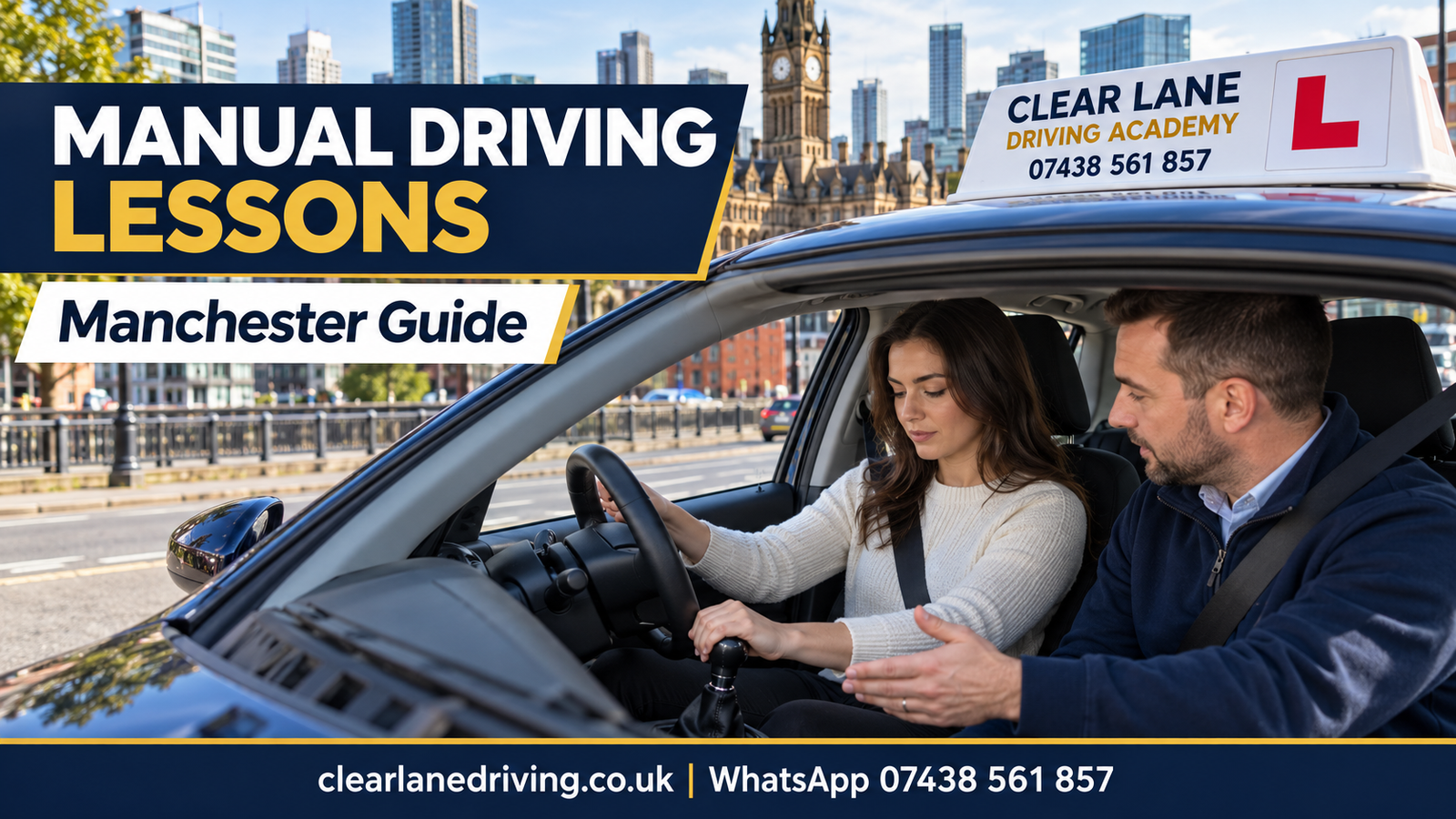
A manual lesson is not simply a drive around the block followed by a list of mistakes. The most useful lessons have a purpose. Your instructor should explain what you are working on, demonstrate the process where needed, give you time to practise, and review how it went at the end.
For a complete beginner, early lessons usually take place on quiet roads. You will learn the basic controls, including the cockpit drill, moving off, stopping safely, steering and changing gear. The pace should reflect your confidence. Some people are ready to move on quickly, while others need a little more repetition before the actions begin to feel natural.
As your control improves, lessons should introduce busier roads, roundabouts, crossroads, dual carriageways where appropriate, and independent driving. You will also practise manoeuvres and pulling up safely in different situations. The aim is not to memorise one route. It is to develop the judgement to deal with roads you have not seen before.
Learning Clutch Control Without the Panic
Clutch control is the part of manual driving that worries many learners before they start. It involves finding the biting point – the point where the engine begins to transfer power to the wheels – then balancing the clutch and accelerator to move away smoothly.
At first, it may feel as though you need to think about every movement. That is normal. Your instructor may use simple exercises on a quiet road, such as moving off and stopping several times, so you can feel how the car responds without pressure from heavy traffic.
Stalling is also normal. It does not mean you are a poor driver or that you will not pass. What matters is learning how to recover safely: secure the car, restart calmly and check that it is safe before moving again. Good coaching makes a stall a learning moment rather than an embarrassment.
Gears Are About Planning, Not Speed
Changing gear is not a test of how quickly you can move your hand. It is about choosing the right gear for the speed, road and situation ahead. As you gain experience, you will learn to listen to the engine, read the road early and prepare for hazards before you reach them.
For example, when approaching a roundabout, you may need to reduce speed and select a lower gear before the give-way line. On a clear stretch of road, you may move into a higher gear to drive efficiently. Your instructor will help you build a routine so that mirrors, speed, position and gears work together rather than competing for your attention.
How Many Manual Lessons Will You Need?
There is no honest fixed number. Previous road experience, how often you practise, your confidence, and the gaps between lessons all make a difference. A learner who has regular weekly lessons and some supervised private practice may progress differently from someone who can only drive occasionally.
It is usually better to focus on progress than a countdown. Are you moving off safely without prompts? Can you deal with a familiar roundabout independently? Do you understand why an approach was safe or unsafe? Those are more useful markers than comparing yourself with a friend who learned faster or took longer.
If you need to make progress within a shorter timeframe, an intensive driving course may be suitable. It can help learners stay focused and build continuity, particularly where work, university or a practical test date creates a clear deadline. However, intensive learning still needs to be realistic. More hours in a week can speed up familiarity, but it cannot replace safe decision-making or proper rest between demanding sessions.
A Guide to Manual Driving Lessons for Nervous Learners
Nerves are common, particularly if you have had a difficult lesson in the past, delayed learning for years, or failed a previous test. The answer is rarely to throw you into the most challenging roads immediately. Confidence tends to grow when the next step is clear and achievable.
Tell your instructor what makes you anxious. It may be hill starts, large roundabouts, being followed closely, or worrying about stalling at traffic lights. A professional instructor can break the situation down, choose an appropriate practice area and give you a routine to follow. Repeating a skill in manageable stages often changes how it feels.
It also helps to separate a mistake from your overall ability. Everyone makes errors while learning, including learners who later become very capable drivers. The useful question is: what happened, what did you notice, and what will you do earlier or differently next time? This approach builds awareness without damaging confidence.
Building Skills for Real Roads and the Practical Test
The practical driving test checks whether you can drive independently and safely, not whether you can complete a perfect lesson. That is why manual lessons should include real-world situations: changing road conditions, parked cars, pedestrians near crossings, meeting traffic on narrow roads and planning ahead at busy junctions.
Mock driving tests are particularly useful once you are nearing test standard. They show how well you manage without frequent guidance and can reveal patterns that ordinary lessons sometimes hide. Perhaps your driving is controlled but you hesitate too long at junctions, or your mirror checks become less consistent when you are concentrating on gears. Identifying this early gives you time to improve.
For learners preparing at Manchester test centres such as Cheetham Hill, Chadderton, Sale or West Didsbury, local route preparation can also be valuable. The purpose is not to learn a route by memory. It is to become familiar with the types of roads, junctions and traffic conditions you may face, while keeping your driving adaptable and safe.
Practise Between Lessons Carefully
Private practice can be a helpful addition to professional lessons when you are insured, supervised by an eligible driver and using a suitable car. It works best when it reinforces a skill you have already covered, rather than introducing something confusing without support.
Agree on one or two focused goals before you set off. You might practise moving away from the kerb, approaching junctions or selecting gears smoothly on familiar roads. Keep sessions calm and stop before tiredness or frustration takes over. Quality practice is more useful than spending hours repeating poor habits.
Choosing the Right Manual Instructor
The right instructor is not only someone who knows the test requirements. They should communicate clearly, adapt to how you learn and give honest feedback. You need to understand both what is improving and what still needs work.
Ask how lessons are structured, how progress is tracked and how test preparation is handled. If you are nervous, ask how they support anxious learners. If you are hoping to learn quickly, ask for a realistic view of the time and practice required. Clear Lane Driving Academy takes this structured approach because confidence is stronger when learners know where they are in the process and what comes next.
A good instructor will not pressure you to book a test before you are ready. Equally, they should not leave you repeating the same comfortable roads when you are capable of more. The balance is gradual challenge, clear feedback and steady progress.
Manual driving asks more of your coordination at the beginning, but it gives you a skill that can feel deeply rewarding. Stay patient with the early stages, practise each routine properly, and let safe habits become familiar before chasing speed. Learn smart. Drive safe. Pass with Clear Lane.