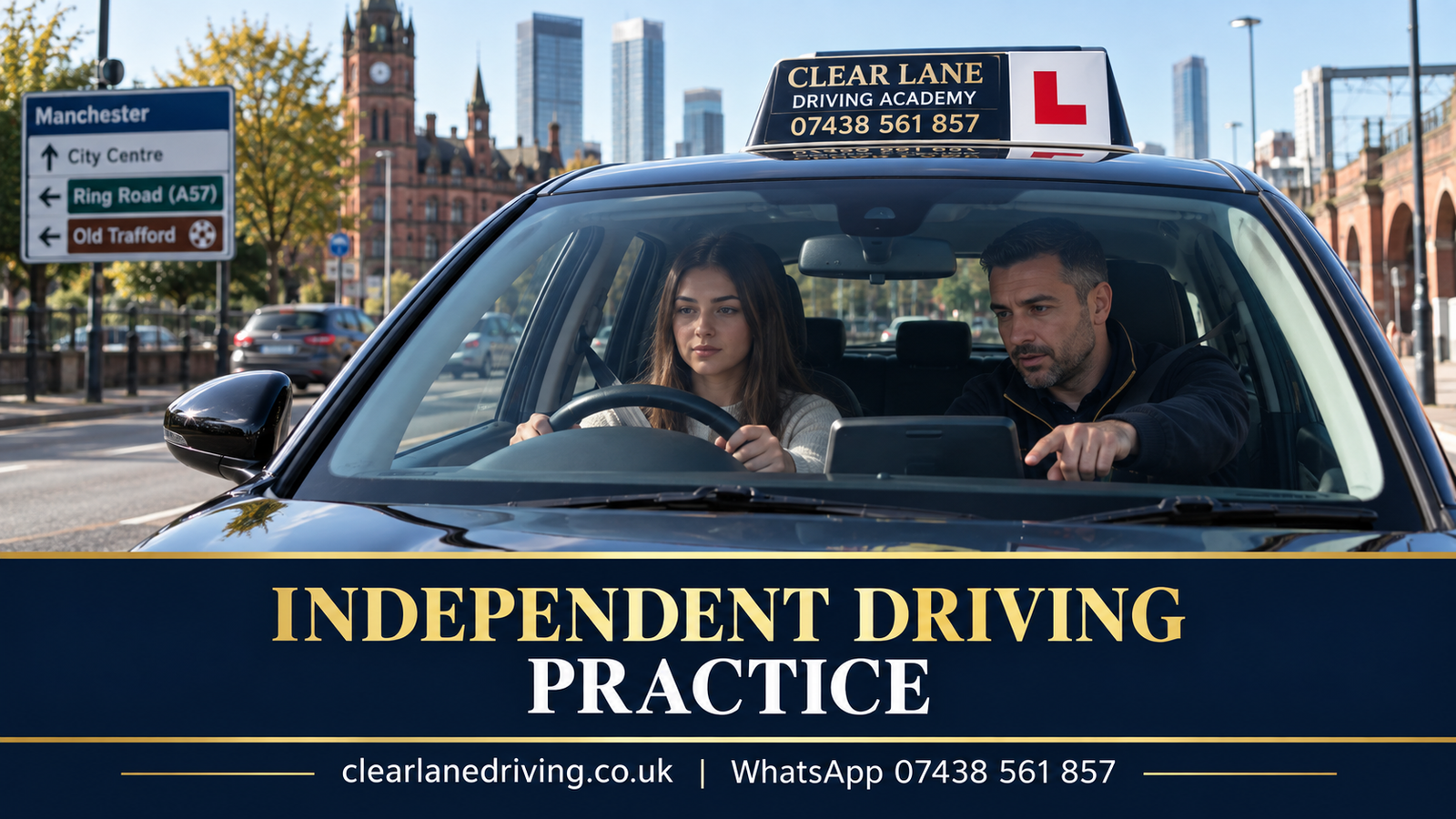
Independent driving is not about proving that you know every road in Manchester. It is about showing that you can make safe, sensible decisions without needing a prompt for every turn. Learning how to practise independent driving well helps turn familiar driving skills into real confidence – the kind that stays with you on test day and after you pass.
For many learners, the pressure comes from thinking they must follow a sat nav perfectly or remember every direction. In reality, the examiner is looking at your driving, not your navigation. If you take a wrong turn safely, that is normally not a driving fault. The priority is always observation, control, planning and responding safely to what is happening around you.
What independent driving means on the practical test
The independent driving section usually lasts around 20 minutes. For most practical tests, you will follow directions from a sat nav. On some tests, you may instead follow traffic signs towards a named destination. The examiner will set the route and give any necessary clarification, but they will not guide every move as they might during the earlier part of the drive.
You are not expected to operate the sat nav, programme a route, or recognise every street name. You simply need to listen, look ahead and drive safely. If the device is unclear, you can ask the examiner to repeat the instruction. If you miss a turn, keep calm and continue safely. Do not suddenly change lanes, brake harshly or attempt to turn at the last moment to get back on route.
This is why independent driving practice should be more than simply driving without your instructor speaking. It should teach you to plan ahead while staying flexible when the road does not go exactly as expected.
Start with the right safety and supervision
Private practice can be extremely useful between professional lessons, especially if you have regular access to a suitable car. However, it works best when the person supervising you understands their role: they are there to keep the session safe, not to overload you with instructions or recreate an exam.
Before setting off, make sure you have the correct learner insurance and L plates displayed. Your supervising driver must be at least 21 and have held a full licence for the relevant type of vehicle for at least three years. If you are learning in a manual car, they must be entitled to drive a manual vehicle.
Agree the purpose of the drive before you move. A clear aim might be following a sat nav through quiet residential roads, reading signs on a route you know, or practising judgement at busy roundabouts. One focused objective gives you a better chance to learn from the drive than trying to tackle everything at once.
A useful pre-drive check is to confirm five things:
- the route is suitable for your current level of experience;
- the car is safe, insured and set up correctly;
- your supervisor knows when to give help;
- you both know the session’s main focus; and
- you have enough time to finish without rushing.
If you are a nervous driver, start at a quieter time of day. A short, calm drive is far more valuable than an hour spent feeling overwhelmed in heavy traffic.
How to practise independent driving in stages
The best approach is gradual. Begin on roads where you have enough spare attention to look beyond the bonnet, read signs and make decisions. As your confidence grows, introduce more complex situations such as multi-lane roundabouts, dual carriageways, unfamiliar junctions and busier town-centre routes.
Stage one: Follow simple spoken directions
Ask your supervisor to give directions a junction or two ahead, such as, “At the end of this road, turn left, then take the second right.” This helps you build the habit of listening once, planning early and staying aware of road signs and lane markings.
Your supervisor should avoid correcting every small decision. If the route allows, give yourself time to assess the situation. The goal is not to drive in silence; it is to make more of the decisions yourself.
Stage two: Use road signs as your guide
Choose a straightforward destination and follow signs rather than relying on turn-by-turn instructions. This is excellent practice for scanning ahead, particularly when approaching larger roundabouts or unfamiliar areas.
Look for signs early, then check which lane you need before you reach the final approach. Where lane markings are unclear or traffic is heavy, prioritise a safe position over forcing your way into the ideal lane. You can still reach the destination by another route.
Stage three: Follow a sat nav
Once you are comfortable with signs and spoken directions, use a sat nav with the volume at a normal level. Treat it as information, not an order. The route may not account for a temporary road closure, a vehicle stopped in your lane or a situation where changing direction would be unsafe.
Practise listening to the next instruction while still watching the road. A common error is looking at the screen for too long when approaching a junction. Keep your eyes moving between the road ahead, mirrors, signs, hazards and the sat nav only when it is safe to glance at it.
It also helps to practise when the route changes unexpectedly. Ask your supervisor to choose a different turn, or deliberately continue safely if you miss one. You will soon see that a missed turn is manageable. A rushed correction is where problems begin.
Build the habits that make decisions safer
Independent driving becomes easier when your basic routines are secure. Good mirror checks, accurate speed control and early observations give you the time and space to think. Without those foundations, following a route can feel like an extra task you cannot manage.
Try using a simple thought process on the approach to any developing situation: What can I see? What might happen next? What do I need to do now? For example, a sign for a roundabout ahead tells you to check the route, assess the correct lane, reduce speed if needed and start looking for traffic from the right. You are planning rather than reacting at the last second.
Keep a sensible gap from the vehicle ahead too. A following distance gives you more time to read signs, judge junctions and respond if the car in front brakes. It is one of the simplest ways to make independent driving feel less hurried.
After each drive, spend a few minutes reviewing it. Pick one moment that went well and one that you would handle differently next time. Be specific. “Roundabouts were bad” is not very useful; “I noticed the lane arrows too late at the third exit roundabout” gives you a clear focus for your next session.
Practise on unfamiliar roads, but choose them carefully
Familiar routes are helpful at first because they reduce the number of things you must process. But test day will involve roads you may not know, so eventually you need to build experience outside your usual area.
For learners preparing around Greater Manchester, that could mean practising different types of road rather than repeatedly driving the same loop. A route near a test centre may include busy urban junctions, parked vehicles, narrow residential streets and complex roundabouts. The purpose is not to memorise test routes. It is to become adaptable wherever you are asked to drive.
Choose unfamiliar routes that match your ability. If you are still developing clutch control or confidence at basic junctions, a difficult multi-lane roundabout at rush hour is unlikely to be productive. Your instructor can help you decide when you are ready to increase the challenge.
Use mock test conditions at the right time
A mock driving test can show how your skills hold up when instructions are limited and you must manage a route independently. It is most useful when you are already close to test standard, not as a way to rush past gaps in your driving.
During a mock session, ask for clear feedback afterwards rather than constant commentary while you drive. You may find that your driving is safe but your planning needs work, or that nerves lead you to rush a decision. Both can be improved with targeted practice.
At Clear Lane Driving Academy, structured mock tests and final preparation are used to identify those patterns calmly, so the next lesson or private practice drive has a clear purpose.
When private practice is not enough
Private practice is a strong supplement to professional lessons, but it is not a replacement for expert feedback. A family member may be an experienced driver, yet they might have developed habits that are not suitable for a practical test or struggle to explain a decision clearly.
If you repeatedly feel unsure about roundabouts, meeting traffic, lane discipline or sat nav directions, bring those moments to your instructor. A calm debrief can help you understand not just what happened, but why it happened and what to do next time.
Independent driving is built one safe decision at a time. Give yourself permission to take the sensible option, even when it means a different route, an extra pause or asking for an instruction again. That is not hesitation – it is responsible driving.