A mock driving test Manchester learners take seriously can change the way they approach their practical test. It is often the moment when driving starts to feel less like a weekly lesson and more like a real responsibility. If you are close to test standard, feeling nervous, or unsure whether you are truly ready, a mock test gives you a clear and honest picture.
For many learners, the hardest part of test preparation is not steering, clutch control or parking. It is uncertainty. You might drive well in lessons, but still wonder what will happen when someone unfamiliar sits beside you, gives short instructions and marks every decision. That is where a mock test helps. It recreates the pressure of the practical test in a calm, controlled way, so you can learn from it before the real day arrives.
What a mock driving test in Manchester actually involves
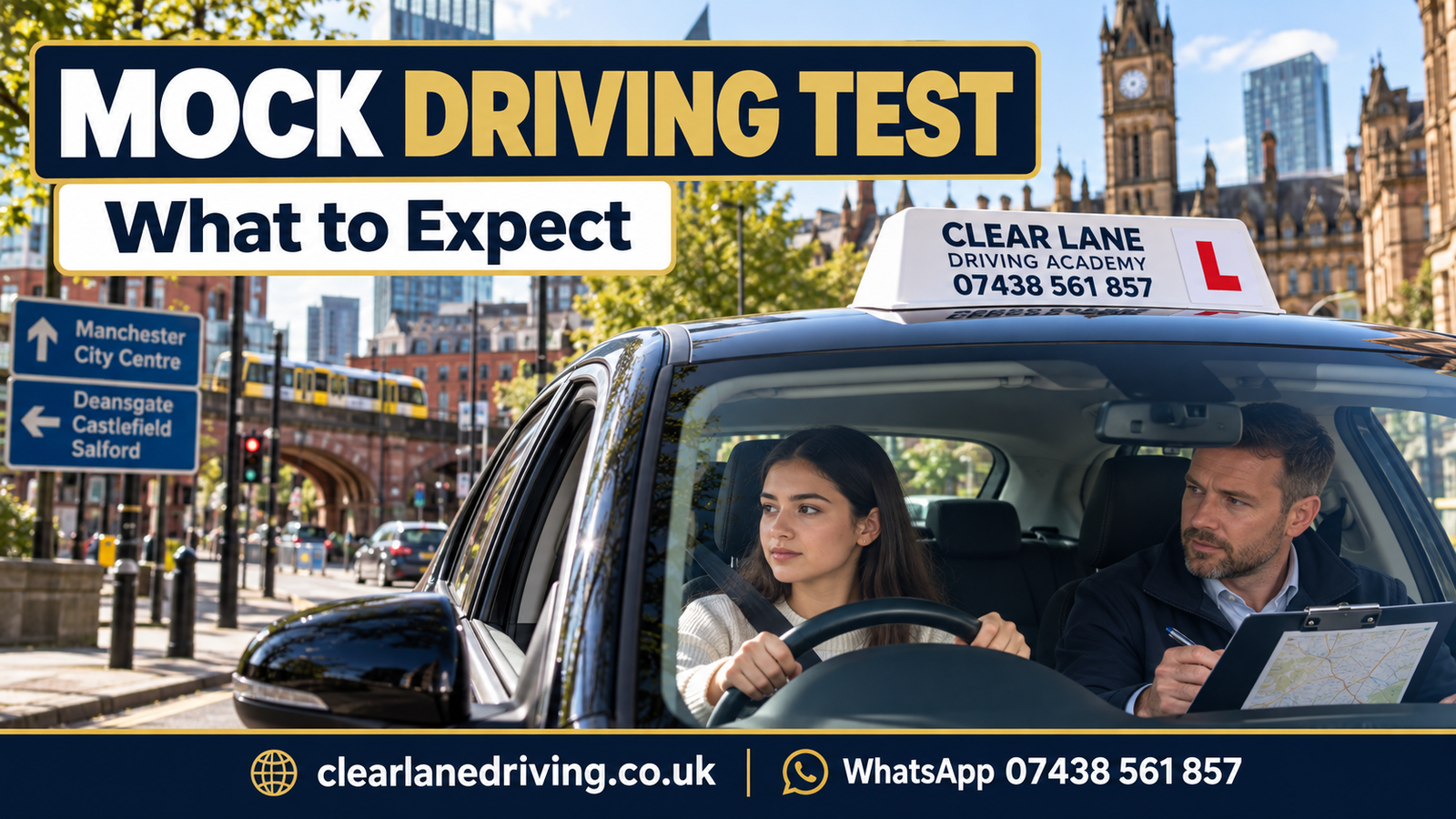
A proper mock driving test is not just a lesson with a stricter tone. It should mirror the structure of the DVSA practical test as closely as possible. That means an eyesight check, a vehicle safety question, around 40 minutes of driving, and a realistic mix of normal roads, more complex junctions, roundabouts, manoeuvres and independent driving.
In Manchester, this matters because local test routes can vary quite a bit depending on the centre. A learner preparing for West Didsbury may need to be comfortable with busy urban traffic and lane discipline, while someone testing in Chadderton or Bredbury may meet a different mix of roundabouts, dual carriageways and residential hazards. A well-run mock test should reflect the kind of roads and decisions you are likely to face, not just the parts you already enjoy.
The instructor will usually take a more examiner-style approach during the drive. That means fewer prompts, less coaching in the moment, and more focus on whether your driving stays safe, legal and independent. Some learners find that change uncomfortable at first. That is normal, and it is one of the reasons the exercise works.
Why mock tests help even good drivers
A lot of learners assume mock tests are only for people who are struggling. In reality, they are just as useful for capable drivers who are nearly ready. Good driving in lessons does not always mean good driving under pressure.
When the pressure rises, small habits become more obvious. Mirrors get missed. Speed creeps up or drops too low. Hesitation appears at roundabouts. A normally tidy reverse bay park becomes rushed. None of that means you are a bad driver. It simply shows where nerves affect your decision-making.
That is valuable information. It is far better to uncover those patterns in a mock test than on your practical. Once identified, they can be worked on directly. Your preparation becomes more focused, and your confidence becomes more realistic rather than hopeful.
The most common issues a mock driving test picks up
Every learner is different, but certain patterns come up again and again. Observation is a big one, especially at junctions and during manoeuvres. Learners often know they should check mirrors and blind spots, but under test conditions the timing can slip.
Another common issue is planning. Manchester roads can change pace quickly. You may move from a quiet side road to a busy main road, then into a multi-lane roundabout within minutes. If your planning is late, everything starts to feel rushed. Positioning, signalling and speed all suffer.
Then there is judgement. Some learners become too hesitant and miss safe opportunities. Others commit too quickly because they do not want to seem unsure. A mock test helps you find the balance. The goal is not to drive perfectly. The goal is to drive safely, smoothly and with enough confidence to make good decisions.
Mock driving test Manchester learners should not treat as pass or fail
One of the biggest mistakes learners make is taking the result too personally. If you would have failed the mock, that does not mean you are not ready to improve. It means the mock has done its job.
A useful mock test is diagnostic. It shows your current standard on that day, under those conditions. Some faults will be one-off nerves. Others will reveal deeper habits that need attention. The important part is the feedback afterwards.
Good feedback should be clear and structured. You should come away knowing what was done well, what counted as a driver fault, what would have been serious, and what to practise next. Vague comments are not enough. You need practical guidance that turns a disappointing mock into productive lessons.
How to get the most from a mock test
Approach it as if it matters, but not as if it defines you. Get a good night’s sleep, arrive on time and treat the drive like the real thing. Bring your concentration, but leave the self-judgement behind.
It also helps to avoid over-talking before the test. Some learners try to calm themselves by asking lots of last-minute questions. Usually, that adds more noise. A brief reminder of key routines is fine, but the purpose of the mock is to see what happens when you drive independently.
Afterwards, give the debrief your full attention. This is where the progress happens. Ask which faults are most urgent, which are linked to nerves, and which are about skill. Those are not always the same thing. For example, a missed mirror check may be a concentration issue, while poor lane choice at a roundabout may point to a knowledge gap or late planning.
When should you book a mock driving test?
Timing matters. If you are very early in your learning, a mock test can feel overwhelming and offer limited value. If you leave it too late, you may not have enough time to correct the issues it reveals.
For most learners, the best point is when you can drive for a full lesson with limited support and can already handle the core test topics. That includes meeting traffic safely, following signs, dealing with roundabouts, completing manoeuvres and keeping generally consistent control of the car. You do not need to be perfect. You just need enough independence for the mock to show something meaningful.
If you have already failed a practical test, a mock can be especially helpful before rebooking. It gives you a reset. Instead of guessing what went wrong, you can rebuild confidence with structure and honest feedback.
Why local knowledge matters in Manchester
There is no secret route that guarantees a pass, and no instructor should pretend otherwise. But local familiarity does help. Roads around Sale, Rochdale, Cheetham Hill or Bury all bring slightly different challenges, and preparation feels more effective when it reflects real conditions.
That might mean practising busy mini-roundabouts, dealing with pedestrian-heavy areas, managing changes in speed limits, or staying calm on unfamiliar multi-lane roads. A mock test rooted in the area where you are likely to take your practical can expose weaknesses that a generic lesson might miss.
This is particularly useful for nervous learners. Anxiety often gets worse when the environment feels unpredictable. The more familiar the road types and local hazards become, the easier it is to keep mental space for observation and decision-making.
What happens after the mock test matters most
The test itself is only half the value. What you do next determines whether it genuinely improves your chances.
A strong follow-up plan should focus on the faults that carry the biggest risk first. Serious observation errors, poor response to junctions, or weak lane discipline need attention before minor polish points. There is no benefit in perfecting a reverse bay park if your approach to roundabouts is still inconsistent.
This is where structured coaching makes a real difference. Rather than repeating full lessons and hoping things improve, you target the areas the mock highlighted. That often leads to faster, calmer progress because the work is specific. For learners on a tight timeline, including those taking intensive courses, that structure can make preparation much more efficient.
At Clear Lane Driving Academy, mock tests are used as part of that structured approach – not to catch learners out, but to show them clearly where they stand and what to do next.
A mock test is also a confidence tool
Confidence is not pretending you are ready. It is knowing what you can do, where you still need work, and having a plan for both. That is why a mock driving test can be so reassuring.
Even if the drive feels shaky, you leave with more certainty than you had before. You know what test conditions feel like. You know how nerves affect you. And you know what needs to improve before the real appointment.
For some learners, the biggest benefit is simply removing the mystery. Once you have experienced a realistic test run, the practical often feels less intimidating. It is still important, of course, but it is no longer unknown territory.
If you are nearing test day and wondering whether you are truly ready, a mock test is one of the most honest steps you can take. Learn smart, drive safe, and give yourself the chance to walk into your practical with a calmer head and a clearer plan.