Your hands may feel tight on the wheel before the engine has even started. You may worry about holding up traffic, making a mistake at a roundabout, or being judged by other drivers. Driving lessons for nervous adults are not about pushing through that feeling or pretending it is not there. They are about turning an unfamiliar, high-pressure task into a series of manageable skills.
Many adults feel more nervous than they expected. Some are learning later in life, some had a difficult experience with a previous instructor, and others have put lessons off for years because driving felt overwhelming. None of this means you cannot become a safe, capable driver. It simply means your lessons need a calm pace, clear structure and an instructor who listens.
Why adult learners can feel nervous behind the wheel
Nerves usually have a reason. Driving asks you to process a lot at once: steering accurately, checking mirrors, choosing the correct gear, reading road signs, watching pedestrians and responding to other road users. When every action is new, it can feel like there is no time to think.
Adults can also carry extra pressure. You may be balancing lessons around work, childcare or family commitments. You might feel that you should have learnt years ago, or compare yourself with friends who passed quickly. These thoughts are understandable, but they do not improve your driving. Progress is more useful than comparison.
A previous test fail can add another layer of anxiety. It is easy to replay one serious fault or one difficult junction and assume it will happen again. In reality, a test result is feedback on one drive on one day. With honest review and targeted practice, it can help you identify exactly what to work on.
What good driving lessons for nervous adults look like
The right lesson should feel purposeful, not rushed. You should know what you are practising, why it matters and what a successful attempt looks like. A calm instructor will give directions early, use clear language and allow you time to process what is happening.
At the beginning, this may mean practising on quieter roads and repeating basic controls until they feel less demanding. There is no benefit in taking on busy multi-lane roundabouts before you are comfortable moving off, stopping, steering and checking your mirrors. Confidence grows from evidence: you complete a task safely, then repeat it until it becomes more familiar.
Lessons should still move forward. Being nervous does not mean staying in your comfort zone forever. It means taking the next challenge at the right time, with preparation. A supportive instructor might talk through a junction before you reach it, then gradually encourage you to make more decisions independently as your skills improve.
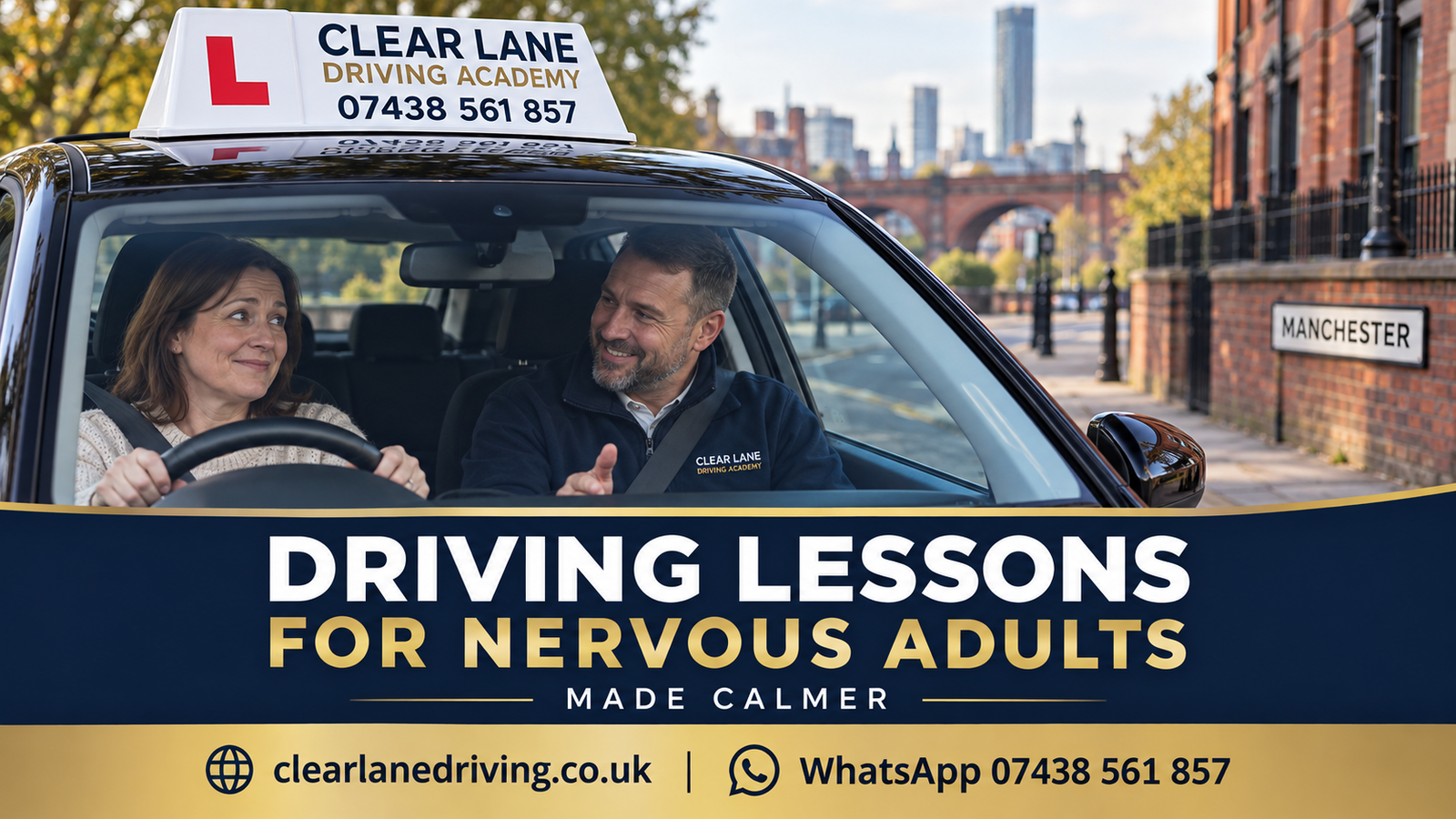
Clear Lane Driving Academy uses structured, coaching-focused lessons so learners can understand their progress rather than guessing whether they are ready for the next stage.
A lesson plan gives your mind less to carry
When anxiety is high, uncertainty makes it worse. Knowing that today’s lesson is focused on emerging at junctions, approaching roundabouts or practising bay parking gives you a clear target.
A useful lesson often follows a simple pattern: recap the previous skill, explain and demonstrate the new one, practise it in suitable conditions, then review what went well and what needs attention next time. This approach makes mistakes easier to learn from. They are not proof that you are failing. They are information for the next attempt.
How to manage nerves before and during a lesson
Trying to eliminate every nervous feeling is not realistic. A better aim is to prevent nerves from taking over your attention. Small routines can make a noticeable difference, particularly if you use them consistently.
Before your lesson, give yourself enough time to arrive without rushing. Wear comfortable shoes with a thin, secure sole so you can feel the pedals properly. Avoid starting on an empty stomach, but do not overdo caffeine if it makes you shaky or restless.
When you get into the car, take a moment before moving away. Adjust your seat and mirrors carefully, settle your hands on the wheel and take one slow breath. If you are particularly anxious, tell your instructor at the start. A professional instructor would rather know that you need a calmer introduction to the lesson than mistake silence for confidence.
During the drive, bring your focus back to the next safe action. Instead of thinking, “I have to get through this whole lesson,” think, “Mirrors, signal, position, speed, look.” Breaking a situation into a routine gives your brain something practical to do.
If you make an error, resist the urge to mentally abandon the rest of the drive. Safely correct it if you can, listen to the guidance and continue. Everyone makes mistakes while learning. The key is how you respond, not whether the mistake happened.
Manual or automatic: choose the option that supports your goal
For nervous adults, the choice between manual and automatic lessons can be significant. A manual car gives you flexibility to drive either type of vehicle after passing, but learning clutch control and gear changes adds another task in the early stages. Some learners enjoy the involvement and feel proud once those skills click.
Automatic lessons remove clutch control and manual gear selection, allowing more attention for steering, observation and road awareness. For some nervous learners, that reduced workload helps confidence build sooner. The trade-off is that an automatic licence limits you to automatic vehicles unless you later pass a manual test.
Neither route is the “easy” option. Both require safe judgement, awareness and consistent practice. The best choice depends on your needs, the car you expect to drive after passing, your available time and how comfortable you feel managing several controls at once.
Build confidence outside the test mindset
A common mistake is treating every lesson as a miniature driving test. That can make you tense, overly cautious and afraid to ask questions. Lessons are where you are allowed to learn. Tests come later, once the skills are dependable.
Keep a short record after each lesson. Write down one thing that felt better, one situation you found difficult and one goal for next time. Over several weeks, this creates a more accurate picture than memory alone. Nervous learners often remember the one awkward stall but forget the twenty minutes of controlled, safe driving around it.
It also helps to practise decision-making aloud with your instructor when appropriate. Saying what you can see and what you plan to do can slow your thoughts down: “The pedestrian is near the crossing, so I am easing off and preparing to stop.” As your confidence grows, you will not need to say every step, but this technique can build stronger observation habits.
Preparing for the practical test without piling on pressure
Being test-ready is not the same as never feeling nervous. Most people feel some nerves before a practical test. The aim is to know that you can drive safely even when you are not completely relaxed.
Mock driving tests can be particularly helpful because they reveal how you respond to independent driving, unfamiliar directions and occasional mistakes. A good mock should be realistic but constructive. Afterwards, focus on patterns rather than single moments. If meeting traffic on narrow roads repeatedly causes hesitation, that is a useful area for targeted practice.
If your test is at a Manchester centre such as Chadderton, Sale or West Didsbury, practising the types of roads and junctions you may encounter can reduce the fear of the unknown. This is not about memorising routes. Test routes can change, and safe driving depends on responding to what is in front of you. It is about becoming comfortable with local road conditions, busy periods and the decisions they require.
Intensive courses can suit adults who learn well through regular, focused practice and need to make progress within a shorter period. They are not right for everyone, though. If anxiety leaves you mentally drained after a lesson, shorter sessions with time to reflect may produce better learning. Honest planning is more valuable than rushing.
When nerves feel bigger than driving
Some anxiety is expected, but it is worth speaking up if you experience panic symptoms, avoid lessons completely, or feel unable to concentrate safely. Your instructor can adjust the pace, revisit foundations and agree small goals. If anxiety affects other parts of life too, support from a qualified health professional may also be helpful.
There is no shame in needing more time. Safe driving is built through repetition, understanding and good judgement, not by forcing yourself into situations before you are ready.
The next time you sit in the driver’s seat, do not ask yourself whether you feel fearless. Ask what one skill you can practise calmly and safely today. That is how confidence becomes real: one controlled decision, one successful journey and one lesson at a time.