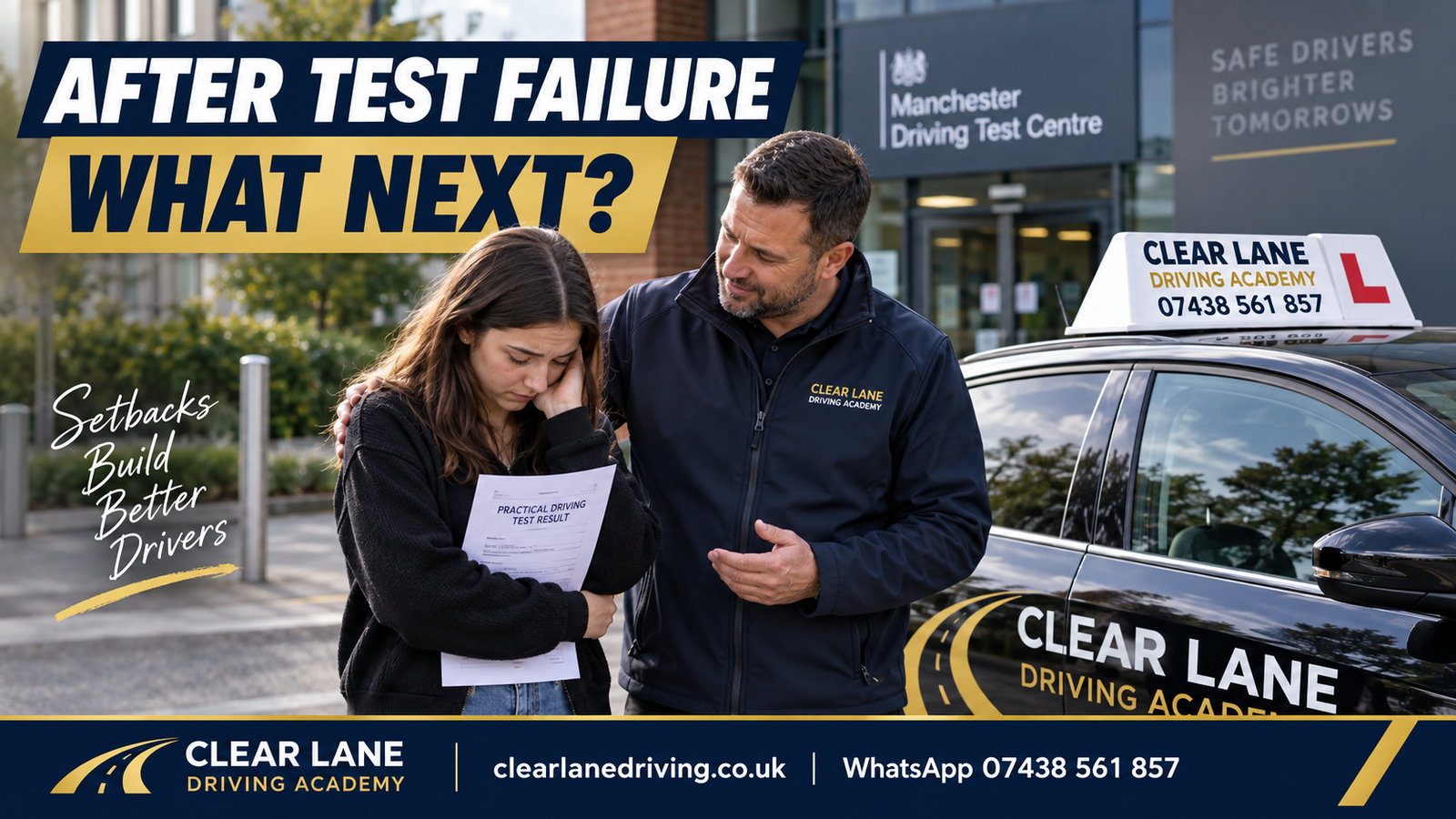
That result can feel much bigger than a single driving test. You may have spent weeks preparing, taken time off work or college, and pictured the moment you would finally pass. But driving lessons after test failure are not about starting again. They are about understanding what happened, rebuilding your calm, and preparing properly for the next opportunity.
A practical test gives a snapshot of one drive on one day. It does not define your ability to become a safe, capable driver. Plenty of good drivers do not pass first time, particularly when nerves, unfamiliar roads or one difficult situation affect their judgement. The useful question is not simply, “Why did I fail?” It is, “What do I need to practise so I can drive safely and consistently next time?”
Why driving lessons after test failure matter
It is tempting to book another test straight away and hope for a better day. Occasionally, that is sensible. If you received one minor fault too many but felt settled, independent and safe throughout, a short period of focused practice may be all you need.
More often, however, the examiner’s feedback points to a pattern that needs careful attention. A serious fault may have happened at one junction, but the cause can be earlier: rushed observation, poor planning, uncertainty over road position, or pressure from following traffic. Repeating the same test without addressing that cause can leave you feeling more anxious and less confident.
Focused lessons provide space to slow the situation down. A good instructor will help you look beyond the word written on the driving test report and identify the decision behind it. For example, a fault marked for judgement at a roundabout may involve approach speed, lane choice, observations or hesitation. The right practice depends on which part was actually difficult for you.
This is where structured coaching makes a real difference. You should leave each lesson knowing what you worked on, why it matters, and what progress would look like before your next test.
Read your driving test report without panic
The driving test report is useful evidence, not a verdict on you. Look at the driving faults first. These are areas where your driving fell below the expected standard on the day, but did not create danger. A cluster of similar faults can show where your routine becomes less reliable when you are under pressure.
Then look at any serious or dangerous faults with your instructor. Be honest about how the situation felt. Were you unsure what to do? Did you see the hazard late? Did nerves make you rush? Or did you know the correct action but fail to carry it out consistently? Each answer calls for a different lesson plan.
It also helps to separate the fault from the emotion attached to it. Missing a mirror check before changing direction can feel embarrassing, but it is a practical habit that can be rebuilt through repetition and commentary driving. Stalling at a busy junction can feel like a disaster, but a calm, safe recovery is part of competent driving. The aim is not perfection. It is safe control and sound decisions, even when something does not go exactly to plan.
Turn feedback into a focused lesson plan
After a test failure, broad lessons where you simply “go for a drive” may not be the best use of your time. Your next lessons should have a clear purpose while still giving you opportunities to drive independently.
Start by revisiting the situations connected to your test report. If you struggled with emerging at junctions, practise reading gaps on quieter roads before working up to busier multi-lane junctions. If roundabouts caused problems, build from simple roundabouts to larger ones with more lane changes and heavier traffic. If your driving became rushed, practise approaching hazards earlier and making a safe plan before you reach them.
Your instructor should also check the skills that support the reported fault. A learner who receives a fault for response to traffic lights, for instance, may benefit from work on anticipation, speed control and mirror use rather than traffic lights alone. This approach is more likely to create lasting progress.
At Clear Lane Driving Academy, mock driving tests can be particularly helpful once the main weaknesses have been addressed. A realistic test-style drive lets you experience the pressure of following directions and making independent decisions, then discuss the result in a calm setting. It is not about catching you out. It is about making test conditions feel familiar.
Rebuild confidence without avoiding the hard parts
Confidence after a failed test is not gained by avoiding the roads or manoeuvres that felt difficult. It grows when you meet those situations with the right support, enough repetition and a clear method.
That does not mean throwing yourself straight into the busiest roundabout in Manchester after a disappointing result. Progress should be gradual. You may begin by revisiting a skill in a quieter setting, then add traffic, more complex road markings, sat nav directions or an unfamiliar route as your control improves.
Nerves deserve attention too. Many learners drive well in normal lessons but become unusually quiet, tense or rushed during a test. If that sounds familiar, say so early. Your instructor can include more independent driving, practise test-day routines, and help you develop simple ways to reset when a mistake happens.
One helpful rule is to keep driving after a small error. You cannot change a missed gear or an awkward move-off, but you can respond safely and concentrate on the next hazard. Examiners assess the whole drive. Letting one moment take over your thoughts can create further errors that were avoidable.
How many lessons do you need before another test?
There is no honest fixed number. It depends on the reason for the failure, how consistently you now drive, how much private practice you have, and whether nerves were the main factor. Someone who was otherwise test-ready may need only a few targeted lessons. Someone with repeated issues in observations, planning or control may need longer to build dependable habits.
A sensible decision comes from evidence, not from urgency. Before booking again, you should be able to complete a mock test or independent drive without regular instructor prompts. You should understand your previous faults and show that you can handle similar situations safely on different roads, not just on one familiar route.
If you need a test quickly, an intensive course can help concentrate practice into a shorter period. However, fast-track learning still needs to be realistic. Intensive lessons work best when you can absorb feedback, practise consistently and take breaks when needed. Packing in hours without reflection can be tiring, especially after a confidence knock.
Prepare for the next test in Greater Manchester
Local familiarity can reduce unnecessary pressure, but it should never replace proper driving skill. If you are taking your next test at Chadderton, Cheetham Hill, Rochdale, Sale, West Didsbury, Bredbury, Bolton, Atherton or Bury, practise the types of roads and traffic conditions you may meet around the centre.
That could include busy junctions, changing speed limits, urban traffic, residential roads with parked cars, country-road bends or dual carriageways where appropriate. Test route preparation is useful because it helps you read local road markings and layouts calmly. Yet the goal is to drive safely wherever the examiner takes you, including on roads you have not seen before.
Make sure the practical details are settled too. Know your test time, bring the right licence, and confirm whether you will use your instructor’s car or arrange test day car hire. A calm plan for the morning leaves more mental space for driving well.
Give yourself permission to be a learner
A failed test can make people feel behind, particularly if friends or family have already passed. Try not to measure your progress against someone else’s timetable. Learning to drive is a safety skill that will shape thousands of future journeys, from commuting and school runs to motorway travel and unfamiliar places.
The best next step is a calm one: review the feedback, practise the real cause of the fault, and only return to test when your driving feels consistent rather than lucky. A pass is a good goal, but the confidence to make safe decisions on your own is what will carry you far beyond test day.