A practical test appointment can feel like the finish line, especially when you have been balancing lessons with work, college or family life. But knowing when to book a practical test is not simply about finding the earliest available date. It is about giving yourself enough time to become a safe, consistent and confident driver – not just someone who can complete the basic exercises.
For some learners, booking early provides a useful goal to work towards. For others, it creates pressure before the foundations are in place. The right approach depends on your current ability, how regularly you can practise, the availability of suitable test dates and the honest view of your instructor.
Book when your driving is consistently safe
The best sign that you are ready to book is consistency. One excellent lesson is encouraging, but the practical test asks you to make safe decisions throughout a drive in unfamiliar conditions. You should be able to drive independently without your instructor needing to step in, prompt you repeatedly or talk you through each hazard.
This means you can deal with normal road situations calmly: moving off safely, approaching junctions at an appropriate speed, reading road signs early, choosing the right lane and responding to pedestrians, cyclists and other road users. You do not need to be perfect. Nobody drives perfectly on test day. You do need to show that small mistakes do not turn into unsafe decisions.
A useful question is: if your instructor stayed quiet for twenty minutes, would you still plan ahead, check properly and drive safely? If the answer is usually yes, you are moving closer to test standard.
When to book a practical test with your instructor’s input
Your instructor sees the parts of your driving that can be difficult to judge from the driver’s seat. You may feel confident because the car is moving smoothly, while your instructor may be noticing late mirror checks, rushed observations or hesitation at busy roundabouts. Equally, you may feel nervous despite driving to a very good standard.
Ask for a clear readiness conversation rather than a vague answer. A professional instructor should explain what is going well, what still needs work and how long that improvement may realistically take. Honest advice is more useful than being told what you want to hear.
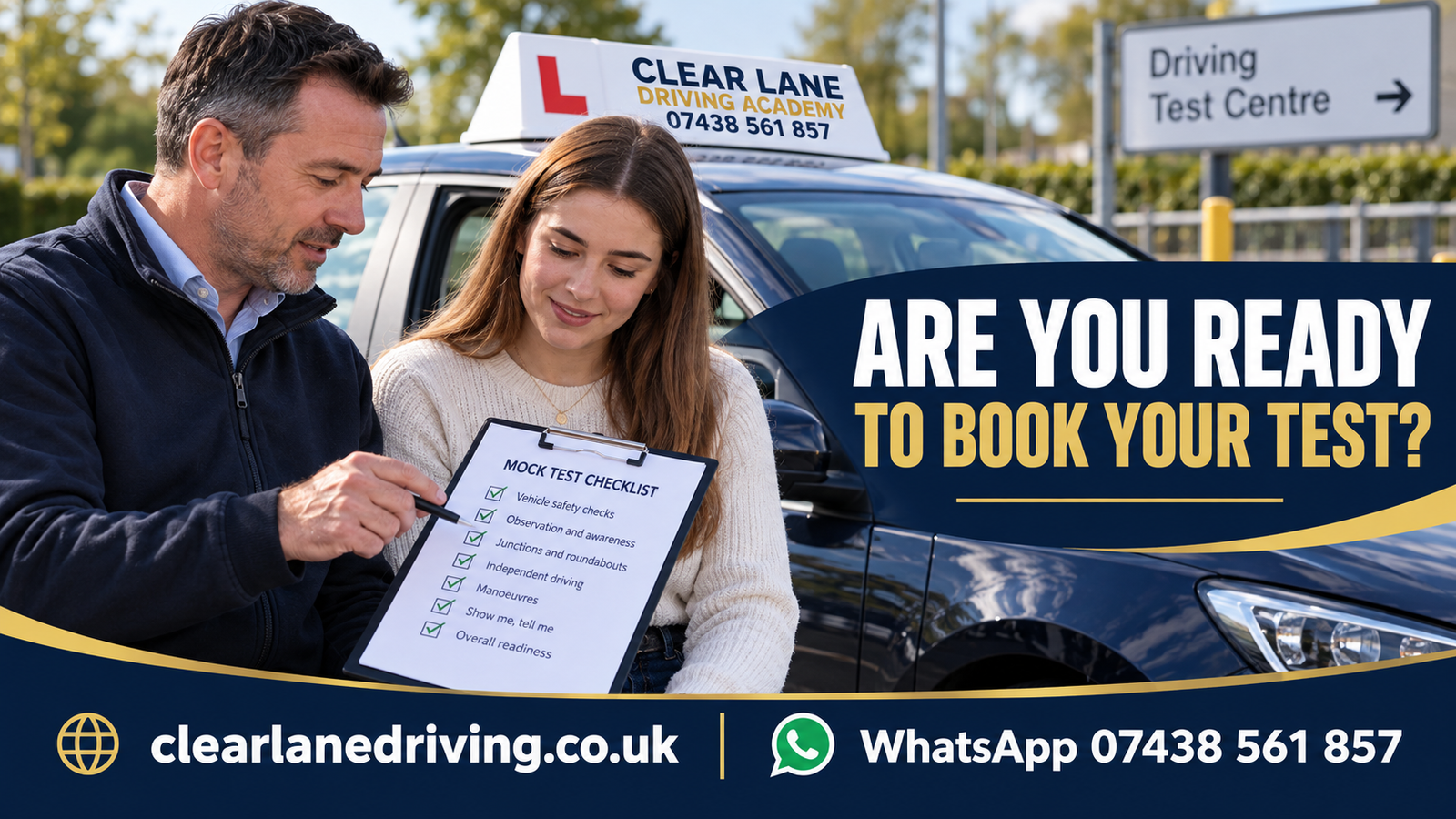
If you are taking lessons with Clear Lane Driving Academy, your progress should be structured around the skills required for safe independent driving, including mock test preparation when the time is right. A mock test can be particularly helpful because it shows whether your driving remains steady when the usual lesson support is reduced.
Signs you are close to test standard
You are likely approaching the right time to book if you can drive independently on a range of roads, including unfamiliar routes; complete manoeuvres with proper observation and control; follow a sat nav or traffic signs without losing focus; and recover calmly if something does not go to plan.
You should also be able to explain your decisions. For example, why you waited at a junction, why you adjusted your speed on a narrow road, or why you chose not to overtake a cyclist. This reflects genuine awareness rather than memorised routines.
Do not wait for every lesson to feel effortless
Many able learners delay booking because they are waiting to feel completely free of nerves. That moment may never arrive. Test-day nerves are normal, and being nervous does not mean you are unready. The goal is to have the skills and routines that keep you safe even when you feel under pressure.
There is a difference between normal nerves and a lack of readiness. Feeling anxious before a busy roundabout but approaching it correctly is very different from regularly missing observations, struggling to control the car or needing regular instructor intervention. One calls for confidence-building practice; the other calls for more time developing core skills.
If confidence is the main barrier, short independent drives, mock tests and practice on routes that challenge you gradually can help. Avoid trying to solve nerves by rushing into a test date before you can drive safely without support.
Think carefully about waiting times and lesson availability
Practical test waiting times can affect your decision. If dates are limited, it can be sensible to secure an appointment once you have passed your theory test and are progressing well. However, only do this if the date leaves enough time for regular lessons and focused preparation.
Before booking, consider how many hours you can realistically commit to. A learner taking two lessons a week may be ready for a date sooner than someone who can only drive occasionally. Access to private practice can also make a difference, provided it is legal, properly supervised and used to reinforce good habits.
You should also check that your instructor and their car are available for the date and time you are considering. Test day car hire may be an option for learners who have reached the required standard and meet the relevant conditions, but it should never be treated as a substitute for proper preparation.
Be cautious about booking a test many months ahead simply because it is available. Plans can change, and you may need to move the appointment. Always check the current DVSA booking, cancellation and change rules before confirming a date.
Intensive courses need a realistic test plan
An intensive driving course can be a strong option if you need concentrated learning and can commit fully to the schedule. It is not a shortcut around safe driving. The course should allow time to assess your starting point, build skills progressively and complete realistic mock test practice.
For a beginner, the right test date depends on how quickly you absorb new skills, previous road experience and the intensity of the course. For a learner who has already had lessons but needs to rebuild confidence after a gap or a previous test, a shorter focused course may be more appropriate.
The key is to book around your likely readiness date, not around an arbitrary deadline. Fast progress is valuable, but safe progress matters more.
Use mock tests to make the decision clearer
A properly run mock practical test gives you evidence, not guesswork. It should include an independent driving section, realistic directions, manoeuvre practice where appropriate and the same quiet, focused atmosphere you can expect in the real test.
The result matters, but the pattern matters more. One serious or dangerous fault means you are not ready to take risks with a test booking. A few minor faults may be manageable if they are understood and improving. Repeated faults in the same area, such as observations at junctions or positioning on roundabouts, need targeted work before test day.
Try to complete more than one mock test in different road and traffic conditions. A pass-standard drive on a quiet afternoon is positive, but you also need to cope when roads are busier, weather changes or a route is less familiar.
Plan for your chosen test centre, without memorising routes
Familiarity with your local area can help your confidence. If you are taking your test at Chadderton, Cheetham Hill, Rochdale, Sale, West Didsbury, Bredbury, Bolton, Atherton or Bury, spend time practising the types of roads and junctions you may meet near that centre.
This is not about trying to memorise test routes. Routes can change, and safe driving should not depend on knowing every turn. It is about becoming comfortable with the local road environment: complex roundabouts, multi-lane approaches, residential streets, busy high roads, country lanes or dual carriageways where relevant.
Good preparation teaches you to read signs, plan early and make safe decisions wherever the examiner takes you. That is far more useful than relying on a route you have driven before.
If you have failed before, book when the cause is fixed
A previous fail can make it tempting to book again immediately, particularly if you only received one serious fault. Sometimes a quick re-test is sensible. Sometimes it repeats the same problem under the same pressure.
Look beyond the result sheet and identify the reason behind the fault. Was it a one-off lapse in concentration, or was it linked to a wider issue such as weak mirror routines, rushed decision-making or difficulty dealing with pressure? Your next booking should follow enough practice to show that the cause has been addressed consistently.
It can also help to practise the period just before a test. Learners often drive differently when they know they are being assessed. A mock test after a normal warm-up, with no coaching during the drive, can make your next step much clearer.
A sensible final check before you book
Before confirming a date, make sure your theory test certificate will still be valid on the day of your practical test. Check that you can attend the appointment without rushing from work, travel or another commitment, and confirm the vehicle arrangements early.
Most importantly, make the decision based on your recent driving, not your best drive or your worst one. If your safe routines are becoming dependable, you can drive independently across varied conditions and your instructor agrees that you are close to or at test standard, booking gives your preparation a clear purpose.
A practical test is one drive on one day. Give yourself the best chance by arriving with calm routines, honest preparation and enough confidence to deal safely with whatever the road brings.
If you have a test date approaching and need to build confidence quickly, Clear Lane Driving Academy offers intensive driving courses in Manchester and Oldham designed to bring you to test standard efficiently. We teach across Bury, Failsworth, Ashton-under-Lyne and the surrounding area.
Looking for driving lessons in Oldham specifically? Clear Lane covers Oldham, Chadderton and surrounding areas with DVSA-approved local instructors.