The ADI Part 3 is not a test of how many teaching routines you can recite. It is an assessment of whether you can help a real learner make safe, meaningful progress. This guide to ADI Part 3 standards explains what DVSA assessors are looking for, how the assessment is structured, and how to build lessons that feel natural rather than rehearsed.
For many trainee instructors, the challenge is moving away from telling and towards coaching. You still need sound technical knowledge, clear communication and control of risk. But your pupil must remain at the centre of the lesson. The examiner is assessing your instructional ability, not whether you can deliver a perfect speech.
What the ADI Part 3 assessment involves
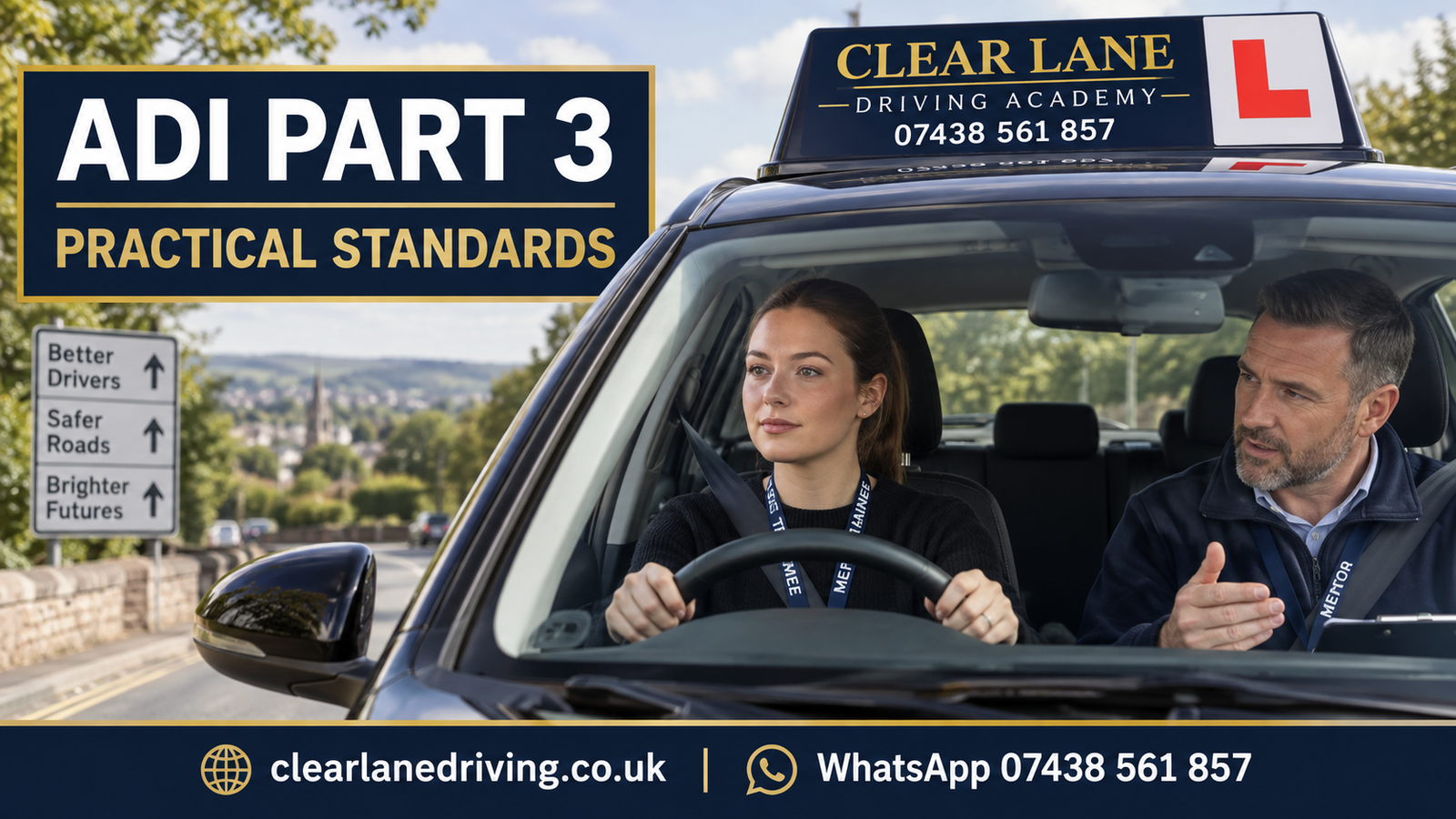
The assessment lasts around 45 minutes and takes place with a genuine learner driver. Your pupil can be at any stage of learning, provided the lesson and level of support are suitable for them. This is why choosing the right pupil matters. A learner who is comfortable with you, honest about their goals and able to drive safely enough for the planned task gives you a fair opportunity to demonstrate your coaching.
The lesson should have a clear purpose. It might focus on emerging at busy junctions, independent driving, roundabouts, manoeuvres or improving anticipation on familiar Manchester roads. The subject itself is less important than your ability to identify what the pupil needs, agree a goal with them, and adapt as the drive develops.
There are 17 competencies on the ADI Part 3 assessment form. Each is scored from 0 to 3, creating a maximum of 51 marks. A grade B requires 31 to 42 marks and a grade A requires 43 to 51. A score of 30 or below is a fail. You can also fail if you score 1 or below in any of the three risk-management competencies, even if your overall total is higher.
That rule reflects the standard expected of an instructor. Good coaching is never separate from safety.
The three areas behind ADI Part 3 standards
The 17 competencies sit within three connected areas: lesson planning, risk management, and teaching and learning strategies. Strong candidates do not treat these as separate boxes to tick. They flow through the lesson.
Lesson planning: start with the learner, not your script
An effective lesson begins with a short, useful conversation. Ask the pupil what they want to improve, how confident they feel and what has been difficult recently. Then agree an achievable goal in plain language. For example: “By the end of this lesson, you’ll be able to approach and emerge at this type of junction with a plan for what you’re looking for and when it’s safe to go.”
You should also check the pupil’s existing knowledge. If they say they struggle at roundabouts, find out what part causes the problem. Is it lane choice, observations, speed, reading other road users or deciding on a safe gap? Assuming the answer and delivering a stock briefing can lead you away from the real issue.
Lesson planning also means adapting the route and task. A nervous beginner may need a quiet approach to practise the foundations first. A more experienced pupil may benefit from busier conditions, more independent decisions and a chance to analyse mistakes. There is no prize for choosing the hardest route. The right level of challenge is the one that promotes learning without creating unnecessary risk.
Risk management: share responsibility clearly
Risk management is often where otherwise capable PDIs lose marks. The key is to make the level of responsibility clear before the task begins and review it when conditions change.
Your pupil needs to know what they are responsible for, what help is available and when you may need to intervene. This may sound simple, but vague phrases such as “I’ll help if needed” do not always give the learner enough information. Be specific. If you are approaching a difficult multi-lane roundabout, explain whether you expect the pupil to make the decisions independently, whether you will prompt for lane position, and what you will do if safety is compromised.
The three risk-management competencies look at whether you identify and respond to hazards, whether you take suitable action to manage risk, and whether you give the pupil enough information to manage risk for themselves. The balance changes with the learner’s experience. Too much intervention can stop the pupil learning; too little can leave them exposed.
Use timely prompts rather than last-second commands. If the pupil is approaching a junction too quickly, a well-timed question such as “What speed would give you time to assess the view?” may be enough. If the situation requires immediate action, safety comes first. A clear verbal instruction or physical intervention may be necessary, followed by a calm explanation when it is safe to do so.
Do not allow the assessment setting to make you passive. An examiner does not expect you to let a situation develop simply to create a coaching opportunity.
Teaching and learning: coach the decision-making
This is the largest part of the assessment and the area where a pupil-led lesson makes a real difference. Good instruction is not silent instruction, nor is it constant questioning. It is purposeful communication that helps the learner understand, practise and reflect.
A helpful pattern is to ask the pupil to describe the problem, explore options, try a solution and evaluate the result. After an awkward approach to a junction, you might ask: “What did you notice about your speed as we came up to the give-way line?” If they identify that they arrived too quickly, follow with: “What could you change on the next one to give yourself more time?”
Questions need to fit the pupil. A complete beginner may need more direct explanation and demonstration. An experienced learner may gain more from analysing their own driving. If a pupil cannot answer, do not keep asking the same question in a different form. Give an explanation, use a simple diagram if appropriate, or talk through the next attempt. Coaching is about supporting understanding, not catching people out.
Clear Lane Driving Academy encourages PDIs to keep explanations brief and practical. Long roadside talks can drain time and break concentration. Where possible, use real driving situations and focused feedback. One well-chosen point, practised properly, is usually more valuable than five observations delivered at once.
Feedback should lead to another attempt
Feedback is most useful when it is accurate, balanced and connected to a next step. Avoid general praise such as “good driving” without explaining what worked. Instead, say what you observed and why it helped: “You reduced your speed earlier there, which gave you time to check the right-hand view and choose a safe gap.”
When something needs improvement, keep the language calm and specific. Focus on the driving behaviour rather than the person. Then give the pupil an opportunity to apply the learning again. The assessment is not about producing a fault-free drive. It is about showing that you can turn errors, uncertainty and successes into progress.
Common mistakes that weaken an otherwise good lesson
Many Part 3 lessons lose quality because the PDI tries too hard to perform. A fixed briefing that does not match the pupil, repeated questions with no support, or a planned route followed regardless of what happens can all make the lesson feel artificial.
Another common issue is talking over the pupil’s driving. Instructions, questions and feedback should not overload them at busy moments. Give them space to process. If a discussion is needed, choose a safe, appropriate time rather than trying to coach through every hazard.
Finally, do not chase a grade A through complexity. A grade A reflects consistently high-quality, learner-centred instruction, not complicated terminology or an ambitious route. A well-managed lesson with a clear goal, thoughtful questions and safe progression is stronger than a lesson crammed with techniques.
Preparing for your ADI Part 3 assessment
Practise with more than one learner where possible. Different pupils reveal different coaching habits, and this helps you become adaptable. Record your lessons only where everyone has agreed, or ask a trainer to observe. Review not just what you said, but what the pupil did as a result. Did they understand the goal? Were they given enough time to think? Did your intervention match the risk?
Mock assessments are valuable when they are honest. Ask for feedback against all 17 competencies, especially the risk-management section. Then work on one or two priorities at a time. Trying to change every part of your teaching in a single lesson can make you less natural, not more effective.
On the day, aim to teach the pupil in front of you. Listen carefully, manage the drive safely and allow the lesson to develop. The strongest evidence of instructional ability is a learner who understands more, makes better decisions and leaves the car feeling more capable than when they started.
A good Part 3 lesson does not need to look theatrical. It should look like professional driving instruction: calm, structured, safe and genuinely useful to the person learning beside you.