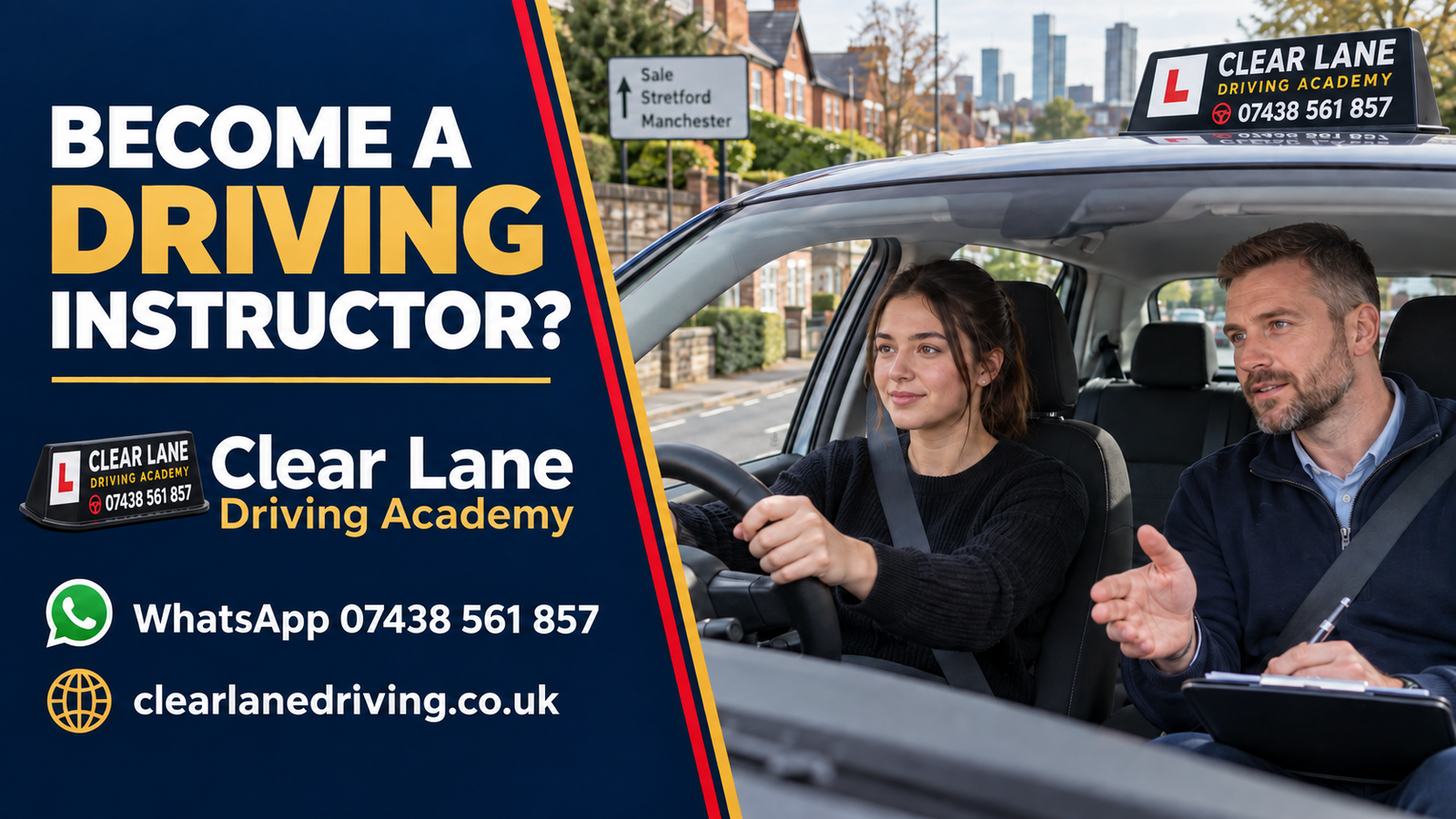
A driving instructor career change can look appealing when your current role has become repetitive, rigid or disconnected from people. You may want more control over your diary, work that feels useful, and the satisfaction of seeing someone grow from an anxious beginner into a safe, independent driver.
It is a worthwhile path for the right person, but it is not simply a case of enjoying driving and deciding to teach it. Becoming an Approved Driving Instructor (ADI) takes preparation, practical skill and a genuine ability to coach people with different needs. The strongest instructors are patient, organised and calm under pressure. They help learners make progress without making them feel rushed or judged.
Why people choose a driving instructor career change
Many career changers come from jobs where they already work closely with people: education, customer service, transport, management, care, retail or the emergency services. Others are looking for a role that can fit more comfortably around family life or personal commitments.
Driving instruction can offer flexibility, but the reality is more nuanced than simply choosing your own hours. Learners often need evening, weekend or daytime availability around college, work and childcare. A flexible diary works best when it is planned properly, with clear boundaries and enough room for administration, vehicle maintenance and professional development.
There is also a real sense of purpose in the job. Learners may arrive with very different starting points. One person may be a complete beginner; another may have had a difficult experience with a previous instructor or failed a practical test several times. Helping them understand a roundabout, manage nerves before a mock test, or build better observation habits can make a meaningful difference to their confidence and independence.
For people based in Greater Manchester, there is consistent demand for clear, professional driving tuition. The area also gives instructors valuable experience of different road environments, from busy urban junctions and multi-lane roundabouts to quieter residential routes and faster dual carriageways.
The ADI qualification route: what it involves
To work as a fully qualified driving instructor, you need to meet the DVSA eligibility requirements and pass the three-part ADI qualification process. Check the current rules before applying, as requirements and processes can change.
Part 1: theory and hazard perception
The first stage tests your knowledge of road rules, safe driving, teaching responsibilities and hazard perception. It rewards proper study rather than last-minute revision. If you have not taken a theory test for many years, allow time to become familiar with the format and refresh your knowledge of the Highway Code.
This stage matters because an instructor needs more than personal driving experience. You must be able to explain why a decision is safe, legal and appropriate, often in a way that makes sense to a nervous learner.
Part 2: advanced driving ability
Part 2 assesses your own driving to a high standard. This is where habits that have gone unnoticed for years can become obvious. Examiners look at planning, observation, control, judgement, awareness of hazards and the ability to drive safely in varied conditions.
Good training is not about memorising a route or performing for a test. It is about developing consistent driving routines that stand up to pressure. You will need to show that you can read the road early, position the car correctly and make safe, measured decisions.
Part 3: instructional ability
Part 3 is where the career becomes real. You are assessed on how effectively you give instruction and respond to a learner’s needs. The focus is coaching, not delivering a fixed script.
A learner who is struggling with clutch control needs a different approach from someone who can drive competently but loses focus at complex junctions. Strong instructors ask useful questions, encourage learners to reflect on their decisions and give timely, clear guidance when safety requires it. They do not overload people with information or take over every decision.
Some trainees choose to gain experience on a trainee licence while working towards qualification. This can be helpful, but it also brings responsibility. You still need the right support, proper lesson planning and honest awareness of where your coaching skills are developing.
Are you suited to teaching people to drive?
Being a confident driver is a starting point, not the full job description. Before committing to a driving instructor career change, consider how you respond when someone makes the same mistake repeatedly. Can you stay composed? Can you explain a skill in more than one way? Can you give feedback without damaging someone’s confidence?
The role also calls for judgement. At times, you will need to slow a learner down, revisit a basic skill or explain that they are not yet ready for a practical test. Honest advice may not always be what a learner hopes to hear, but it protects their safety, their money and their long-term progress.
Communication matters just as much as car control. Learners can be quiet, overconfident, frustrated, nervous or distracted by pressures outside the car. A professional instructor notices what is happening, adapts the lesson and keeps the atmosphere calm. You do not need to have all the answers instantly, but you do need to listen carefully and coach with care.
Understanding the practical and financial realities
A common reason for changing career is the prospect of more independence. Many instructors work on a self-employed basis, which can provide choice over working hours, pupils and the areas they cover. However, that independence comes with responsibility for income planning, tax, insurance, fuel, vehicle costs, lesson cancellations and finding a steady flow of pupils.
Income can vary significantly. It depends on your availability, local demand, running costs, the lessons you offer and how consistently you manage your diary. The early months can feel less predictable while you build experience and a reputation. A sensible plan includes savings or another source of income during training and the initial period after qualifying.
There are practical costs to consider too. These may include training, tests, a dual-controlled car, insurance, maintenance, fuel, advertising and professional memberships. You should also budget for time that is not directly paid lesson time: responding to enquiries, reviewing pupil progress, cleaning the vehicle and keeping records up to date.
None of this is a reason to avoid the profession. It is a reason to enter it with clear expectations. The instructors who build sustainable careers tend to treat their work as both a people-focused service and a well-managed business.
Choosing training that builds real confidence
The quality of your training shapes how prepared you feel when you begin teaching. Look for ADI training that explains the standard required at each stage, gives you regular feedback and helps you understand the reasons behind your development points.
A useful programme should cover more than passing Part 2 and Part 3. It should help you practise lesson planning, risk management, communication, fault analysis and client-centred learning. You should have opportunities to teach real skills progressively, from moving off and stopping through to independent driving, meeting traffic and dealing with complex road layouts.
It is reasonable to ask direct questions before enrolling. Find out how lessons are structured, what support is available between sessions, how progress is reviewed and what happens if you need extra work on a particular area. Clear Lane Driving Academy supports trainee instructors across Manchester with DVSA-focused Part 2 and Part 3 preparation built around calm, practical coaching.
Build experience without rushing the process
It can be tempting to focus only on qualifying quickly. Progress matters, but safe, confident teaching takes time to develop. Use your training to observe how different learners react, practise explaining the same topic in several ways and reflect honestly after each session.
Keep notes on what works. Perhaps a learner understands mirror checks after a simple question rather than a long explanation. Perhaps another needs a quieter road to build control before moving to busier traffic. These small observations become the foundation of your own teaching style.
If you plan to work around Manchester test centres, develop local road knowledge as part of your wider training, not as a substitute for it. Understanding the kinds of junctions, traffic flow and road conditions learners may meet near places such as Chadderton, Sale or West Didsbury can help you prepare lessons realistically. The aim is always to build adaptable drivers, not learners who only know one route.
A career built on calm, safe progress
Driving instruction suits people who want their work to have visible, human results. There will be demanding days, last-minute cancellations and learners who need more time than expected. There will also be the quiet wins: the nervous pupil who completes their first independent drive, the learner who finally understands a difficult manoeuvre, and the new driver who leaves knowing they can make safe decisions alone.
If that balance feels motivating, take the first step carefully. Check the current ADI requirements, assess your finances, choose training that values coaching over shortcuts and give yourself space to learn properly. A good instructor does more than help people pass a test. They help people learn smart, drive safe and carry confidence beyond test day.