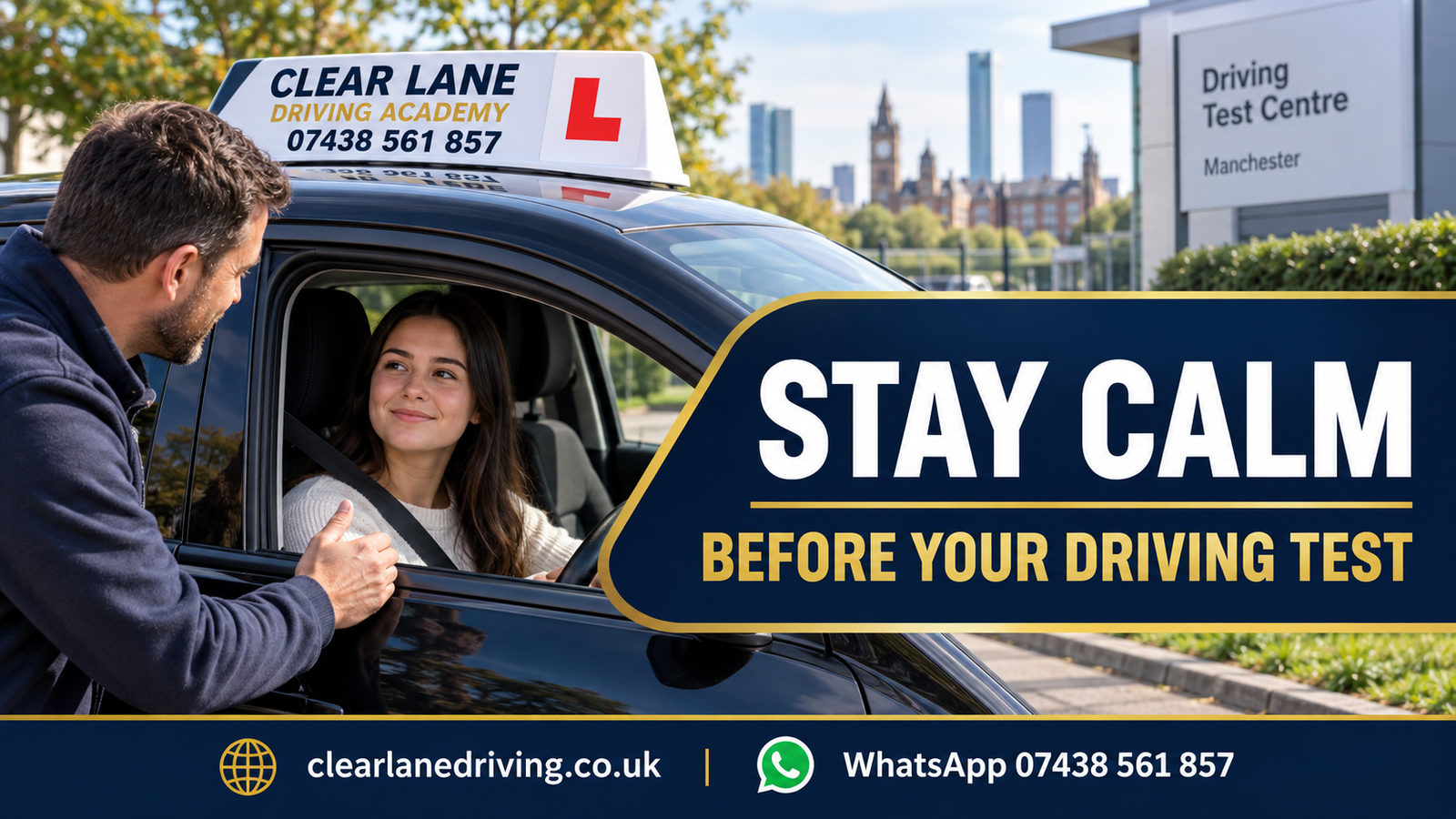
A busy roundabout, an unfamiliar road or a driving examiner sitting beside you can make even a well-prepared learner feel tense. The best ways to stay calm driving are not about pretending nerves do not exist. They are about using simple routines that help you think clearly, make safe decisions and recover when something does not go exactly to plan.
Nerves are a normal response to doing something that matters. A little alertness can even help you focus. The goal is to stop that alertness turning into rushing, overthinking or freezing at the wheel.
Why anxiety affects your driving
When you feel under pressure, your body may speed up before your thoughts do. Your breathing becomes shallow, your hands grip the steering wheel too tightly, and you may start looking only a few metres ahead. That can lead to late braking, missed signs or hesitation where a clear decision is needed.
The answer is not to drive faster to get the difficult part over with. It is to slow your thinking down. Safe driving is built on observation, planning and control. If you can return to those three things, you give yourself a practical way through almost any moment of nerves.
Best ways to stay calm driving: start before the engine does
A calm drive usually begins before you set off. Give yourself enough time to arrive without rushing, whether you are meeting your instructor for a lesson or travelling to a practical test. Being late can make a manageable level of nerves feel much bigger.
Before getting in the car, take a minute to settle your breathing. Breathe in gently through your nose, then let the out-breath last a little longer. Repeat this a few times. You do not need an elaborate technique. The point is to tell your body that there is no immediate danger and give your mind a moment to focus.
It also helps to avoid loading test day with too much stimulation. A strong coffee may be fine if it is part of your usual routine, but several caffeinated drinks can make shaking, racing thoughts and a fast heartbeat worse. Choose a light meal, comfortable clothing and shoes that allow you to feel the pedals properly.
Once you are seated, use a familiar cockpit routine. Adjust your seat, mirrors and steering position carefully. Check the doors, seatbelt and controls. These small actions are useful because they are within your control. They also bring your attention back to the task in front of you rather than the result you are worrying about.
Break the drive into small decisions
Thinking, “I have to drive perfectly for 40 minutes,” is enough to make anyone tense. Instead, deal with the road in short sections. Your only job might be to move off safely, approach the next junction, read the road ahead or position correctly for the next turn.
Try using a quiet commentary in your head: “Mirrors, signal, position, speed, look.” This is not about reciting a script. It is a way of keeping your attention on the information that matters. As you approach a roundabout, for example, focus first on speed and observations. You do not have to solve the whole route at once.
Looking well ahead is especially helpful when you feel nervous. Scan for traffic lights, pedestrian crossings, parked vehicles, road markings and developing hazards early. The earlier you spot a situation, the more time you have to respond smoothly. Calm driving often looks like unhurried driving because the planning happened sooner.
Loosen your grip and use your breathing at the wheel
Physical tension can quietly affect your control of the car. Check your shoulders at regular intervals. If they are raised, drop them. If your hands are clamped around the wheel, soften your grip while keeping full control. Holding the wheel correctly does not mean squeezing it as tightly as possible.
At a red light or when safely waiting in traffic, take one slower breath. There is no need to close your eyes or switch off from the road. Simply breathe out fully, relax your jaw and prepare for what comes next. These short resets are particularly useful on intensive courses, when you are processing a lot of new information in a shorter period.
If your mind starts racing, give it a useful instruction: “Take time, look, then act.” It reminds you that a safe, well-timed decision is better than a hurried one. Other road users may be impatient, but their impatience does not decide your actions.
Give yourself permission to make a mistake
One minor error does not automatically mean a failed test, and it certainly does not mean you are a bad driver. Learners often become more unsettled after a stall, a missed turn or an awkward gear change because they start replaying it in their head. That distraction can create a second mistake.
Use a simple reset instead. If you stall, secure the car if needed, restart calmly and move on when it is safe. If you take a wrong turn, continue safely and listen for the next direction. During a practical test, the examiner is assessing how safely you drive, not whether you know every street.
The same applies in lessons. Mistakes are valuable when you understand why they happened and practise a better response. A patient instructor should help you identify the cause without making you feel rushed or judged. Confidence grows from evidence: you have faced a situation before, learned from it and handled it more effectively next time.
Practise the situations that make you nervous
General driving practice helps, but targeted practice helps more when a particular situation is causing anxiety. You may be comfortable on quieter roads but worry about multi-lane roundabouts, hill starts, dual carriageways or meeting traffic on narrow residential streets. Tell your instructor clearly which situations make you tense.
A structured approach can make difficult areas feel predictable. Start with an explanation and a demonstration where appropriate. Then practise the skill on a quieter route before gradually adding traffic, time pressure and unfamiliar roads. Repetition matters, but so does reflection after each attempt.
For Manchester learners, practising around the type of roads you may meet near your chosen test centre can be reassuring. Test-route preparation should not be about memorising turns. It is about getting used to reading busy junctions, varying speed limits and changing road layouts with the same calm routine wherever you are.
Mock driving tests can also help if the official test environment is your main concern. They reveal whether your nerves affect observations, speed control or decision-making, while giving you time to work on those areas before test day. Treat feedback as a plan for the next lesson, not a verdict on your ability.
Keep your self-talk realistic
Avoid telling yourself that you must not feel nervous. That creates another thing to worry about. A more helpful thought is, “I feel nervous because I care, and I can still drive safely.”
Replace broad statements such as “I always get roundabouts wrong” with something specific you can act on: “I need to reduce my speed earlier and look for the lane signs sooner.” Specific language turns worry into a driving plan.
It is also worth remembering that a test is not a performance for an audience. You are showing that you can make safe, independent decisions. You do not need to impress anyone with perfect gear changes or an overly confident manner. Steady, observant and controlled is exactly what you are aiming for.
Build calm into every lesson
Confidence is rarely created by one good drive. It comes from regular practice, clear goals and honest feedback. At the start of each lesson, agree on one or two priorities. At the end, talk through what improved, what still needs work and how you will practise it next time.
If anxiety is repeatedly stopping your progress, say so early. The right pace depends on the learner. Some people benefit from shorter, regular sessions; others prefer longer lessons once they have the basics in place. A fast-track course can work well when it is structured around your current ability and gives you time to reflect, rather than simply adding more hours.
Clear Lane Driving Academy encourages learners to focus on progress, not pressure. Calm preparation does not remove every nervous feeling, but it gives you the tools to stay present when the road becomes demanding.
The next time you feel tension building, do not judge it. Check your breathing, look further ahead and return to the next safe decision. One calm, well-planned action is always enough to begin with.