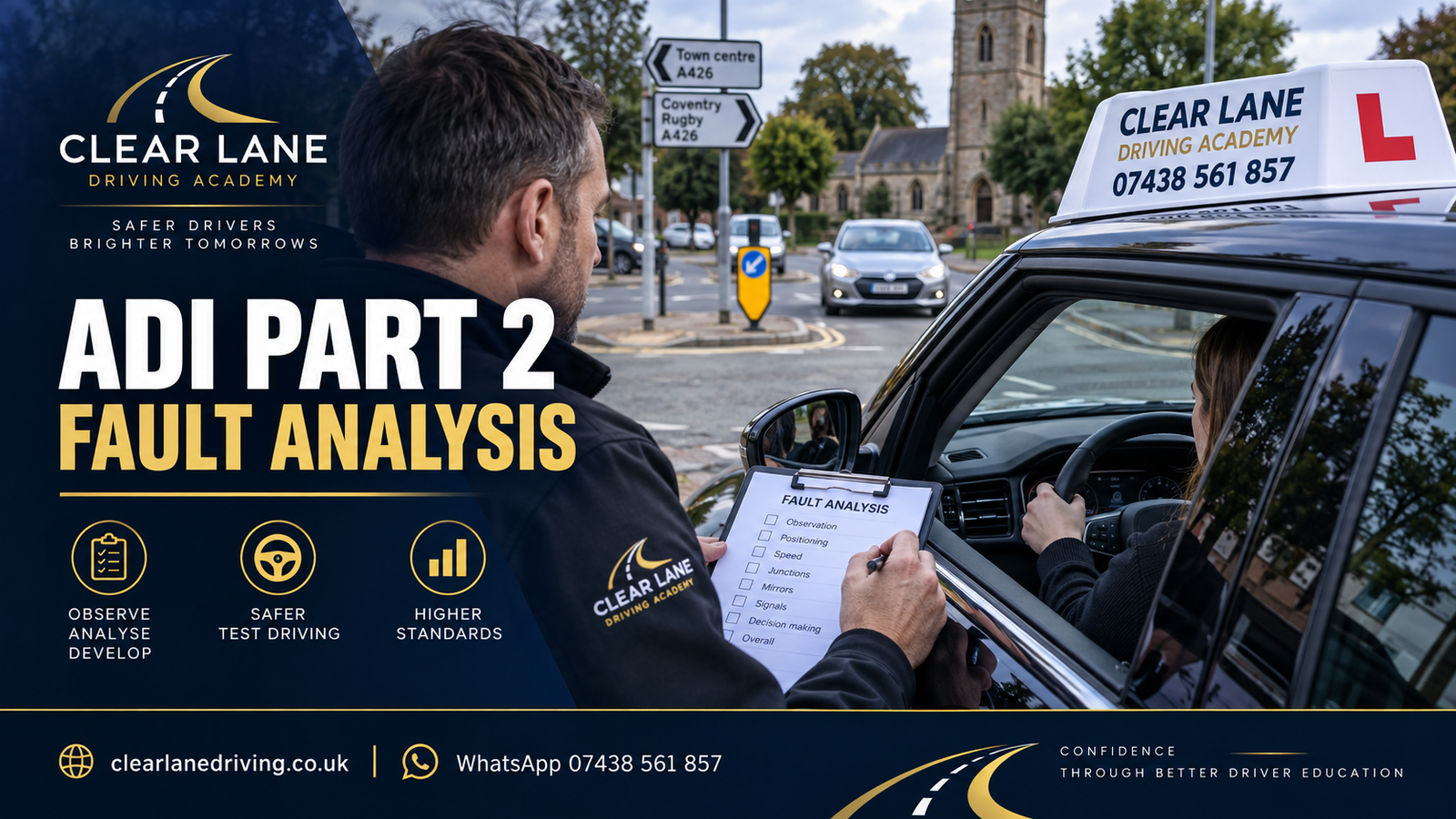
An ADI Part 2 driving test is not won by trying to be perfect. It is passed by showing that your driving is consistently safe, controlled and well judged. Good ADI part 2 fault analysis helps you move beyond simply hearing that something went wrong. It shows you why it happened, what risk it created and what to practise so the improvement lasts.
For trainee instructors, this matters twice. You need to drive to a high standard on assessment, but you also need the awareness to understand driving faults properly. That awareness becomes the foundation for the coaching skills you will use during ADI Part 3 and throughout your career.
What ADI Part 2 fault analysis really means
Fault analysis is the process of looking at a driving error in context. Rather than labelling every issue as a mistake, ask four useful questions: what happened, why did it happen, was anyone affected, and what would have made it safer?
For example, approaching a roundabout too quickly may begin with a late observation. The late observation then leaves less time to read the road, choose a suitable gap and adjust speed. If the candidate brakes sharply but no one is affected, the examiner may view it differently from a situation where another road user has to brake or change direction. The action can look similar, but the risk is not.
This is why counting faults alone is not an effective preparation method. A candidate can make a small error and recover safely. Equally, one poor decision at a busy junction can be serious because of the danger or potential danger it creates.
The difference between driving, serious and dangerous faults
Examiners consider the standard of driving throughout the test. A driving fault is usually an error that does not create danger or serious risk, although repeated faults in the same area can show a developing problem.
A serious fault is one that creates danger or potential danger, or where the standard falls well below what is expected. A dangerous fault is one where actual danger has been caused. The precise decision always depends on the circumstances, including traffic, road layout, speed and the actions of other road users.
The most useful mindset is not, “Can I get away with that?” It is, “Was that decision safe, legal, considerate and appropriate for what was happening around me?” That is the standard you should build into every practice drive.
The common patterns behind ADI Part 2 faults
Many faults do not happen because a trainee lacks vehicle control. They happen because one part of the driving routine is rushed, assumed or missed under pressure. Once you can see the pattern, targeted practice becomes much more productive.
Observation faults often start before the manoeuvre
Missed mirror checks, weak shoulder checks when moving off, or a late look at a junction are rarely isolated problems. They often show that the driver is focusing on the next action before gathering enough information.
When pulling away, for instance, a full observation routine must match the situation. Moving off uphill, from behind a parked vehicle, near a pedestrian crossing or into a cycle lane each brings different risks. A routine should never become a performance. The check must be meaningful, timely and linked to the road environment.
At junctions and roundabouts, look early enough to plan. Read signs, lane markings, traffic flow and the position of vulnerable road users before you reach the point where a decision is needed. Late observations tend to lead to late braking, poor road position or hesitation.
Speed faults are often planning faults
Exceeding a speed limit is an obvious concern, but ADI Part 2 fault analysis should also consider speed that is legal but unsuitable. A narrow residential road with parked cars, poor visibility or pedestrians nearby may call for a lower speed than the posted limit.
The same principle applies on approach to hazards. If you need harsh braking because you saw a developing situation too late, the root cause may be forward planning rather than braking technique. Aim to identify hazards early, ease off the accelerator where appropriate and arrive at decisions with time in hand.
Driving too slowly can also become a fault when it holds up traffic unnecessarily or suggests uncertainty. There is a balance. You do not need to rush, but you should make reasonable progress when the road, conditions and speed limit allow it.
Positioning and lane discipline reveal how well you read the road
Poor positioning can occur on bends, at junctions, on approach to roundabouts and when passing parked vehicles. Sometimes it is caused by looking too close to the bonnet. Sometimes it comes from choosing a lane too late or following another vehicle without checking signs and road markings for yourself.
Practise looking well ahead and using the road information available. On multi-lane approaches, decide early, confirm your lane choice and keep the vehicle positioned accurately. If you are unsure, do not make a sudden last-second move. Continue safely and allow the route to develop.
Examiners are not looking for a rehearsed route. They are looking for safe, independent decisions. This is especially relevant when practising around unfamiliar Manchester test areas, where lane layouts and busy traffic can quickly expose late planning.
Hesitation needs context, not criticism
Hesitation is often misunderstood. Waiting for a genuinely safe gap is good judgement. Pulling out when you are not certain is never the answer.
However, repeated unnecessary waiting when safe opportunities are available can affect other road users and may show weak assessment of gaps. The solution is not to force quicker decisions. It is to practise judging approaching speed, distance and the space needed to join traffic safely.
A calm instructor will help you separate caution from indecision. That distinction matters because confidence should come from better information and better judgement, not from taking risks.
How to review a practice drive properly
A useful debrief should be specific, fair and practical. “Watch your mirrors” is too broad to guide your next attempt. “Check the interior mirror before easing off for the pedestrian crossing, then assess the road behind before braking” gives you a clear action linked to a real situation.
After a practice drive, choose the faults that had the greatest safety impact or appeared more than once. Discuss what you noticed at the time, what you missed, and whether your decision changed the actions of another road user. Then repeat a similar situation while it is still fresh.
Keeping a short fault record can help, particularly in the final stages of preparation. Record the driving category, the trigger, the consequence and one correction. For example: “Approach to right-turn junction – noticed oncoming traffic late – stopped position was rushed – scan further ahead before selecting gear and position.” This turns feedback into a practical plan rather than a vague concern.
Do not fill a notebook with every minor imperfection. Too much information can make you overthink. Focus on patterns: perhaps your observations weaken after a busy roundabout, your speed control changes on downhill roads, or your clutch control becomes less accurate when you feel watched.
Build pressure into your ADI Part 2 preparation
A good test drive should feel familiar, not easy. Include varied road types, busy and quieter periods, roundabouts, country roads where appropriate, dual carriageways and independent driving. You cannot predict every situation, but you can prepare to apply the same safe process in each one.
Mock tests are useful when they are followed by constructive analysis. Treat the result as information, not a verdict on your ability. If a serious issue appears, recreate the type of situation with coaching and time to reflect. Repeating the full mock test without fixing the underlying cause can simply repeat the same fault.
It also helps to practise recovery. Everyone makes small errors. If you take a wrong lane, miss a turning or stall, remain calm, secure the vehicle and make the next safe decision. Trying to correct an error suddenly is often more serious than the original mistake.
The standard to aim for on test day
Your aim is not to impress an examiner with exaggerated routines or overly cautious driving. Drive naturally, make observations that fit the situation, use the controls smoothly and give yourself time to plan. A composed drive usually comes from preparation, not luck.
At Clear Lane Driving Academy, ADI Part 2 training focuses on this structured approach: identifying the real cause of a fault, practising the correction safely and building confidence through consistent feedback. The goal is to help you become the kind of driver – and future instructor – who can explain safe decisions clearly.
When a fault happens in practice, do not let it become a label. Treat it as evidence. Understand the situation, improve the process and let every well-handled drive strengthen the calm judgement you will rely on long after the assessment.