A practical driving test can be over before your nerves have had time to settle, so the last thing you need is a problem at reception. If you are asking what to bring for a driving test, start with the one item that matters most: your valid provisional driving licence. Everything else is about making sure you, your car and your plans are ready for a calm start.
Most test-day issues are avoidable. A quick check the evening before gives you space to focus on driving safely, responding to what you see and making sensible decisions – rather than worrying about paperwork or a warning light on the dashboard.
What to bring to your driving test
Bring your UK photocard provisional driving licence. The examiner needs to see it before the test can begin. Check that it is the physical photocard, not simply a photo of it on your mobile phone, and make sure you have not accidentally left it in another bag, wallet or coat.
If you still hold an older-style paper driving licence, you will usually need to bring your passport as photographic identification too. If your licence has been lost, damaged or is out of date, do not assume the test can go ahead. Deal with this as early as possible rather than waiting until test day.
It is also sensible to have your driving test booking confirmation available on your mobile phone or printed out. You may not always be asked for it, but it confirms your appointment time, test centre and reference details if there is any confusion. Check the location carefully as Greater Manchester has several test centres, and turning up at Chadderton when your booking is at Cheetham Hill is a stressful mistake with no easy fix.
If you need glasses or contact lenses to meet the legal eyesight standard, bring them and wear them from the moment you arrive. The examiner will ask you to read a number plate from 20 metres for a new-style plate or 20.5 metres for an old-style plate. If you cannot read it, the test cannot continue.
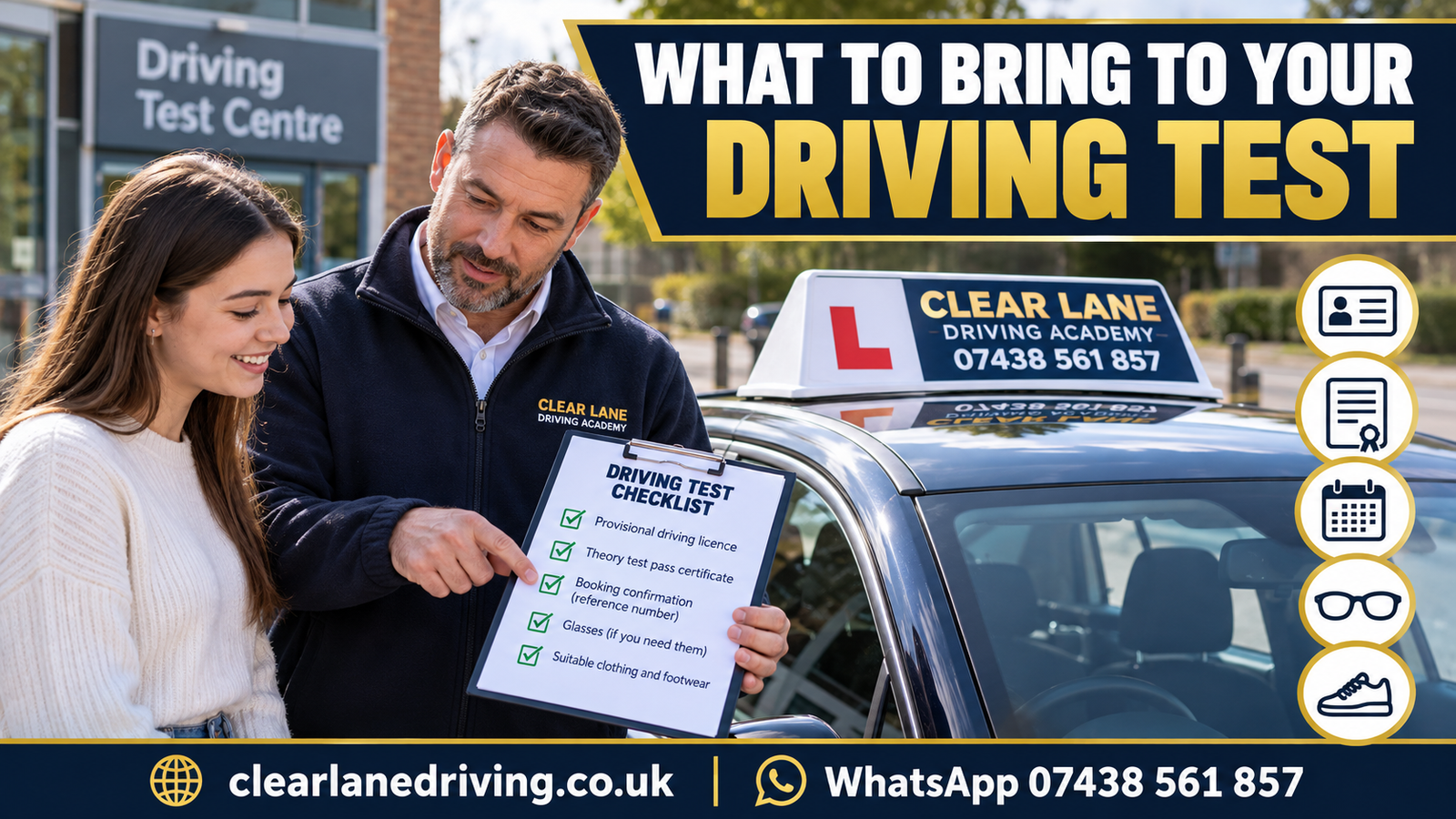
Your essential test-day checklist is:
- Your valid photocard provisional driving licence
- Your glasses or contact lenses, if you need them for driving
- Your test booking confirmation or reference number
- A suitable, legal and roadworthy car, if you are using your own
- Any medication you genuinely need during the appointment
- Water and a light snack for before the test, especially if you have travelled or had a lesson first
You do not need to bring your theory test pass certificate. The result is recorded electronically. You also do not need to bring piles of documents “just in case”. Keep things simple, organised and easy to find.
If you are taking your own car
Using your instructor’s car can remove a lot of practical pressure, because it is usually already prepared for the test. If you are taking your own car, though, it is your responsibility to make sure it meets the required standard. The examiner can refuse to use a vehicle that is unsuitable or unsafe.
The car must be insured for you to drive and have valid tax and MOT where required. It should be roadworthy, with tyres in good condition, working lights, a clear windscreen and enough fuel for the journey and the test. Make time to check the basics the day before, not in the car park five minutes before your appointment.
It must display L plates on the front and rear. It also needs an additional interior rear-view mirror for the examiner, a functioning passenger seat belt and a suitable passenger head restraint. The examiner needs a clear view and a safe seating position throughout the drive.
Avoid taking a car with a warning light showing, obvious body damage that could affect safety, a heavily tinted windscreen or windows, or a fault you have been hoping will disappear. A car may feel familiar, but familiarity does not make it test-ready. If there is any doubt about its condition, ask your instructor for honest advice before the day.
Manual or automatic matters
Take the test in the type of car you intend to be licensed to drive. Passing in a manual car gives you a full licence for manual and automatic vehicles. Passing in an automatic car gives you an automatic-only licence.
This is not about one being better than the other. The right choice depends on where you are in your learning, how consistently you manage the car and what will help you drive safely with confidence. Changing vehicle type immediately before a test can add unnecessary pressure unless it has been planned properly as part of your training.
What to prepare, rather than pack
The most useful things for a driving test are often not items you put in a bag. They are small pieces of preparation that keep your attention where it belongs.
Plan to arrive around 10 to 15 minutes early. That gives you time to park safely, use the toilet, have a drink and settle without sitting outside for an hour building up anxiety. If you are meeting your instructor first, confirm the collection time and test centre the day before.
Wear comfortable clothing and practical footwear. You should be able to operate the pedals accurately and move your feet freely. Very thick soles, loose flip-flops or unfamiliar shoes can make clutch control and pedal pressure less predictable. This is not the day to try footwear you have never driven in before.
Have your mobile phone charged for travel arrangements, but switch it off or silence it before the test begins. You will not need to use it while driving. Set navigation aside too: the examiner will give you directions, and during an independent driving section you may be asked to follow signs or a sat nav provided for the test.
Try not to fill the final hour with last-minute online advice. One video may tell you to exaggerate mirror checks; another may make a routine manoeuvre sound impossibly complicated. Your instructor’s feedback and the skills you have practised are more useful than panic revision. Drive as you have been taught: observe properly, plan ahead and make progress when it is safe.
A calm approach to the start of the test
Before the drive, the examiner will check your eyesight and ask you a “tell me” vehicle safety question. You may also be asked a “show me” question while driving. These are not trick questions. They are there to check that you understand basic vehicle safety and can use controls without losing focus on the road.
If you do not hear an instruction, ask for it to be repeated. If you take a wrong turn, keep calm and follow the road safely. Going the wrong way is not, by itself, a driving fault. What matters is how you deal with the situation: correct observations, appropriate speed, safe positioning and controlled decisions.
The same applies if you make a small mistake. A stall, an imperfect gear change or needing a moment to reset does not automatically mean you have failed. Do not let one moment decide the rest of the drive in your mind. Secure the car, breathe, assess what is happening and continue when it is safe.
When test-day car hire is the better option
If you have learned in an instructor’s vehicle, using that same car for the test often makes sense. You already know the clutch or automatic response, the mirror positions, the controls and the reference points you have practised. It also means a professional can check the vehicle is ready before you arrive at the test centre.
For learners using Clear Lane Driving Academy’s test-day car hire, that preparation should form part of a clear plan, not a last-minute substitute for practice. A short warm-up drive before the test can help you settle into the car and identify anything you need to focus on, whether that is approaching roundabouts, meeting traffic or keeping a steady pace on unfamiliar roads.
Bring the essentials, prepare the car properly and leave enough time to arrive without rushing. Then give yourself permission to drive the next road, the next junction and the next decision well. Learn smart. Drive safe. Pass with Clear Lane.