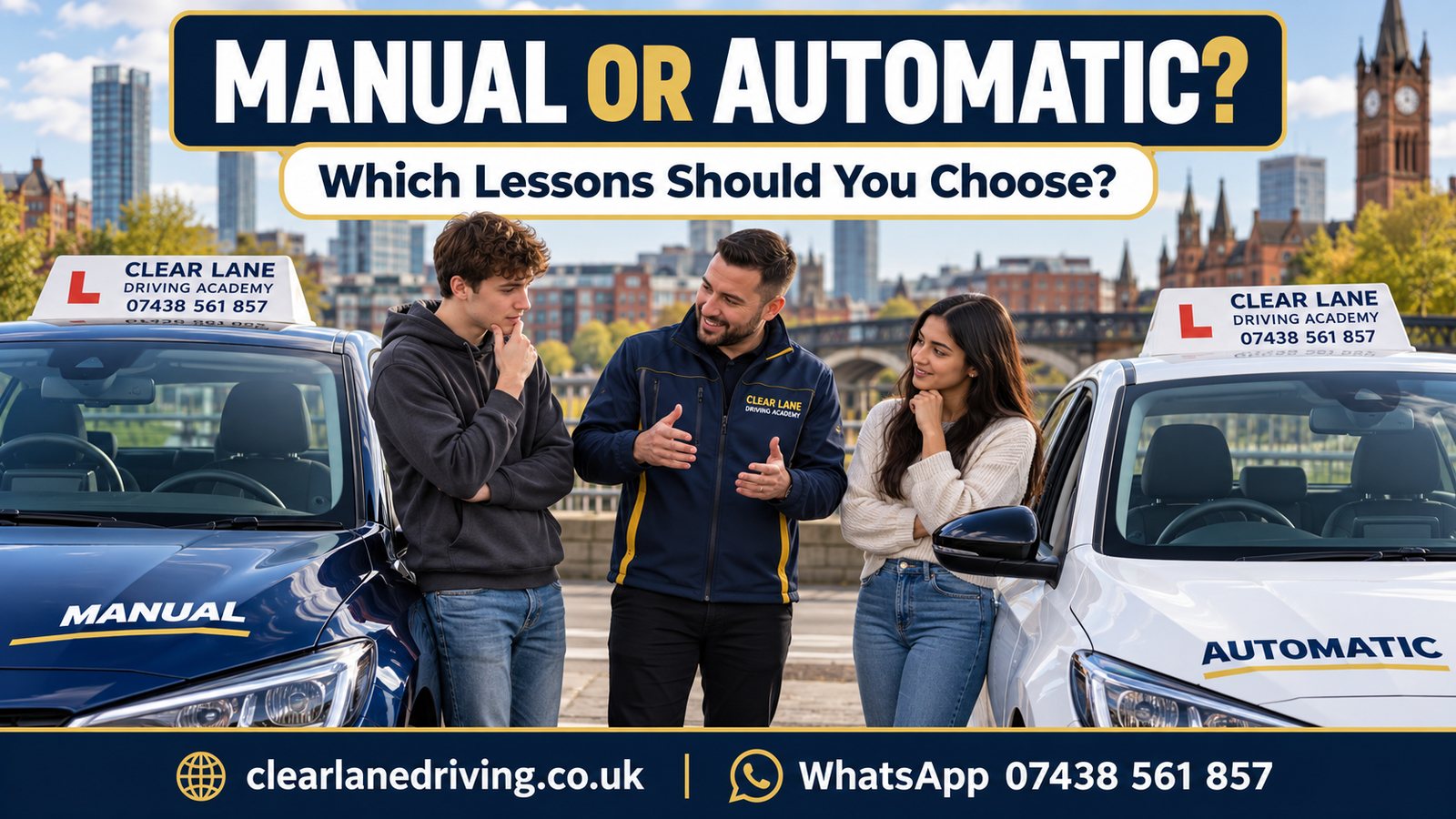
Manual or Automatic Lessons: Which Should You Choose in 2026?
Choosing between manual and automatic driving lessons is one of the first real decisions you will make as a learner driver — and it matters more than most people expect. It is not simply about gears. It shapes how quickly you build confidence, how much mental effort each lesson demands, and what kind of licence you hold when you finally pass.
At Clear Lane Driving Academy, based in Oldham and serving learners across Greater Manchester, we are asked this question every single week. There is no one-size-fits-all answer — but there is almost always a right answer for you. This guide will help you find it.
—
What Is the Real Difference Between Manual and Automatic Lessons?
The mechanical difference is straightforward. In a manual car, you operate a clutch pedal, change gears yourself, and manage tasks like moving off smoothly, controlling the bite point on a hill, and avoiding stalling. In an automatic car, the gearbox handles all of that for you. You focus entirely on steering, speed, observation, and decision-making.
What surprises many learners is how differently these two experiences feel in practice — especially in the early weeks of learning.
In manual lessons, you are coordinating several physical tasks simultaneously while also trying to check mirrors, read junctions, manage speed, and anticipate other road users. For some learners, that challenge is motivating. For others, it is genuinely overwhelming, and it slows progress in ways that can knock confidence.
In automatic lessons, the removal of clutch and gear tasks gives you more mental space to focus on the road. Many learners settle into real traffic earlier, feel calmer at busy junctions, and find the whole experience less stressful from the start.
Neither option is easier in the sense of requiring less skill. Safe, test-standard driving demands strong observation, hazard awareness, positioning, and judgement — in both car types. The difference is simply where your attention goes during the early stages of learning.
—
Why Many Learners Still Choose Manual Lessons in Manchester
Manual driving lessons in Manchester remain the most popular choice, and there are solid reasons for that.
The most significant benefit is licence flexibility. When you pass your test in a manual car, you are legally permitted to drive both manual and automatic vehicles. If you pass in an automatic, you receive a Category B automatic restriction (code 78 on your licence), which means you cannot legally drive a manual car without sitting a further test.
For many Manchester learners, that flexibility matters. You might be sharing a family car, borrowing a friend’s vehicle, looking at a wider range of used cars to buy, or planning a career that involves driving — such as delivery, care work, or transport. In those situations, a full, unrestricted licence is genuinely valuable.
Manual lessons may suit you if:
- You want the broadest licence option with no restrictions
- You enjoy a hands-on, technical style of learning
- You are comfortable repeating skills over several sessions until they click
- You have a flexible timeline and are not under pressure to pass quickly
- You expect to borrow or drive different vehicles in future
That said, the first phase of manual learning does ask more of you. Clutch control, gear selection, hill starts, and smooth moving-off all take time to feel natural. If early struggles with stalling dent your confidence, it is worth having an honest conversation with your instructor about whether the pace of learning is working for you.
—
Why Automatic Lessons Are Growing in Popularity Across the UK
The trend is clear. In 2012, there were around 550,000 drivers in the UK holding automatic-only licences. By 2022, that figure had more than doubled to over 1.1 million — and it continues to rise. The growth of electric vehicles (which are always automatic by design) is accelerating this shift further. Many major manufacturers have already stopped producing manual versions of popular models.
For learners, this context is worth knowing. The driving landscape is changing, and choosing automatic is increasingly a practical and future-facing decision.
Automatic driving lessons in Manchester are a particularly strong option for learners who want to reduce pressure and build genuine confidence from the start. Without clutch control and gear selection competing for your attention, many pupils find they can:
- Settle into busy Manchester traffic earlier in their training
- Focus on mirror-signal-manoeuvre routines more consistently
- Absorb hazard perception and road positioning with greater clarity
- Feel less mentally exhausted after each lesson
Automatic lessons may suit you if:
- You are a nervous beginner or returning to learning after a gap
- You want to pass within a set timeframe — for work, family, or a move
- You plan to drive an automatic or electric car after passing
- You find manual coordination consistently difficult or overwhelming
- You want to reduce overall stress during the learning process
The one limitation to be aware of is the licence restriction. If you later decide you want to drive a manual car, you will need to take an additional test. For many learners, though, this simply does not affect their day-to-day driving life — and that is a perfectly valid position.
—
Manual or Automatic for Nervous Drivers: An Honest Answer
If the idea of driving makes you anxious, this is where honesty matters most. Many nervous learners assume they should choose manual because it seems more complete — more traditional. But if the added coordination leaves you flustered at junctions or stuck in survival mode, it can slow progress significantly.
Automatic lessons often give nervous drivers far more breathing room. You are still learning mirror checks, lane discipline, roundabouts, junctions, and manoeuvres — none of that disappears. But you are not also managing stall risk in heavy Manchester traffic while trying to stay in the correct lane approaching a busy roundabout.
That said, some nervous learners make excellent progress in manual once they are given enough time, a calm instructor, and a lesson structure that builds skills step by step. Anxiety often comes from unfamiliarity rather than inability. The right instructor makes a bigger difference than the car type in many cases.
If you are unsure, get in touch with our team for an honest assessment before you book. We will not push you toward one option for the sake of it.
—
Cost and Value: What to Think About Beyond the Hourly Rate
Many learners compare lesson prices first, which is understandable. In 2026, the average cost of a one-hour manual lesson in the UK sits between £36 and £40, according to DVSA instructor data. Automatic lessons typically run £2 to £6 more per hour, largely because automatic instructor cars are more expensive to purchase and insure, and availability remains tighter in some areas.
Over a full course of lessons, that difference might amount to £90 to £270 — but here is the more important question: how many hours will you actually need?
If you pick up clutch control quickly and make steady progress in manual, the broader licence may offer excellent overall value. But if you spend several extra lessons repeating gear-related errors, the total cost can exceed what automatic training would have required. Automatic lessons are not always cheaper upfront, but for learners who progress faster without the mechanical workload, the overall learning cost can be lower.
This is why we always look at your confidence, your goals, and your progress together — not just the hourly rate.
—
Manual or Automatic for Intensive Courses?
If you are considering a fast-track approach, the choice between manual and automatic becomes especially practical. Our intensive crash courses in Manchester are designed to get learners to test standard efficiently — but intensive learning works best when each session builds cleanly on the last, without unnecessary overload.
For many intensive learners, automatic is a strong fit. Without the added coordination of clutch and gears, you can cover more ground in terms of road skills, manoeuvres, test routes, and independent driving within a concentrated period. That does not mean everyone should choose automatic for an intensive course — but it is worth being honest about your timeline and how much mental demand you are comfortable handling in a short burst.
Manual intensive courses absolutely work too. If you are committed, motivated, and able to absorb a high volume of practice quickly, a manual intensive can be highly effective. But the early hours do ask more of you, so your resilience and focus matter.
—
Thinking About Your Future Life on the Road
One of the clearest ways to approach this decision is to picture your driving life after you pass. Ask yourself:
- What car will you most likely drive? If you already own or plan to buy an automatic or electric vehicle, an automatic licence is entirely sufficient.
- Will you need to drive other people’s cars? If you expect to borrow vehicles frequently, a full manual licence gives you more options.
- Do you have a career that involves driving? Some roles — particularly in logistics, care, or fleet driving — may still favour a full unrestricted licence.
- How quickly do you need to pass? If you are working to a deadline, the option that gets you there most confidently is the right one.
In Manchester, where everyday driving means stop-start city traffic, complex roundabouts, bus lanes, and tram crossings, some learners genuinely appreciate the simplicity that automatic brings. Others are happy to take on manual because they want the broader licence and do not mind the steeper early learning curve. Both are valid choices — what matters is that yours fits your real situation.
—
Test Day: Does the Car Type Affect Your Chances?
The driving test itself is identical in terms of what is assessed: your ability to drive safely, respond to hazards, follow instructions, and handle manoeuvres correctly. The examiner does not mark you differently based on whether you are in a manual or automatic car.
What does differ is where your mental energy goes on test day. In a manual car, even experienced learners can feel extra pressure around hill starts, gear changes at speed, or recovering from a stall. In an automatic, those specific stressors do not exist — which can leave you more capacity to focus on observation, positioning, and calm decision-making.
This does not mean automatic learners always have higher pass rates — but reducing unnecessary stressors on test day is never a bad thing.
When you are ready, you can also book our test day car hire in Manchester so you take your test in a familiar, well-maintained vehicle you already know — whether that is manual or automatic.
—
Frequently Asked Questions
Can I switch from automatic to manual lessons part-way through? Yes, though it is worth thinking carefully before doing so. Switching means learning clutch control, gears, and smooth moving-off from scratch, which adds time and cost. If you are thinking of switching, speak to your instructor first about whether it makes sense at your current stage.
Is an automatic licence a problem for future employers? For most jobs, no. Where it can be a consideration is in roles that specifically require driving a manual vehicle — some logistics, emergency services, or fleet-based roles may specify this. If you have a specific career in mind, it is worth checking in advance.
Are automatic lessons harder to book in Manchester? Automatic instructors can be less widely available than manual instructors in some areas. At Clear Lane Driving Academy, we offer both and can usually match learners with an available instructor quickly. Contact us to check current availability.
Will I need more lessons in manual than automatic? It varies by learner. Some people pick up clutch control naturally and need no more hours in manual than they would in automatic. Others find the coordination genuinely challenging and would progress faster in an automatic. There is no universal answer, but your instructor should be honest with you about how your progress is going.
Do I need to tell my insurance provider which type of car I learnt in? Once you pass, your licence type does matter for insurance purposes — particularly if you hold an automatic-only licence and attempt to drive a manual car, which would be illegal and could void your cover. Make sure your insurer knows your licence category.
What about electric cars — are they automatic? Yes. All electric vehicles are automatic. As EVs become more common on UK roads and in driving schools, the practical case for learning in an automatic is growing steadily. If you plan to drive an EV, an automatic licence is perfectly suited.
—
The Right Choice Is the One That Moves You Forward
Some learners spend a long time worrying about making the wrong decision here. In reality, both choices can lead you to a full driving licence, genuine confidence, and safe independent driving. What matters is picking the route that fits your pace, your confidence, and your real driving goals.
A learner who chooses manual and struggles repeatedly is not failing — they may simply need a more structured lesson plan, a calmer environment, or occasionally a switch to automatic. A learner who chooses automatic and passes efficiently has made a smart, valid choice that works for their life.
At Clear Lane Driving Academy, we offer manual driving lessons, automatic driving lessons, intensive crash courses, and test day car hire — all delivered by qualified, patient ADI instructors who understand what it takes to build real confidence on Manchester roads. We also offer ADI Part 2 and Part 3 training for those looking to qualify as driving instructors.
If you are still not sure which path is right for you, the best starting point is a conversation — not a guess. Get in touch today and we will give you honest, straightforward guidance based on your situation, your goals, and what will genuinely help you progress.
—
Clear Lane Driving Academy serves learners across Oldham, Manchester, and the wider Greater Manchester area. All instructors are DVSA-approved ADIs.
If you’re based in Oldham or Manchester, Clear Lane offers automatic driving lessons at the same price as manual — no hidden premium for choosing an automatic car.