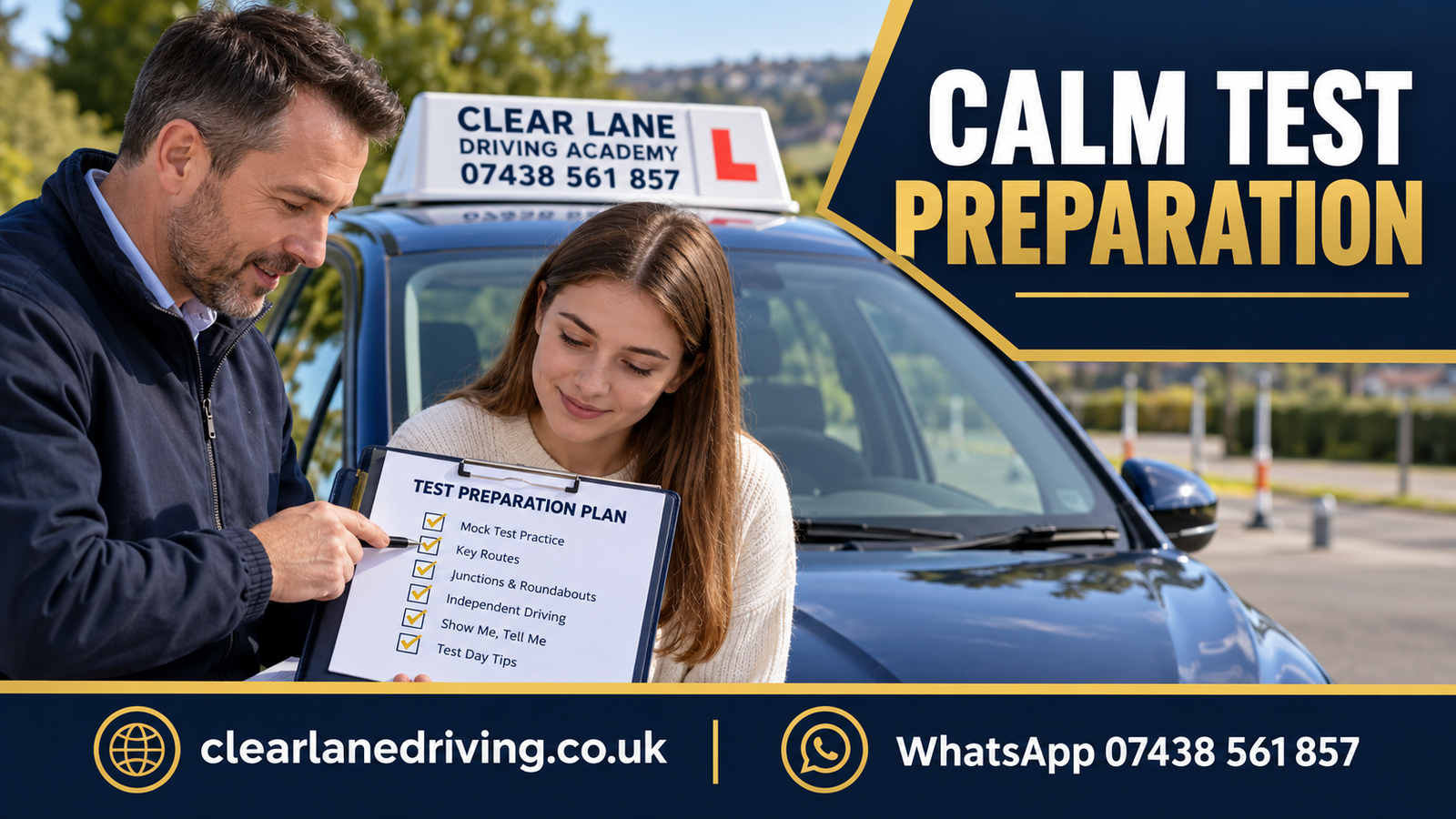
A practical test is not won by trying to impress the examiner with perfect driving. It is passed by showing safe, consistent decisions across an ordinary drive – including when something unexpected happens. This learner driver test preparation guide is designed to help you replace last-minute panic with a clear plan, whether you are taking your first test or returning after a previous disappointment.
The goal is not to become a different driver on test day. It is to make your safest, most settled driving the version that appears when it matters.
Start with an honest test-readiness check
Being able to drive independently on familiar roads is encouraging, but test readiness asks for more. You need to manage different road layouts, changing traffic conditions and directions from the sat nav or examiner without losing your routine.
A useful question is this: if your instructor stayed quiet for 20 minutes, would you still drive safely and make sensible progress? That means choosing suitable gaps, checking mirrors before changing speed or direction, responding to signs early and staying composed if you take a wrong turn.
Do not book extra practice simply to fill time. Identify the parts of driving that still need attention. For one learner, that may be emerging at busy junctions. For another, it may be planning ahead in a multi-lane system, parking accurately, or keeping appropriate speed on unfamiliar roads. Focused lessons usually build more confidence than repeating the parts you already enjoy.
If you are unsure, ask for a straightforward assessment and a mock test. Honest feedback can feel challenging, especially close to a test date, but it gives you the best chance to improve the right things.
Build your learner driver test preparation around routines
Safe driving is made up of small routines performed consistently. Under pressure, learners often know what to do but rush the order, skip a check or react too late. A calm routine gives your attention somewhere reliable to go.
Before every change of speed or position, use the mirror-signal-manoeuvre approach in a way that fits the situation. Check what is behind and around you, signal where it will benefit other road users, then carry out the manoeuvre with control. It should not be mechanical. A signal after you have started braking, or a mirror check that does not influence your decision, will not help you drive well.
At junctions, begin planning early. Notice road markings, signs, pedestrian crossings and the shape of the road before you reach the give-way line. Select an appropriate gear in good time, approach at a speed that allows you to assess properly, and only move when the gap is safe. There is no prize for being first away. Waiting briefly is far better than forcing another driver to react.
The same principle applies to roundabouts. Read the signs on approach, choose the correct lane where markings require it, check mirrors before changing position and keep looking for traffic as you enter. Manchester routes can include busy roundabouts, narrow residential streets and complex lane layouts, so the ability to read the road early matters more than memorising one route.
Practise the areas that cause real test faults
Most practical test problems are not dramatic. They often come from a lapse in observation, hesitation that affects traffic flow, poor positioning or a decision made too late. Your preparation should reflect this reality.
Junctions, meeting traffic and clearance
On narrow roads, look well ahead for parked vehicles, oncoming traffic and passing places. Ask yourself who has priority and whether there is room to continue safely. If you need to give way, do so positively and without blocking a junction where possible.
Give parked cars enough clearance in case a door opens or a pedestrian steps out. When passing cyclists, horses or vulnerable road users, be patient and leave suitable space. If there is not enough room to overtake safely, stay behind. A test is an opportunity to show good judgement, not to prove that you can squeeze through.
Manoeuvres and controlled accuracy
The manoeuvres test control, observation and planning rather than speed. Slow down enough to think. Keep checking all around the vehicle throughout the movement, especially for pedestrians and cyclists, and stop if anyone enters your path.
A minor adjustment is not a failure. If your position is safe, observations are effective and you correct calmly, you are demonstrating control. Rushing to finish a bay park or pulling up on the right usually creates more pressure than it removes.
Independent driving and sat nav directions
During independent driving, treat directions as information, not instructions that override safety. If you miss a turn, continue safely and let the route change. The examiner is assessing your driving, not your ability to follow every direction perfectly.
Practise following a sat nav with your instructor present before test day. Get comfortable hearing a direction, processing it and then deciding what preparation is needed. On a roundabout, for example, you may need to identify your exit, lane choice and timing well before you reach it.
Use mock tests properly
A mock test is most valuable when it feels close enough to reveal your natural habits. Ask your instructor to give directions with minimal help and to make notes until the end, unless intervention is needed for safety. This can feel uncomfortable, which is exactly why it is useful.
Afterwards, separate the feedback into three groups: serious safety issues, repeated habits and isolated slips. Serious issues should be dealt with first. Repeated habits, such as late mirror checks or inconsistent speed on approach, need deliberate practice across several drives. An isolated slip may simply need a reminder and another chance to show that it is not a pattern.
If you have failed a test before, avoid assuming the same result will happen again. Review the feedback carefully with your instructor. A previous fault is useful evidence, not a label. With targeted practice, many learners return more aware, better prepared and calmer than they were on their first attempt.
Prepare for test day before the morning arrives
Test-day nerves are normal. The aim is not to eliminate them completely, but to stop them taking over your decisions. Organise the practical details early so your mind has more room for driving.
Check these points the day before:
- Your provisional driving licence is available and valid.
- You know the test centre location, meeting time and how you will get there.
- Your glasses or contact lenses are ready if you need them for driving.
- You have suitable footwear that allows you to feel and control the pedals.
- Any agreed test-day car hire or lesson arrangements are confirmed.
Try not to turn the final lesson into an exhausting cram session. A short warm-up drive can help you settle into the vehicle, revisit a key routine and ask any final questions. What you need most is a clear head, not ten new things to remember.
Eat something light if you can, arrive with time to spare and use slow breathing while you wait. If you make a mistake during the test, do not spend the next five minutes replaying it. Bring your attention back to the road, mirrors, speed and space. Many learners assume a test is over after one imperfect moment when it may not be.
Choose support that matches your learning needs
Some learners benefit from regular weekly lessons, while others need a more concentrated period of preparation because their test is approaching or they have availability to learn intensively. Neither route is automatically better. It depends on your existing experience, how well you retain learning between drives and how calmly you cope with longer sessions.
Automatic lessons can allow some learners to focus more attention on observation and planning, while manual driving requires confident gear control alongside those skills. The best choice is the one that helps you drive safely and consistently, rather than the one that feels like the quickest answer.
For Manchester learners preparing around centres such as Chadderton, Cheetham Hill, Sale or West Didsbury, local route practice can be helpful when it teaches transferable skills: reading signs, handling busy traffic and adapting to changing road conditions. Clear Lane Driving Academy uses structured practice and mock tests to keep that work focused on safe driving rather than route memorisation.
Your practical test is one drive, but the habits you build for it will stay with you long after the result. Learn smart, drive safe, and give yourself permission to make calm, well-judged decisions – one road, one junction and one safe choice at a time.