Your practical test is not designed to catch you out. It is a structured assessment of whether you can drive safely, make sensible decisions and stay in control independently. Knowing what happens on driving test day can take away much of the uncertainty, leaving you free to focus on the road ahead.
Nerves are completely normal, including for learners who have driven well for months. The aim is not a perfect performance with zero pressure. It is a safe, steady drive where you respond to what is happening around you.
Before You Arrive at the Test Centre
Plan to arrive around 10 to 15 minutes before your appointment. Arriving very early can leave you sitting with your nerves for too long, while arriving late creates avoidable pressure. Have a calm final drive with your instructor if that is part of your plan, then take a few minutes to settle before going into the waiting room.
Wear any glasses or contact lenses you need for driving. Make sure you have suitable footwear that lets you feel the pedals properly, and avoid anything that feels unfamiliar or restrictive. This is not the day to wear new shoes or make last-minute changes to your normal driving routine.
If you are using your instructor’s car, they will normally make sure it is clean, roadworthy, insured for the test and fitted with the required extra interior mirror. If you are taking your own car, check the requirements well in advance. It must be legal, safe, appropriately insured and suitable for a practical test.
Eat something light, drink water and give yourself enough time to get there. Too much caffeine can make nerves feel stronger for some people, so stick to what usually works for you. A quiet mindset helps more than trying to force confidence.
What Happens on Driving Test Day at the Start
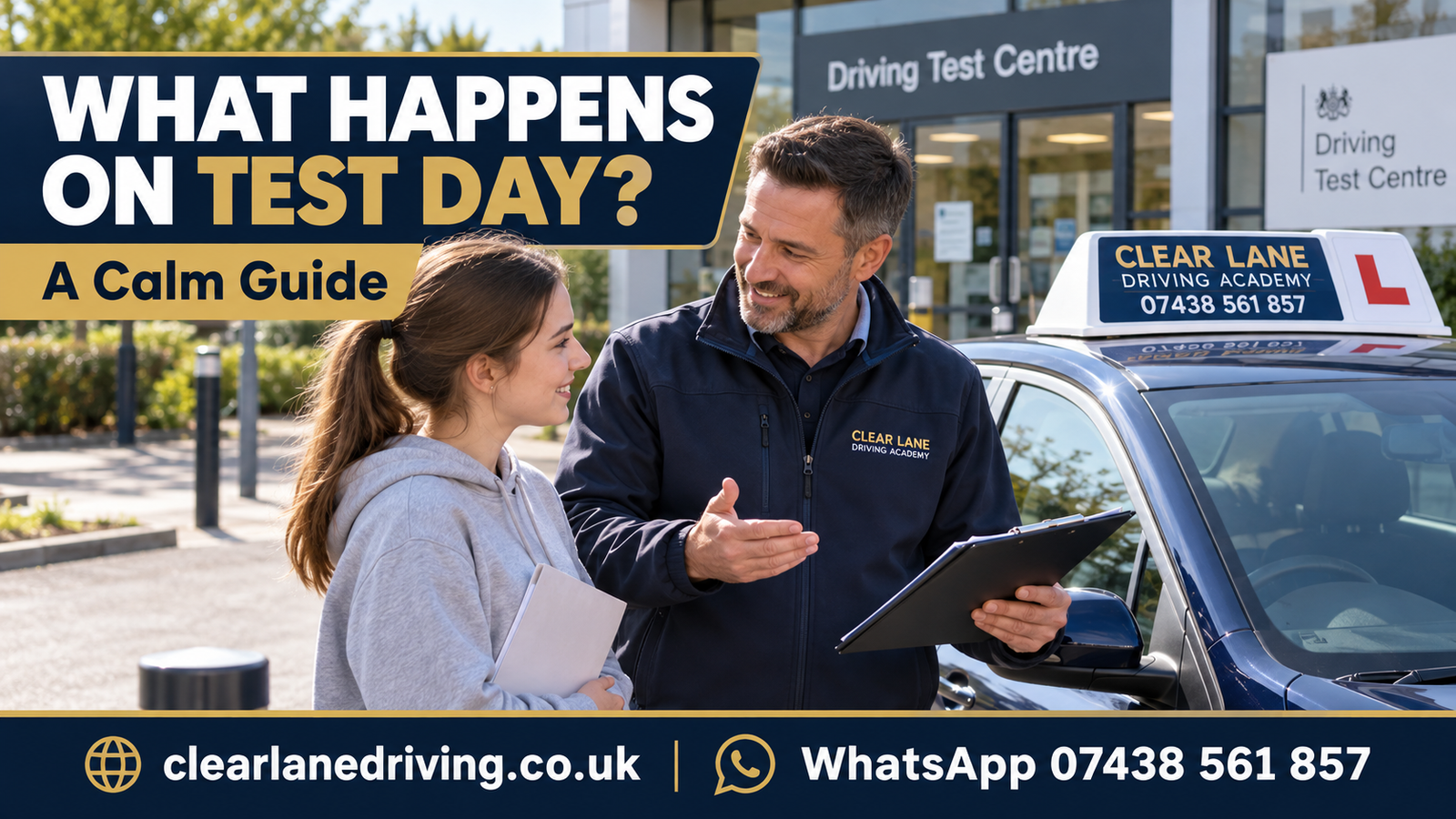
When your examiner calls your name, they will introduce themselves and check that you are ready to begin. They may ask to see your driving licence details or test confirmation information if needed. Your instructor can usually come to the car with you at the start, and you can choose whether they sit in the back during the test. You can also ask for the examiner’s supervisor to join the test where available.
The examiner will ask you to read a number plate from the required distance. This is the eyesight check. If you cannot read it, the test cannot continue, so make sure your prescription is current and that you bring the glasses or lenses you normally drive with.
You will then be asked one vehicle safety question, often known as a “tell me” question. This could cover topics such as checking tyre condition, using headlights or identifying warning lights. You are not expected to give a long technical explanation. Answer clearly and honestly, based on what you have practised.
Before moving away, take your time to get comfortable. Adjust your seat, mirrors and head restraint if needed, select the right gear, and carry out your normal moving-off routine. There is no prize for rushing out of the parking bay. A composed, well-observed start sets a useful rhythm for the drive.
The Drive: What the Examiner Is Looking For
The practical driving test usually lasts around 40 minutes. The examiner will give directions clearly and in good time. If you do not hear or understand an instruction, ask them to repeat it. It is far safer to clarify than to guess.
For most of the test, you will follow simple directions. You may be asked to turn left or right at the next junction, follow signs towards a destination, or take an exit at a roundabout. The route can include residential roads, busier main roads, dual carriageways where appropriate, roundabouts, junctions and different speed limits.
In Manchester, conditions can change quickly between quieter side streets and busy routes near a test centre. That is why useful preparation is about reading real roads, not trying to memorise every possible test route. Good observations, sensible speed and calm planning matter wherever you are driving.
The examiner is assessing whether you can drive safely and independently. They will look at your use of mirrors, awareness of other road users, positioning, speed choice, judgement at junctions, response to signs and road markings, and ability to make progress when it is safe to do so.
This does not mean you must drive exactly like your instructor. Safe drivers make small adjustments all the time. If you take a wrong turn but do it safely, that is not normally a problem. The examiner will simply redirect you. Never attempt a late lane change, sharp turn or rushed manoeuvre to correct your route.
Independent Driving
Around 20 minutes of the test is independent driving. You will either follow directions from a sat nav set up by the examiner or follow traffic signs for a stated destination. The sat nav is there to provide directions, not to test your ability to operate technology.
Continue to prioritise the road over the device. If you miss a direction, carry on safely. The examiner will help you get back on track. Your job is not to navigate perfectly. It is to show that you can remain safe when making decisions without constant instruction.
The “Show Me” Question
During the drive, the examiner will ask one “show me” question. For example, they may ask you to show how you would operate the rear demister or wash and clean the windscreen.
Only do this when it is safe. If the road is demanding, complete the driving task first and deal with the control when you have more space and attention available. Safety always comes before answering quickly.
Manoeuvres and Stopping Exercises
You will be asked to complete one reversing exercise. This may involve parallel parking, bay parking or pulling up on the right-hand side of the road before reversing. You may also be asked to carry out an emergency stop, although this is only included on some tests.
The key is to use the same method you have practised: prepare the car, observe properly, move slowly and correct calmly if needed. A manoeuvre does not have to look effortless. It needs to be safe, controlled and considerate of anyone nearby.
The examiner may ask you to pull up and move away again at different points. This could be on the right, on a hill, or after a normal stop at the side of the road. Each time, focus on observations and control rather than assuming it is just a pause.
How Driving Test Faults Work
The examiner records faults as driving faults, serious faults or dangerous faults. A driving fault is a minor issue that does not create a serious safety concern. You can still pass with driving faults, provided they do not become repeated or develop into something more serious.
A serious fault is one where your driving creates a potentially dangerous situation, or where you need significant correction. A dangerous fault involves actual danger to you, your passengers or other road users. One serious or dangerous fault means the test is unsuccessful.
Try not to spend the rest of the test analysing every moment. Learners often assume they have failed after a small mistake, then drive differently because of it. Keep going. A safe recovery and a focused attitude are far more useful than letting one uncertain moment take over the drive.
If the examiner needs to give a verbal prompt for safety, use the information and carry on. Do not argue or apologise repeatedly. Stay composed and return your attention to the road.
Receiving Your Result and What Comes Next
At the end of the test, the examiner will ask you to park and will tell you the result. If you pass, they will explain any driving faults and give you your pass certificate. Listen carefully – those points are still valuable for becoming a safer independent driver after the test.
If you do not pass, it can feel disappointing, particularly after the build-up to the day. Give yourself a moment, then listen to the feedback. The examiner will explain the faults recorded, and this gives you a clear starting point for your next lesson. A test result is feedback on that drive, on that day. It does not define your ability to become a capable driver.
A focused mock test before the real appointment can make the routine feel familiar, while test-day car hire and route preparation can remove practical worries for learners taking a test at centres such as Chadderton, Cheetham Hill or West Didsbury. Clear Lane Driving Academy encourages learners to prepare with structure, not panic.
On test day, keep the goal simple: look well ahead, give yourself time, use your observations and make safe choices. Learn smart. Drive safe. Pass with Clear Lane.