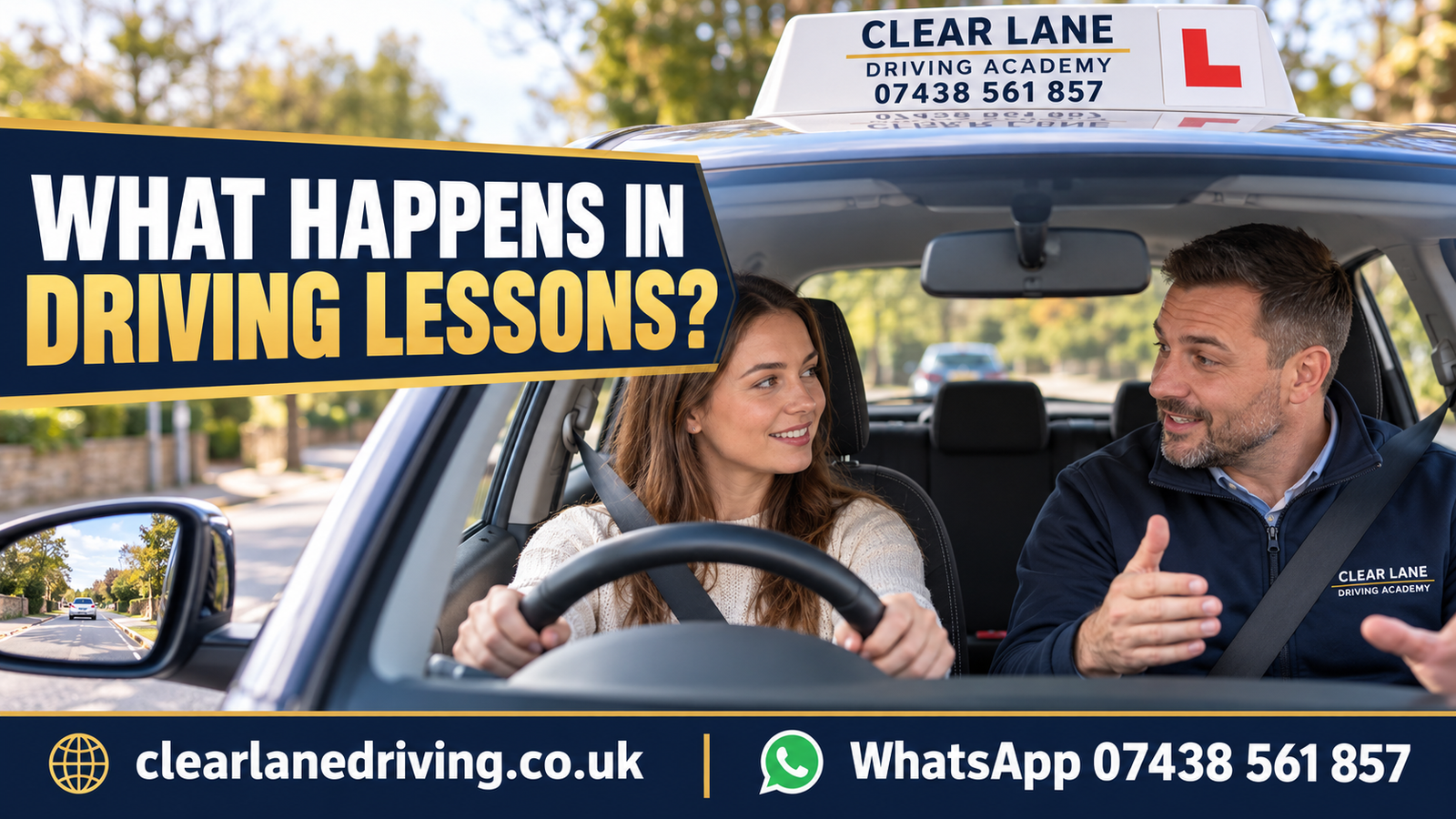
Your first lesson is unlikely to begin with busy roundabouts or a long drive across Manchester. It usually starts with a calm conversation, a seat adjustment and a clear plan. If you are wondering what happens in driving lessons, the short answer is that each session builds one manageable layer of skill at a time – until safe driving starts to feel natural rather than overwhelming.
A good lesson is not about covering as many roads as possible. It is about understanding what you are doing, making safe decisions and having enough time to practise them properly. That approach helps complete beginners, nervous learners and people returning after a previous test attempt.
What happens in driving lessons from the first session?
Your instructor will normally begin by checking your licence, eyesight and previous driving experience. If you have never driven before, there is no expectation that you should already know the controls. You will be talked through them clearly before the car moves.
You will learn how to set up your driving position: adjusting the seat, steering wheel, head restraint and mirrors so you can reach the pedals comfortably and see properly. This may seem basic, but a poor driving position can affect steering, observations and control throughout the lesson.
In a manual car, the early focus is usually on the clutch, gears and finding the biting point. In an automatic, you can concentrate sooner on braking, steering, observations and road position. Neither route is automatically easier for every learner. Automatic lessons remove clutch control, while manual lessons give you the option to drive either type of car after passing.
Your instructor will often choose a quiet area for the first practical exercises. You may practise moving off, stopping safely and steering around simple bends. Dual controls allow the instructor to assist if needed, so you can learn in a controlled environment. Feeling nervous is completely normal, especially in the first few minutes.
A driving lesson follows a clear structure
As you gain experience, lessons should have a purpose beyond simply driving around. Your instructor may start by asking how you felt after the previous session and what you remember. This helps identify whether you need a quick recap or are ready to move forward.
There is usually a brief discussion before driving, particularly when learning something new. For example, before approaching roundabouts, you might talk through lane choice, observations, signalling and how to judge approaching traffic. The instructor can then demonstrate, guide you through it and gradually give you more responsibility.
During the drive, you will receive coaching rather than a constant stream of instructions. At first, clear prompts are useful: when to check mirrors, where to position the car or when to prepare for a junction. As your confidence develops, the prompts should reduce. You will be encouraged to spot hazards, plan ahead and explain your own decisions.
At the end, there should be time to review what went well and what needs more work. Honest feedback matters. A productive lesson can include mistakes, provided you understand why they happened and know how to improve them next time.
Skills are built in a sensible order
The order can vary because learners progress at different rates, but driving skills usually develop from car control to more complex traffic situations. Early lessons cover moving off and stopping, steering, changing gear in a manual car, using mirrors and approaching simple junctions.
Once those foundations are more secure, you may work on meeting traffic, crossroads, roundabouts, pedestrian crossings, hill starts, dual carriageways and driving in different weather or light conditions. The aim is not to rush through a checklist. It is to make each skill reliable enough to use alongside the others.
For instance, a roundabout requires more than steering. You need to read signs and road markings, choose a lane, check mirrors, signal where appropriate, judge traffic and maintain control of the vehicle. This is why some learners need repeated practice before a skill feels comfortable. Repetition is not going backwards – it is how safe habits are formed.
You will learn the routines behind safe decisions
Driving involves routines, but they should never become empty actions. Mirror checks are not just something to perform because an instructor has mentioned them. They tell you what is happening behind and beside the car before you change speed or direction.
Similarly, good road positioning is not about driving in exactly the same place on every road. It depends on the width of the road, parked vehicles, bends, oncoming traffic, cyclists and road markings. Lessons help you understand the reason behind each decision, which is far more useful than memorising instructions for a test.
Practice becomes more independent over time
A learner’s first few lessons often involve plenty of support. Later, your instructor may ask you to follow sat nav directions, take the lead on a familiar route or decide how to handle a developing situation. This prepares you for independent driving and for the practical driving test.
The independent driving part of the test asks candidates to drive by following a sat nav or traffic signs for around 20 minutes. That does not mean you should only practise sat nav driving near test day. Independence grows gradually when you are given safe opportunities to plan, assess and act for yourself.
You may also practise manoeuvres such as bay parking, parallel parking or pulling up on the right and reversing. These are assessed as part of real-world control and observation, not as tricks to memorise. A good instructor will help you use reference points where useful, while also teaching you to look around properly and adapt to the space available.
What happens in driving lessons when you make mistakes?
Mistakes are expected. Stalling, choosing the wrong gear, braking too late or missing a turn can feel frustrating, but none of these moments defines your ability to learn. The key question is what caused the error: was it a control issue, a missed observation, a rushed decision or uncertainty about the road?
Your instructor may intervene verbally, use the dual controls or take control of the steering in a developing safety situation. Afterwards, they should explain what happened calmly and help you try again when it is safe. This is how confidence becomes genuine. It comes from knowing you can recover and improve, not from never making an error.
If you are particularly anxious, tell your instructor. Lessons can be adapted through quieter routes, slower progression, more recap time and clear goals. Fast progress does not have to mean feeling pressured.
Test preparation is more than practising test routes
As you become test-ready, lessons may include mock driving tests. These reveal how well you manage a full drive with fewer prompts, including independent driving, manoeuvres and changing road conditions. The feedback afterwards is valuable because it shows whether a fault is occasional or part of a pattern.
Practising around local test centres can also be useful. Learners preparing in Greater Manchester may encounter busy multi-lane junctions, tight residential roads, changing speed limits and varied traffic flow. Familiarity can help reduce uncertainty, but it should never replace sound driving judgement. Test routes can change, and the examiner is assessing safe driving rather than local knowledge.
For learners on an intensive course, the structure is more concentrated. You may drive more frequently and revisit skills across several sessions in a shorter period. This can suit someone with a deadline or existing experience, but the right course length still depends on your starting point, availability and how consistently skills develop.
How long does it take to feel confident?
There is no honest fixed number of lessons for every learner. Previous experience, lesson frequency, coordination, confidence, opportunities for private practice and whether you learn manual or automatic can all affect progress. Comparing yourself with friends usually creates unnecessary pressure.
A better measure is whether you can drive safely and consistently with decreasing support. Can you approach unfamiliar roads without panic? Do you notice hazards early? Can you correct a small mistake without losing focus? These are signs that you are building the judgement needed beyond test day.
At Clear Lane Driving Academy, lessons are planned around your current ability and next sensible goal, whether that is mastering the basics, preparing for a mock test or gaining confidence before a practical test. There is no benefit in pretending you are ready before you feel ready.
Your next lesson does not need to be perfect. Arrive rested where possible, wear comfortable footwear, ask questions when something is unclear and allow yourself to learn one decision at a time. Learn smart. Drive safe. Pass with Clear Lane.
Looking for driving lessons in Oldham specifically? Clear Lane covers Oldham, Chadderton and surrounding areas with DVSA-approved local instructors.