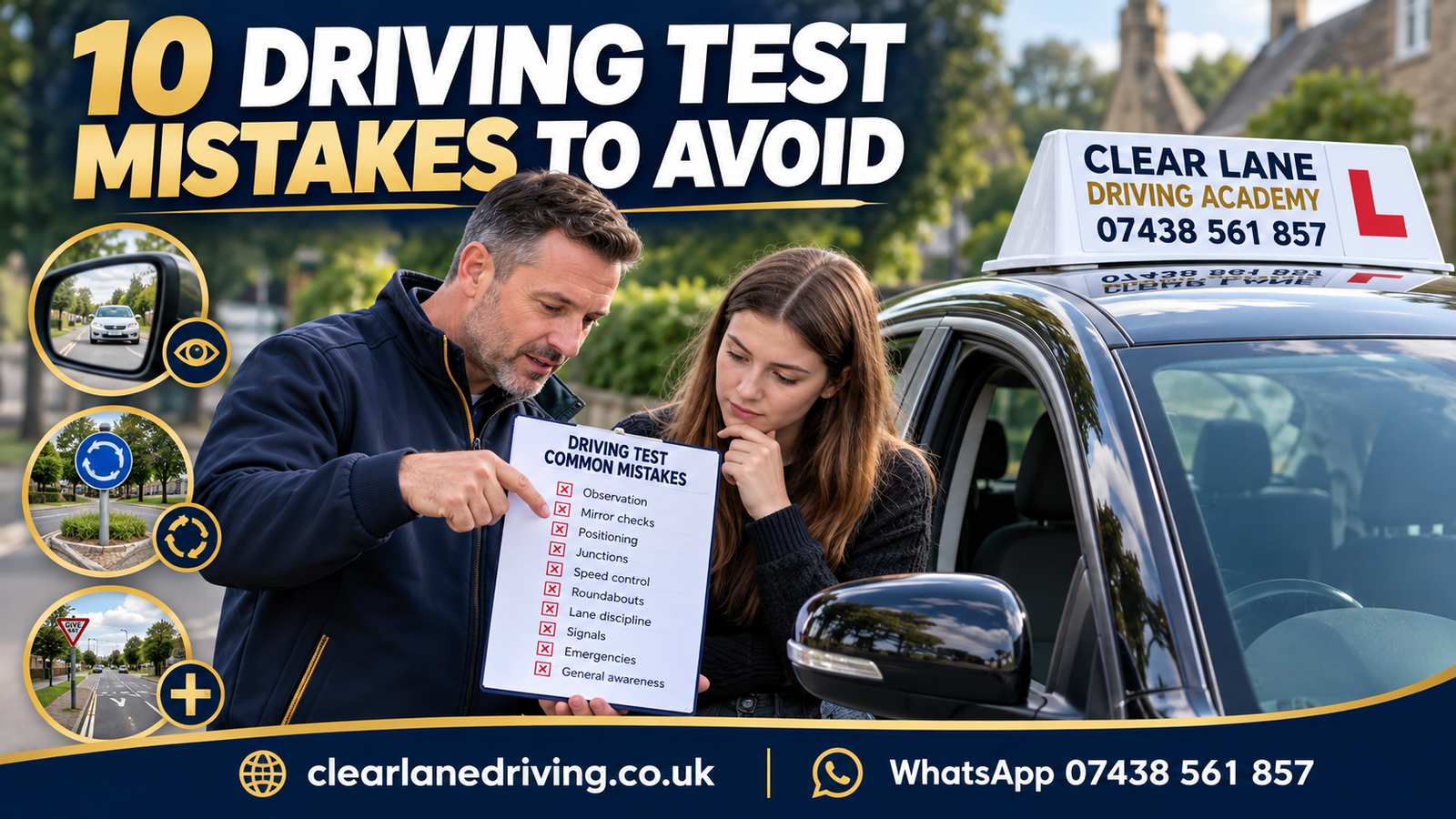
That moment when the examiner says, “Take the next road on the right,” can make even a capable learner tense up. The top driving test mistakes learners make are rarely about not knowing how to drive at all. More often, they happen because of pressure, rushed decisions, or small habits that were never fully corrected before test day.
The good news is that most of these mistakes are preventable. With the right preparation, steady practice and honest feedback, learners can turn common weak points into strengths. Passing a practical test is not about being perfect. It is about showing safe, consistent and independent driving.
Why the top driving test mistakes learners make keep happening
Many learners are good in lessons but drive differently under test conditions. That change usually comes from nerves. A learner who normally checks mirrors well may forget one observation when flustered. Someone who can park confidently might rush the manoeuvre because they feel watched.
Another issue is inconsistent practice. If your lessons have been broken up, rushed or focused too heavily on one area, gaps can show on test day. This is why structured preparation matters. You need enough time on junctions, roundabouts, manoeuvres, dual carriageways where relevant, and independent driving so that nothing feels unfamiliar.
It also depends on how honest your preparation has been. Some learners only focus on what they enjoy. Others avoid busy roads, hill starts or meeting traffic because it feels uncomfortable. Unfortunately, the test does not avoid those moments. Safe progress usually comes from working on weak areas directly, not hoping they will not come up.
Observation mistakes at junctions and roundabouts
Poor observation is one of the most common reasons learners pick up serious faults. This does not always mean a learner failed to look. Often, they looked too late, looked briefly without properly judging speed, or moved off when the gap was not safe.
At junctions, learners sometimes stop correctly but then rush the emerging decision. On roundabouts, the pressure can be worse because there is more to process. If you are unsure, waiting a moment is usually better than forcing it. Examiners are looking for safety and judgement, not boldness.
This is especially important in busier areas where traffic can change quickly. A car approaching faster than expected, a cyclist filtering through, or a pedestrian stepping near a crossing can all affect your decision. Good observation is not a quick glance. It is a full routine, followed by calm judgement.
Mirror checks that are missing, late or unclear
Learners are often told to check mirrors so many times that they start doing it mechanically. The problem is that the test is not about head movement for show. It is about checking the right mirror, at the right time, and acting on what you see.
Before signalling, before changing speed, before changing direction and before moving away, your mirrors matter. A missing mirror check can become serious if another road user is affected. A late mirror check can be just as unhelpful because by then the situation may already have changed.
This is one of the top driving test mistakes learners make because nerves make routines shrink. People focus ahead and forget what is around them. A good way to improve this is to link mirror use to specific actions until it becomes natural rather than forced.
Speed control problems go both ways
Some learners fail for driving too fast for the road, but many also lose marks for driving too slowly without good reason. Both can create problems. Driving too fast reduces your safety margin. Driving too slowly can hold up traffic, create uncertainty and suggest a lack of confidence.
Speed control is not just about staying under the limit. It is about reading the road. A 30 mph road with parked cars, pedestrians and oncoming traffic may need a much lower speed. On a clear stretch, crawling along at 18 mph can become an issue if conditions do not justify it.
This is where mock tests help. Under pressure, many learners either rush or become over-cautious. Practising with realistic test conditions helps you find a balanced pace. The aim is steady, safe progress.
Positioning errors on the road
Road position tells the examiner a lot about your planning. Learners often drift too close to parked cars, turn right from the wrong part of the road, or approach roundabouts in the wrong lane because they decided too late.
Positioning faults are often linked to planning faults. If you spot signs late or do not look far enough ahead, you give yourself less time to prepare. Then everything becomes sharper and more rushed.
On narrower roads, good positioning also shows awareness of hazards. You may need to hold back, ease off, or adjust slightly for oncoming vehicles. There is not always one perfect road position. Sometimes it depends on the width of the road, the traffic and the hazard ahead. What matters is whether your position is safe, legal and sensible.
Manoeuvres rushed by nerves
Parallel parking, bay parking and pulling up on the right can all go wrong when learners stop trusting their routine. They know the steps, but test nerves make them hurry. They steer too early, miss observations, or try to fix a parking position too quickly without pausing to think.
The examiner does not expect a manoeuvre to be done at speed. In fact, taking your time usually works in your favour. Keep the car slow, keep observing, and reset calmly if needed. A small correction is not a problem. Poor observation or loss of control is.
If manoeuvres feel shaky, that usually points to a need for more repetition in varied spaces rather than simply doing the same one repeatedly in the same quiet road. Real confidence comes from flexibility.
Following signs and sat nav directions badly
Independent driving catches some learners out because they stop driving well while trying to follow directions. They miss a sign, panic, then change lane suddenly or try to turn too late.
It is worth remembering that taking the wrong route does not mean you fail. Unsafe decisions do. If you miss a turn, continue safely and listen for the next instruction. Examiners would much rather see a calm wrong turn than a dangerous last-second move.
This matters in unfamiliar areas and around larger roundabouts where lane discipline can be tested. If you are preparing for a local test centre, practising varied roads nearby can help build confidence with real junction layouts and traffic patterns.
Moving away without proper checks
A surprising number of faults happen when moving off. Learners complete a stop safely, then forget all-round observations before setting off again. This often happens after pulling up on the left, at the side of the road during normal driving, or after the emergency stop exercise.
The habit needs to be complete every time: mirrors, signal if needed, blind spot checks, then move away only when safe. If a cyclist, pedestrian or car is approaching, you may need to wait.
This part of the test can seem basic, which is exactly why learners sometimes switch off. On test day, simple routines need just as much attention as the more difficult parts.
Letting one mistake turn into several
One of the biggest test-day problems is not the first mistake. It is the reaction to it. A learner stalls, clips the kerb lightly, or takes the wrong exit at a roundabout and then spends the next five minutes upset and distracted.
The practical test rewards recovery. You can make a minor mistake and still pass. What matters is whether you stay composed and continue driving safely. If something goes wrong, breathe, reset and focus on the next decision.
This is why calm coaching matters so much in the run-up to test day. Learners who have practised under pressure, including mock tests and honest feedback, are often better at recovering when things are not perfect.
How to avoid common test mistakes before your practical
The best preparation is targeted, not random. If your observations are weak at roundabouts, spend time there. If your parking falls apart under pressure, practise with a clear routine until it becomes steady. If your speed changes too much, work on commentary driving and hazard awareness.
It also helps to practise full test-style drives. These reveal the difference between doing one skill well and linking everything together for 40 minutes. Many learners can manage separate tasks in lessons but need more work on maintaining concentration across a full drive.
If you are close to test standard, honest feedback is vital. You do not need false reassurance. You need to know what still needs work and what is already strong. At Clear Lane Driving Academy, that structured approach is a big part of helping learners build confidence in a realistic way.
The top driving test mistakes learners make are fixable
Most learners who struggle on test day are not hopeless drivers. They are usually dealing with a handful of repeat issues that can be improved with focused practice. Observation, mirrors, speed, positioning and nerves are all manageable when they are coached properly.
Learn smart. Drive safe. Pass with Clear Lane. If your test is coming up, do not aim to look impressive. Aim to be calm, safe and consistent. That is what carries people through when it matters most.