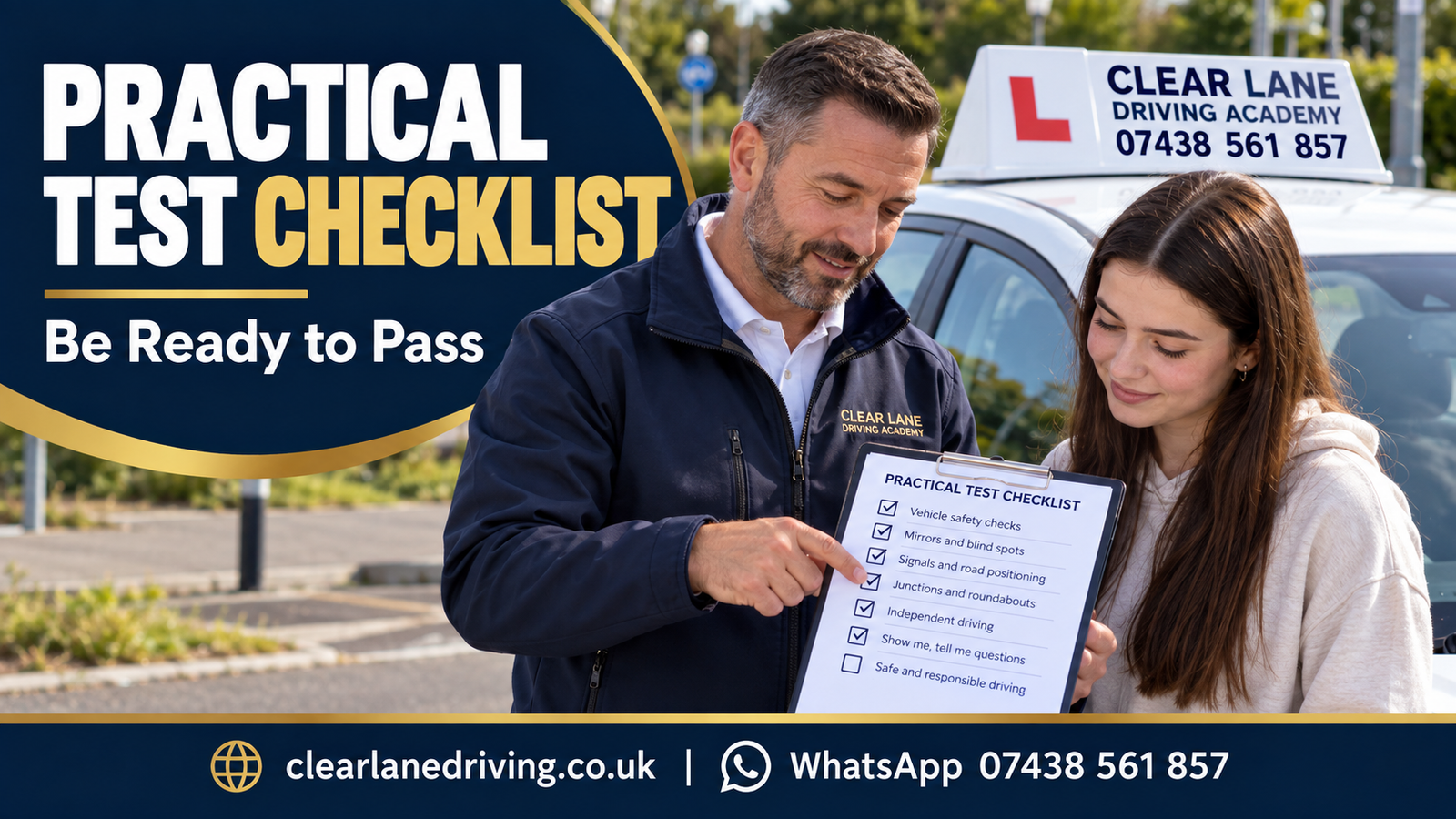
The night before a driving test is rarely the problem. It is the small things people forget on the day itself – a missing licence, unclear mirrors, poor observations at a roundabout, or letting nerves rush simple decisions. A good practical driving test checklist helps you stay organised and gives you one less thing to worry about when you need a calm head.
This is not about chasing perfection. The aim is to arrive prepared, drive safely, and make sensible decisions even if you feel nervous. That is what examiners are looking for.
Your practical driving test checklist for before test day
Preparation starts earlier than most learners think. If you leave everything until the evening before, small problems can quickly become bigger ones.
Make sure your theory test pass is still valid and your practical test booking details are correct. Check the time, the test centre, and how long it takes to get there with realistic traffic in mind. If you are using your instructor’s car, confirm the lesson time beforehand and whether you are doing a short warm-up drive before the test.
You also need to make sure you bring the right licence. If you have an old-style paper licence or there is anything unusual about your booking, check the current DVSA requirements in advance rather than guessing. Most test day issues are avoidable when you leave time to sort them.
Sleep matters as well, but not in the overly dramatic way people sometimes describe it. One poor night will not automatically ruin your test. What matters more is avoiding a late, stressful evening and giving yourself enough time in the morning so you are not rushing out the door already flustered.
What to bring on the day
Keep this part simple. You need your provisional driving licence and, if relevant, anything else required for your booking. If you wear glasses or contact lenses for driving, bring them. It is sensible to bring water and wear comfortable shoes you have driven in before.
Try not to turn test day into a special occasion where everything changes at once. New shoes, too much caffeine, skipping breakfast, or cramming in last-minute advice from five different people can all make you feel less settled, not more prepared.
If you are hiring a car for the test or using your instructor’s vehicle, check that insurance, tax, and general suitability are already sorted. That should never be left as a same-day surprise.
Car checks that belong on every practical driving test checklist
A car can be perfectly legal to drive in normal life but still become a problem on test day if basic checks have been ignored. Before the test, make sure the car is clean enough for safe visibility, especially the windscreen, mirrors, and number plates.
Tyres must be in good condition and correctly inflated. All lights should work. Fuel should be sufficient for the lesson and test without cutting it close. Warning lights on the dashboard should not be ignored. If there is any doubt about the vehicle, deal with it before the test day.
Inside the car, adjust your seat, mirrors, and steering position properly before moving off. Examiners do not expect speed here. They expect safe preparation. If you rush and start from an awkward position, it can affect your control and observations straight away.
For learners using a car they do not drive regularly, this point matters even more. Every clutch bites differently. Automatic cars vary in braking feel and creep. A short drive before the test can help you settle into the vehicle and avoid those first ten minutes feeling unfamiliar.
The mindset part of your practical driving test checklist
Nerves are normal. Most learners feel them, including those who are genuinely test-ready. The problem is not feeling nervous. The problem is letting nerves turn your driving into something rushed, hesitant, or inconsistent.
The best approach is to narrow your focus. You do not need to think about the full test route or whether you will pass in the first five minutes. You only need to deal with the road in front of you, one decision at a time. Move away safely. Read the signs. Keep your speed appropriate. Observe well at junctions. Repeat.
If something does not go perfectly, keep driving. Many learners assume one mistake means they have failed, then make several more because their concentration has gone. A minor slip is not always a serious fault. What matters is how safely you respond afterwards.
A calm instructor can help here, which is one reason many learners book a mock test or final preparation lesson before the real thing. Structured practice makes test day feel more familiar and less intimidating.
What examiners are really looking for
Examiners are not looking for a polished performance that feels robotic. They are checking whether you can drive safely and independently.
That means good observation, sensible speed, proper lane discipline, awareness of other road users, and safe reactions when plans change. If a pedestrian steps out, if traffic builds suddenly, or if a sat nav direction comes late, the examiner wants to see controlled judgement rather than panic.
You do not fail for being cautious. You can fail for being over-cautious if it affects safety or progress, but sensible, planned driving is a strength. This is especially important for nervous learners who sometimes think they need to drive more aggressively to seem confident. Real confidence looks calm and measured.
Common faults to watch for during the test
Most practical test faults are familiar ones from lessons. Observations are a big one, especially at junctions, when moving off, and during manoeuvres. Mirrors are another. Learners often know they should check them, but under pressure they either forget or do it too late to be useful.
Speed control causes problems in both directions. Some learners creep too slowly and hold back traffic without reason. Others drift above the limit because they are more focused on the examiner’s instructions than the road signs. Neither is ideal. Good speed awareness is steady, not dramatic.
Positioning also matters. That includes lane choice at roundabouts, keeping a safe road position on normal roads, and not cutting corners when turning. Then there is decision-making. Hesitation can be just as unhelpful as rushing if it shows you are not reading the situation clearly.
If any of these areas still feel inconsistent in lessons, they deserve attention before the test rather than blind optimism. Honest preparation is always better than hoping for a lucky drive.
Show me, tell me and the small details learners forget
Your practical driving test checklist should include the non-driving parts too. You may be asked a vehicle safety question at the start or while driving. These are straightforward if you have revised them properly, but easy to muddle if you have only glanced at them once.
Take time to practise saying the answers out loud. It is different from reading them quietly. The same goes for the eyesight check. If you need glasses for distance, do not leave them at home.
Small details can affect your confidence more than your result, but they still matter. Arriving late, feeling thirsty, or not knowing where to park before the appointment can all increase pressure before the test has even started.
Why local route practice helps – but only up to a point
If you are taking your test in Manchester, local route practice can be very useful because every test centre has its own patterns. Some areas are known for busy roundabouts, others for tighter residential roads, trickier lane markings, or more complex dual carriageways.
That said, route practice should build skills, not dependence. You are not trying to memorise a script. Roads change, traffic changes, and examiners choose different directions. The real benefit comes from recognising the kind of hazards and decisions a local area tends to present.
For many learners, the best final preparation combines general driving strength with focused practice around the test centre. That balance usually builds more confidence than repeatedly driving the same roads without understanding why certain spots catch people out.
A final practical driving test checklist for the morning
On the morning of your test, keep things steady. Eat something light, leave with time to spare, and avoid turning the drive to the test centre into a panic rehearsal. Bring your licence, any glasses you need, and settle into the car properly before moving off.
Once the test starts, do not aim to impress. Aim to be safe, aware, and consistent. If you need an extra second to think, take it. If a situation changes, respond calmly. Learn smart. Drive safe. Pass with Clear Lane.
A driving test is not asking whether you are perfect. It is asking whether you are ready to drive responsibly on your own, and good preparation gives you the best chance to show exactly that.