A practical driving test can feel very close when you have a test date in the diary, but readiness is not measured by how badly you need to pass. If you are asking, “can I pass driving test quickly?”, the honest answer is yes, sometimes – but only when your learning plan matches your current ability, availability and confidence behind the wheel.
Quick progress should never mean rushed driving. It means identifying exactly what is holding you back, practising it properly, and arriving at test day able to make safe, independent decisions. That is a far better route to a pass than simply adding hours without a clear purpose.
Can I pass driving test quickly without cutting corners?
You may be able to pass quickly if you already have a solid foundation. Perhaps you have driven before, have recently failed for a small number of correctable faults, or have had a break from lessons and need structured refresher training. In these situations, focused lessons can bring your standard up relatively quickly.
For a complete beginner, the timeline is usually longer. You need time to develop vehicle control, judgement, observation and the ability to deal with unfamiliar situations calmly. Learning the controls of a manual car, for example, takes practice before you can give full attention to traffic, road signs and planning ahead. Automatic lessons can remove the clutch and gear element, but the safety and decision-making standards remain exactly the same.
The aim is not to collect a certain number of hours. It is to become consistently safe. A good instructor will be honest about whether an intensive course, regular lessons or a short period of test preparation is the right next step.
Start with an honest driving assessment
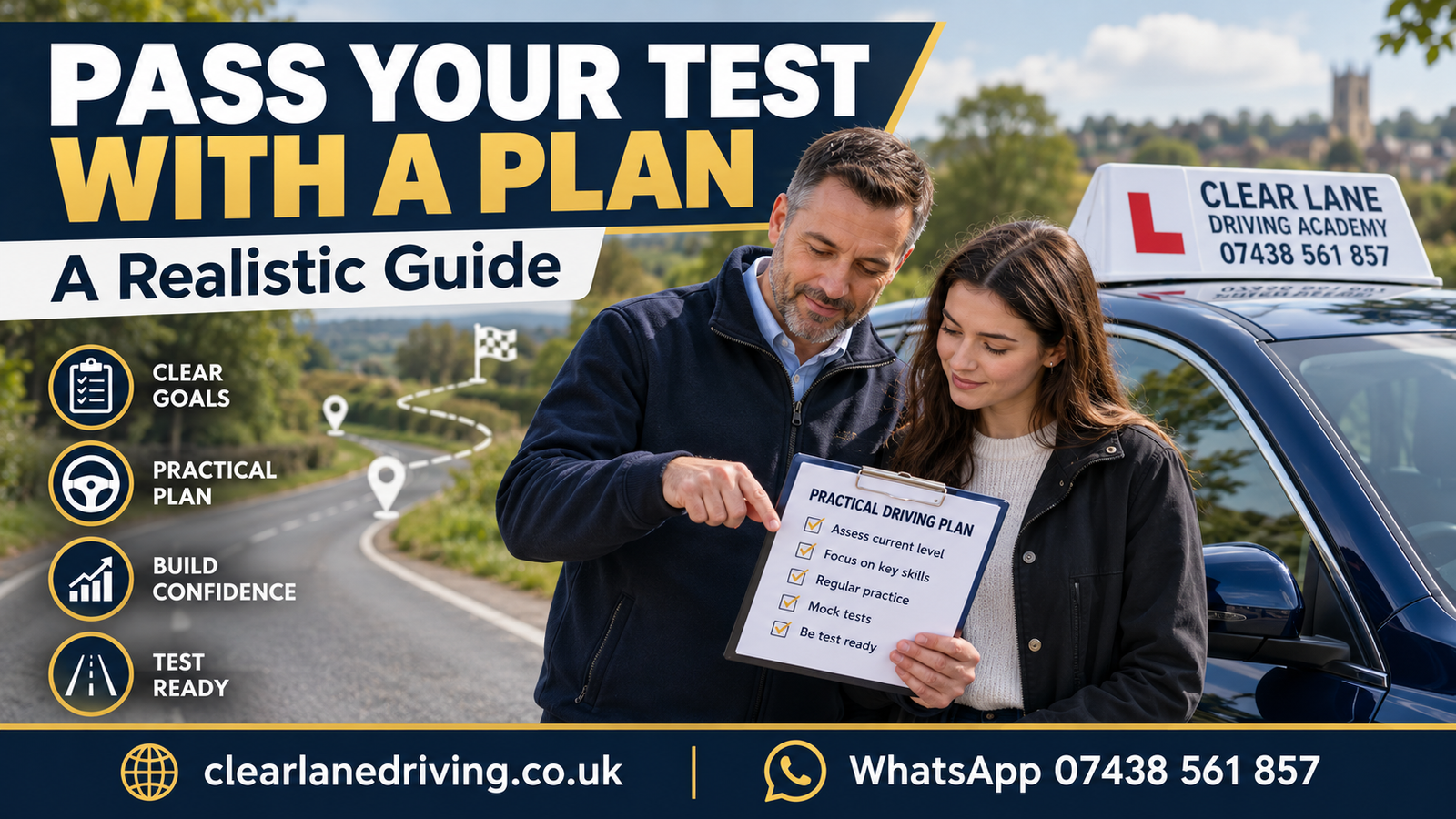
The quickest sensible plan begins with a proper assessment lesson. This is not about judging you. It is about finding your starting point so that your lessons target the right areas.
You should be able to drive on a range of roads, follow directions independently, use mirrors at the right time and respond safely to other road users. Your instructor will also look at clutch control or smooth braking, speed choice, road position, junction routines, roundabouts, manoeuvres and emergency stops.
One mistake does not automatically mean you are far from test standard. Everyone makes occasional errors while learning. The key question is whether you spot and correct them safely, or whether the same fault appears under pressure. A learner who occasionally hesitates but observes well may need less work than someone who drives confidently but repeatedly misses hazards.
Ask for clear feedback at the end of the lesson: what is already test-ready, what needs work, and what could cause a serious or dangerous fault if it happened on test. That gives you a realistic plan rather than false reassurance.
Choose the learning format that suits your deadline
If your test is several months away, regular weekly lessons often provide the best balance of progress, reflection and affordability. You have time to practise between sessions, sleep on feedback and build skills steadily.
If you already have some experience and a nearer test date, an intensive driving course can be useful. Longer sessions over a short period help you keep momentum and avoid spending the first part of every lesson re-learning what you did last week. They are particularly helpful for learners with flexible availability, university holidays or a clear deadline.
Intensive training is not a shortcut for missing skills. It works best when lessons are planned around precise goals. A few long drives with no feedback or structure will not necessarily prepare you for the practical test. You still need time to process coaching, practise independently where appropriate, and develop calm decision-making rather than relying on prompts.
For some learners, a mixed approach works well: regular lessons to build core skills, followed by a focused block nearer the test. Your instructor can help you decide based on how quickly you retain learning and how consistently you drive.
Practise the parts of the test that expose weak habits
A practical test is not designed to catch you out, but it does reveal whether your safe habits hold up when you are nervous. The examiner may ask you to follow sat nav directions or traffic signs for part of the drive, complete one manoeuvre, and possibly carry out an emergency stop. More importantly, they will assess your driving throughout.
That means your preparation should go beyond repeating manoeuvres in an empty car park. Spend time on real junctions, busy roundabouts, changing speed limits, meeting traffic on narrow roads and moving off safely on hills. Practise pulling up on the right and reversing if your instructor advises you are ready for it. Build the habit of reading the road early rather than reacting at the last moment.
The most common improvement comes from planning. Look well ahead, check signs in good time, choose the correct lane early, and leave enough space to respond. When your driving is planned, your steering, speed and observations tend to become calmer too.
Use mock tests properly
A mock test can be one of the fastest ways to see whether you are ready. Treat it like the real thing: arrive prepared, drive without coaching during the assessment, and accept the result honestly.
The value is in the debrief. Instead of only hearing that you made a fault, understand why it happened and what you should do differently next time. If you repeatedly receive faults for mirrors, clearance, hesitation or approach speed, ask for targeted practice rather than immediately booking another mock test.
Nerves may lead to a few minor slips in a mock test, and that is useful information. You can then practise simple reset techniques: breathe before moving off, listen fully to the instruction, and focus only on the next safe decision. Trying to replay an earlier mistake while driving often creates another one.
Learn the local roads, but do not memorise routes
Knowing the features around your chosen test centre can build confidence. It helps to be familiar with local speed changes, busy junctions, roundabouts, narrow residential roads and places where meeting traffic requires patience. For learners taking tests around Greater Manchester, this kind of preparation can make an unfamiliar area feel more manageable.
However, route knowledge is not the same as test readiness. Test routes can change, traffic conditions vary, and the examiner may take you somewhere you have not driven before. The safer goal is to learn transferable routines: effective observations, appropriate speed, good positioning and measured decisions.
Clear Lane Driving Academy prepares learners for the road conditions around Manchester test centres while keeping the focus on safe driving wherever the test takes you.
Be realistic about booking and test day support
A quick pass depends partly on factors outside your control, including test availability. Do not book a date simply because it appears sooner if you have not had an assessment of your current standard. Moving a test once can be frustrating, but taking it before you are ready can cost confidence as well as money.
If you plan to use an instructor’s car for the test, confirm this early. You need to be comfortable with the car, insured correctly, and familiar with its controls. Test day car hire is most useful when it is part of a planned preparation process, not a last-minute substitute for lessons.
In the days before the test, protect your concentration. Keep practice purposeful rather than exhausting yourself with long, anxious drives. Check your licence, test appointment details and eyesight. Get enough sleep, eat normally and leave plenty of time for the journey. Being early gives you space to settle without turning up flustered.
What to do if you have failed before
A previous fail does not mean you cannot pass quickly next time. It means you now have useful evidence about what needs attention. Read the driving test report with your instructor and separate one-off nerves from recurring weaknesses.
If the result involved observations, junctions or response to other road users, work on the underlying routine rather than just the location where it happened. If nerves were the main issue, include mock tests and independent driving in your preparation. Confidence grows when you repeatedly prove to yourself that you can recover, adapt and continue safely.
There is no benefit in rushing to rebook before you understand the reason for the result. A short, focused period of coaching can make the next attempt feel very different.
Pass quickly by becoming consistently safe
The fastest route to a driving test pass is rarely a secret technique. It is a clear assessment, lessons matched to your ability, deliberate practice and honest feedback. Some learners can be ready in a short period; others need more time, and that is completely normal.
Set your goal as driving safely and independently, not merely surviving forty minutes with an examiner beside you. When your routines are dependable and your decisions are calm, a quicker pass becomes a realistic possibility – and you will be better prepared for the roads after the test as well.
For learners who want to progress efficiently, Clear Lane Driving Academy offers intensive driving courses in Manchester and Oldham with structured, focused tuition. We also cover Bury, Failsworth, Middleton and neighbouring areas — contact us to discuss what suits you.
Looking for driving lessons in Oldham specifically? Clear Lane covers Oldham, Chadderton and surrounding areas with DVSA-approved local instructors.