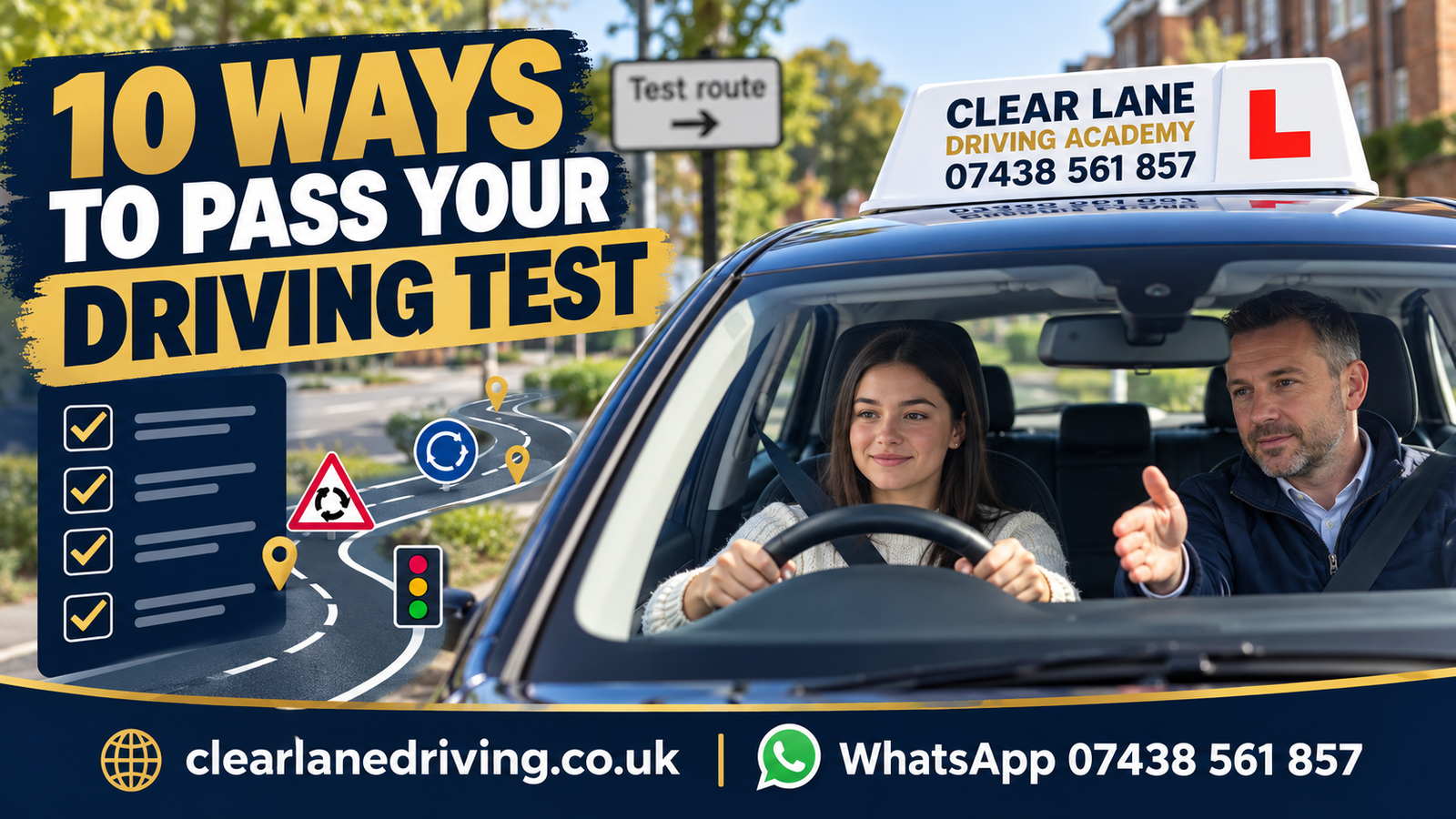
Failing a practical test often has less to do with not knowing how to drive and more to do with pressure, timing, and gaps in preparation. The best ways to pass driving test are usually not dramatic changes – they are small, focused improvements that build confidence, consistency, and safer decision-making.
If you are close to test standard, the goal is not to cram more miles in for the sake of it. It is to make sure your driving is reliable under pressure. That means knowing what examiners look for, understanding your weak points, and turning test-day nerves into something manageable.
What the examiner is really looking for
A driving test is not about perfect driving. It is about safe, legal, independent driving. Examiners are checking whether you can deal with normal road situations calmly, make sound decisions, and keep control of the car without needing help.
That matters because many learners put too much energy into trying to look flawless. In reality, one small mistake will not usually fail you. Repeated faults, poor observation, rushed judgement, or anything unsafe is what causes problems. Once you understand that, your preparation becomes more practical and far less stressful.
10 best ways to pass driving test
1. Learn with a clear structure, not random practice
One of the biggest differences between learners who pass and learners who struggle is structure. If each lesson jumps from one topic to another without a clear plan, progress can feel slow and patchy. A structured approach helps you build skills in the right order, then revisit them until they become consistent.
This is especially useful if you are learning quickly through an intensive course or returning after a failed test. You need to know which areas are secure and which still need work. Manoeuvres, meeting traffic, roundabouts, independent driving, and dual carriageways all need proper attention, not guesswork.
2. Focus on the faults that come up again and again
Most learners do not fail because they are bad at everything. They fail because the same two or three issues keep showing up. It might be observations at junctions, lane discipline on roundabouts, hesitation, mirrors before changing speed, or clutch control in slow traffic.
Be honest about your pattern. If a fault appears repeatedly in lessons or mock tests, that is where your effort should go. There is little benefit in spending half a lesson on a manoeuvre you can already do well if your junction approach is still inconsistent. Smart preparation is targeted preparation.
3. Use mock driving tests properly
Mock tests are one of the best ways to pass driving test because they reveal how you drive when the pressure changes. Many learners perform well in normal lessons but become rushed or forgetful the moment they feel assessed.
A good mock test should feel realistic, with minimal prompting and proper feedback afterwards. The real value is not the score itself. It is seeing where your decision-making changes under pressure. That gives you time to fix those habits before the real test.
4. Practise on the types of roads you are likely to face
You do not need to memorise every possible route, but local familiarity helps. Different test areas tend to bring different challenges. Some centres involve tighter residential roads, others have more complex roundabouts, faster roads, awkward junctions, or heavier traffic.
If you are preparing for a test in Manchester, it makes sense to spend time on the kinds of roads commonly found around your chosen test centre. That does not mean trying to second-guess the route. It means becoming comfortable with the road layouts, speed changes, and traffic patterns you are likely to meet.
5. Treat commentary driving as a confidence tool
Many nervous learners stay too much in their own head. Their thoughts become a cycle of worry rather than a calm running plan. Commentary driving can help break that pattern.
Quietly talking through what you see and what you plan to do keeps your attention on the road rather than on your nerves. For example, you might say to yourself, “Parked cars ahead, check mirrors, ease off, look for a safe gap.” It sounds simple, but it improves forward planning and helps you avoid late reactions.
6. Get comfortable with independent driving
A lot of test anxiety comes from the fear of getting lost or taking a wrong turn. In truth, taking the wrong direction is not usually a fault if you do it safely. What matters is how you respond.
This is why independent driving practice matters so much. You need experience following signs, listening to sat nav instructions, and continuing calmly when things do not go exactly to plan. Learners who only ever drive with step-by-step prompting can feel exposed on test day. Learners who have practised thinking for themselves tend to feel far more settled.
7. Sort out test-day nerves before test day
Confidence is rarely built the night before a test. It comes from preparation, repetition, and a routine that makes the day feel familiar. If you know nerves affect you, plan for them early.
Get used to driving at the same time of day as your test if possible. Make sure you know where you are meeting your instructor, what documents you need, and what the first few minutes of the test process look like. Eat something light, arrive with time to spare, and avoid last-minute conversations that increase pressure. Calm routines reduce avoidable stress.
Breathing also matters more than many learners realise. If your breathing becomes shallow, your driving can become rushed. A few slow, steady breaths before moving off can help you settle your pace and think clearly.
8. Do not chase perfection during the test
This catches a lot of learners out. They make one minor mistake, then spend the next five minutes thinking about it instead of focusing on the road ahead. That is often when more faults creep in.
The better approach is to reset quickly. If something did not go quite right but it was safe, leave it behind and continue. Examiners judge the whole drive, not your internal panic after one imperfect moment. Staying composed after a mistake often makes a bigger difference than the mistake itself.
9. Make your observations obvious and meaningful
Observation faults are one of the most common reasons learners are unsuccessful. This is not just about moving your head dramatically. It is about checking at the right time, in the right order, and using what you see to make safe decisions.
That applies when moving off, changing lanes, approaching junctions, reversing, and dealing with cyclists or pedestrians. If your mirrors are quick but empty, or your blind spot checks are rushed, your instructor will usually spot it before the examiner does. The fix is not to exaggerate randomly. It is to build a proper routine so your checks are timely and purposeful.
10. Only take the test when you are genuinely ready
This can be frustrating to hear, especially if you want to pass quickly, but timing matters. Taking a test too early often leads to more pressure, extra cost, and disappointment that could have been avoided.
Being test-ready means your driving is consistently safe, not occasionally good. You should be able to drive in different traffic conditions, handle sat nav directions, recover from small errors, and complete a full lesson with very little input. If your standard still changes a lot from one drive to the next, a little more preparation is usually the better choice.
The trade-off between fast progress and proper preparation
Many learners want to pass as soon as possible, and that is understandable. Intensive learning can work very well when it is structured properly and matched to your current level. It keeps momentum high and helps you retain skills.
But fast progress is not the same as rushed progress. Some learners do brilliantly with regular, concentrated lessons over a short period. Others need a bit more time to build confidence, especially if they are anxious or have failed before. Honest guidance matters here. The right pace is the one that produces safe, consistent driving, not just a test booking.
Small habits that make a real difference
Often, passing comes down to details that seem minor until they are repeated under pressure. Being ready to move off promptly but safely, checking mirrors before changing speed, choosing the correct lane early, and keeping a steady following distance all help create a smooth drive.
These habits do not attract much attention when they are done well, and that is exactly the point. Calm, controlled driving tends to look simple from the outside. Underneath, it is built on routine, awareness, and good coaching.
For many learners, the final stage before test day is less about learning brand new skills and more about tightening the basics until they hold up every time. That is where structured lessons, mock tests, and calm support can make a real difference, especially for learners preparing around Manchester test centres with different road layouts and traffic conditions.
Passing your driving test is not about trying to impress the examiner. It is about showing that you can drive safely, think clearly, and stay composed when the road gets busy or plans change. Learn smart, drive safe, and give yourself the best chance by preparing in a way that builds real confidence, not just hope.